
At the time when the primary engines produce a constant and soft sound, and the bridge lights are lively, the emergency generator is usually the least noticed component in a ship. But in the quick quietness of a complete power failure, it turns out to be the lifeblood of the vessel. Making certain that this important machine starts in the required 45 seconds is not only a rule by SOLAS; it is the dividing line between an orderly recovery of the situation and a maritime disaster.
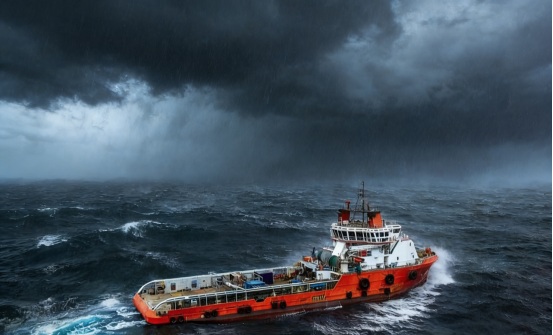
The Emergency Generator as the Last Safety Barrier
The emergency generator is built to be completely independent. In contrast to the main engines, which depend on the ship’s systems, this generator is designed to operate independently and provide the power needed for emergency lighting and the internal communication system, steering equipment as well as fire pumping. Its primary function is to provide the crew with sufficient “electrical breathing room” to solve the problem or, in extreme scenarios it is to be able to safely leave the ship.
Knowing how to begin this device requires a mix of technical expertise and a calm mind. It doesn’t matter if it’s a routine drill or an emergency at midnight in a storm the procedure should be an automatic procedure for all engineers on board.
Standard Operating Procedures for a Successful Start
Modern vessels are usually equipped by the Automatic Mains Failure (AMF) system. If the main switchboard detects the loss of power and causes the generator for emergency to begin and shut down its breakers. However, it is possible for automation to fail, so manual intervention is often required.
Essential Pre-Start Inspection
Before making a manual starting an immediate “circle check” is vital to ensure that the engine is not damaged:
- Fuel Supply: Ensure that the service tank valves are open and that the tank is at a minimum of 75 percent filled.
- Levels of Lube Oil: Check the dipstick. An engine that has been idle for several weeks could be suffering from problems with drainage of oil.
- Cooling System: In radiator-cooled units, be sure that the louvers of the air are not blocked and can move freely.
- Control Panel: Ensure that there aren’t currently active “Emergency Stop” or “Common Alarm” lights.
Manual Execution
Change to Local Mode: Switch the switch that controls the mode from “Auto” to “Manual” or Local’.
- Prime the Fuel System: If the fuel system was idle using your hand primer in order to eliminate any air.
- Engage the Starter: Pressing and holding the button to start. Check the oil pressure and RPM immediately after starting.
- Monitoring Power Quality: Once it has stabilized at the speed of rated (usually 1800 RPM at 60Hz) make sure to check the voltmeter and frequency gauge before closing the circuit.
Comparing Primary and Secondary Emergency Generator Start Methods
SOLAS guidelines require at least two separate sources of energy for the start-up of the emergency generator. This redundancy will take into account the fact that the circumstances leading to blackouts often impact the systems that start the equipment and.
| Starting Method | Energy Source | Pros | Cons |
| Electric Start | Lead-acid or NiCd Batteries | Fast, simple, integrated into AMF. | Batteries lose charge in cold; require constant maintenance. |
| Compressed Air | Dedicated Air Bottles | High torque, reliable for larger engines. | Risk of air leaks; requires a working compressor to refill. |
| Hydraulic Start | Hand-pumped Accumulator | Independent of electricity. | Complex piping; risk of oil leaks and pressure loss. |
| Mechanical Spring | Manual Cranking / Stored Energy | Highest reliability; no external power needed. | Requires physical effort to “wind” the starter. |

Why Mechanical Spring Starters are the Ultimate Fail-Safe?
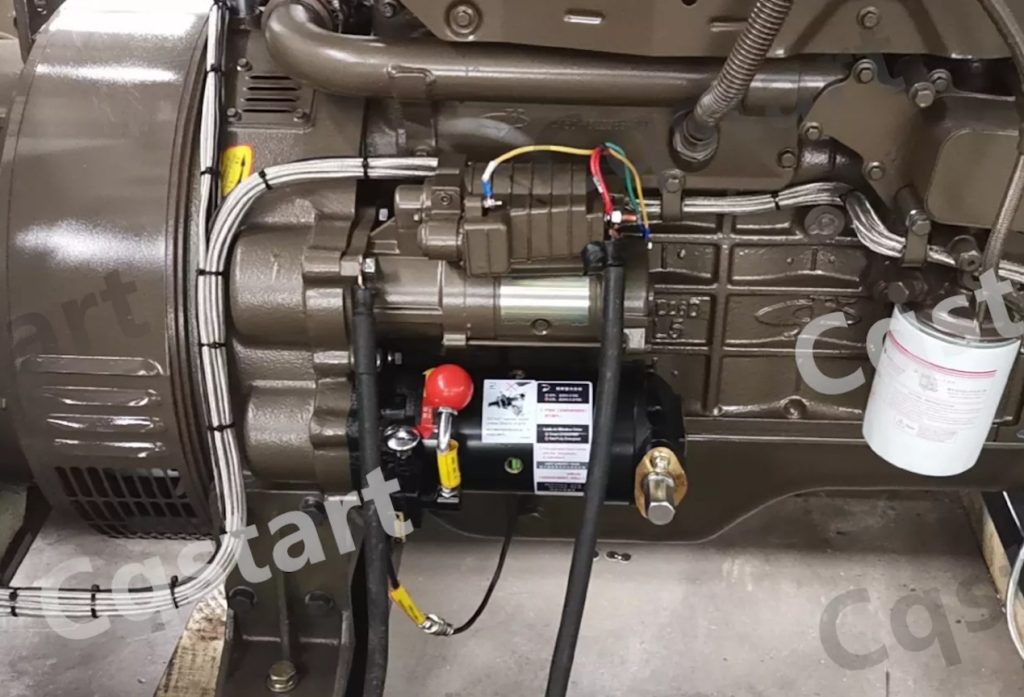
In the event of a “Blackout” situation, the most frequent cause of failure can be found in the battery. Sulfate buildup, cold weather or a damaged charger could make an electric start system ineffective when required the most. This is why the Spring Starter, such as the ones developed by Cqstart becomes an asset that is invaluable.
How it Works
The spring starter is solely mechanical device. It is made up of a strong internal spring, which is compressed by an hand crank. After the energy is stored the trip lever releases it, turning the engine’s flywheel at a high speed to start combustion.
Technical Advantages in Marine Environments
- Zero Electric: Dependency operates perfectly, even if the batteries of the ship are submerged or completely depleted.
- Maintenance-free design: In contrast to batteries with only a short lifespan the spring starter could remain idle for years and still be able to perform immediately.
- Protection In Volatile Zones: As there aren’t any electrical sparks, they’re ideal for vessels or tankers carrying dangerous cargo for which the need for explosion-proofing is paramount.
- Installation is simple: It is often installed with a bolt-on direct replacement or as a alternative to the current electric motor.
Troubleshooting Common Emergency Generator Start Failures
Even with a well-constructed system, engines can become difficult to work with. If the generator spins but doesn’t “catch,” the issue is typically one of three reasons:
Fuel System Air Locks
If the engine is coughing but doesn’t start the engine, it’s likely that air is entering in the lines for fuel. This is usually the case if fuel filters have been changed recently or if the level of fuel was low. Unlock the bleed screw on the fuel injection pump, then make sure to prime until bubbles go away.
Governor Linkage Sticking
Emergency generators are 99% of their time shutting down. This could result in that governor’s linkage getting stiff as a result of corrosion of the salt air. Make sure that all mechanical links move effortlessly and are well greased.
Extreme Cold (Waxing)
In the arctic route diesel fuel may “wax,” clogging the filters. Check that your emergency generator area is adequately heated or that winter-grade fuel that has additives is utilized in the designated service tank.
Strategic Redundancy for Modern Vessels
Incorporating a mechanical start option isn’t just a technological upgrade. It is an intelligent choice for owners of ships. Utilizing the Cqstarte spring starter as a second or third backup, you remove the only source of failure in electrical systems. It will provide the chief engineer confidence knowing that even when you’re in a dark ship and batteries are dead, the crew will be able to bring the ship back to life by using nothing other than the manual effort and precision of a mechanical device.
In the unpredictability of the ocean, the capacity to generate energy is the most effective option to survive. Through the combination of rigorous manual checklists, with the dependable reliability of mechanical starting technology you can be sure that your vessel is always ready for any eventuality. A vessel that is able to always begin its emergency generator is an unstoppable ship that will always return to home.