
When the lights go out at sea, the countdown starts. Batteries may go flat, air reservoirs may run out – but the emergency generator must still spring into action. And a mechanical spring starter does the job. Wound up by hand to store spring energy, it cranks the engine without the need for electricity, compressed air or hydraulics. This self-reliance means spring starters are standard kit for emergency generators, workboats and hazardous-site facilities. Below we’ll look at when to use them, the performance trade-offs, and how to choose.
What a Mechanical Starter Does
A mechanical starter stores energy in a spring that a person charges by hand. Releasing the spring spins the engine’s flywheel fast enough to start the diesel. The starter is pre-engaged, so there is no pinion that must mesh at the last second. On Cqstart’s spring starters, a start takes about 30 seconds, or about 10 seconds on the smallest models.
Because the energy source is a person and a spring, nothing else on the vessel has to be working.
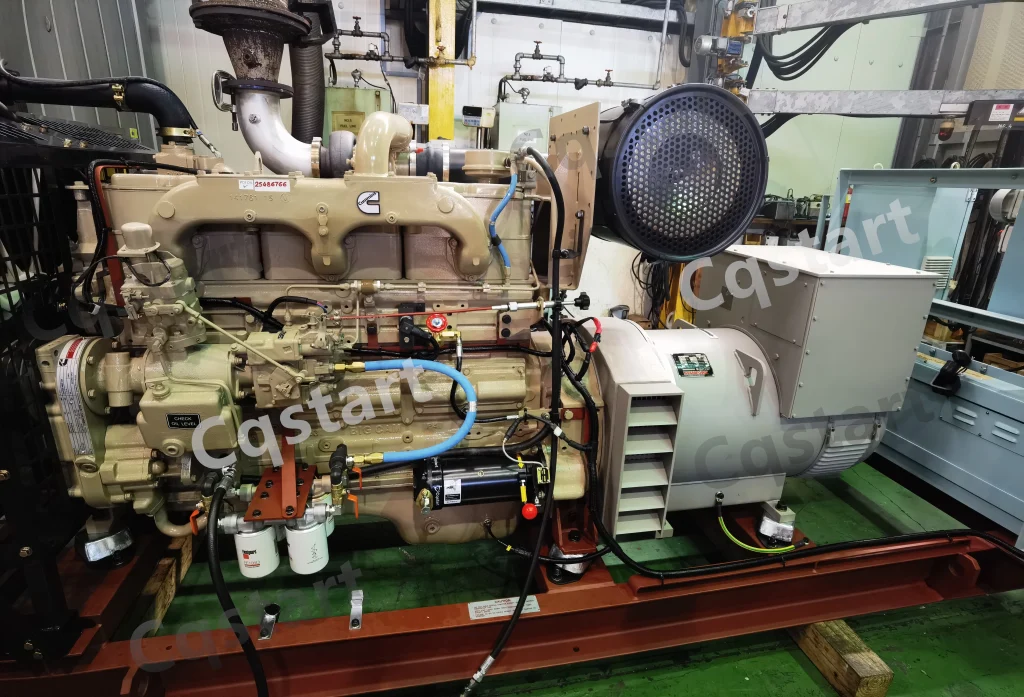
When Marine Engines Need One
Mechanical starters earn their place in situations where other starting systems may not be available:
Cold climates: Battery output falls as temperatures drop, while a spring’s mechanical function is far less affected.suggests it needs to be scheduled for charging or replacement. A load test under actual cranking problems is a lot more trustworthy than a fixed voltage reading alone.
- Blackout recovery: After a dead-ship event, you need a way to restart without shore or ship power.
- Emergency generators and fire pumps: These must start regardless of the state of the main systems.
- Lifeboats and rescue craft: Simple, reliable backup starting matters most here.
- Workboats and small vessels: A compact starter avoids a full air or hydraulic system.
- Offshore and hazardous areas: Sparks from electrical equipment are a risk, so ATEX applications favor a naturally explosion-proof design.
Five Reasons Operators Choose Mechanical Starters
1. It works without external energy. A flat battery, a leaking air receiver or a failed compressor cannot stop it. This independence makes it a true last line of defense.
2. It tolerates marine conditions. Salt spray, moisture, oil and temperature swings are normal at sea. Cqstart’s units use corrosion-resistant coatings and a mechanical design that stays reliable across a wide temperature range.
3. It is safer in dangerous areas. With no electrical ignition source and pre-engagement, the design is naturally explosion-proof. Suitable for gas-risk zones on tankers and platforms.
4. It keeps the system simple and light. No air compressors, air bottles, hydraulic power units or accumulators are needed. Fewer parts mean lower cost of installation and less maintenance.
5. It is quick to install and operate. It fits standard SAE flywheel housings and is built for foolproof use, so crew training is short.
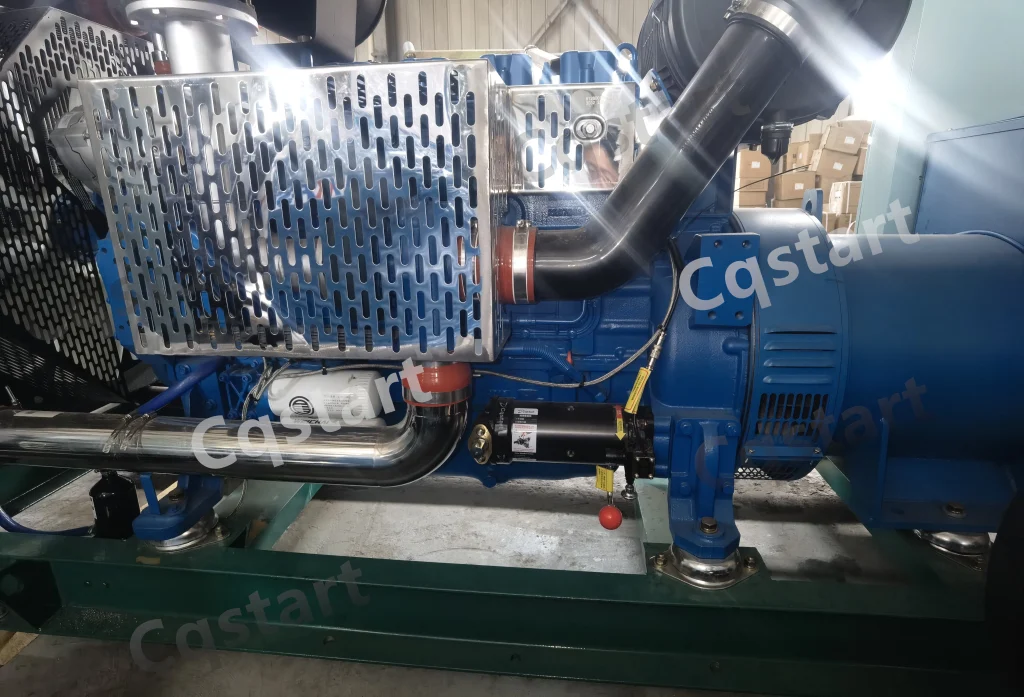
Mechanical vs Electric, Air and Hydraulic Starters
| Mechanical (spring) | Electric | Compressed air | Hydraulic | |
| Energy source | Manual spring charge | Battery | Air compressor and receivers | Pump and accumulator |
| Depends on other systems | No | Yes | Yes | Yes |
| Extra equipment | Minimal | Batteries, charger | Compressor, bottles, piping | Power unit, accumulator |
| Cold and salt-spray effect | Low | Battery capacity drops in cold | Depends on air system condition | Depends on seals and oil |
| Hazardous-area suitability | Naturally explosion-proof | Needs special design | Generally good | Depends on design |
| Best use | Emergency and backup | Routine start | Larger engines | Specific industrial uses |
The point is not that one replaces the others. Many vessels keep an automatic starter for daily use and add a mechanical starter as an independent backup.
What the Rules Say
SOLAS Chapter II-1, Regulation 44 sets the starting requirements for emergency generating sets. According to IMO’s interpretations (MSC/Circ.736), they must be able to start readily from cold at 0°C. Automatically started sets need stored energy for at least three consecutive starts, plus a second energy source for three more starts within 30 minutes, unless manual starting can be demonstrated to be effective.
Transport Canada’s guidance (TP 14609 E) adds that where automatic starting isn’t required, manual starting is permissible, and it lists manual cranking, inertia starters and manually charged hydraulic accumulators as examples, provided they can be shown to be effective. Whether a specific installation is accepted depends on your flag administration and class society, so confirm early.
What a Mechanical Starter Can’t Do
A good starter choice means knowing the limits:
- It needs a trained person, so it is not for frequent automatic starts.
- It covers engines up to about 50L. Larger engines need another approach.
- Crews must know the procedure and practice it.
- It works best as emergency or backup equipment, not as the only start method on a vessel that needs unattended automatic starting.
How to Choose the Right Size
Start with four checks: engine displacement, SAE flywheel housing, available space and weight, and the operating environment (marine, ATEX or both). Then match the series:
| Series | Engine displacement | Weight |
| 7 Series | Under 2L | 11 kg |
| 5 Series | 1–4L | 16 kg |
| 1 Series | 4–7.5L | 18 kg |
| 2 Series | 7.5–11L | 21 kg |
| 4 Series | 10–13L | 23 kg |
| 3 Series | 13–16L | 26 kg |
| 6 Series | 16–30L | 27 kg |
| 0 Group | Up to 50L | 50–55 kg |
Standard models ship in 3 to 5 workdays. Customized models take 2 to 4 weeks, and Cqstart provides the custom design at no extra charge.
FAQ
Is a mechanical starter the same as a spring starter?
In most marine contexts, yes. Spring starters are the most common mechanical starters for diesel engines.
Can it replace an electric starter?
Usually it complements one. Electric or air starters handle routine starts, and the mechanical starter provides independent backup.
Does it work in cold weather?
Its mechanical design is built for wide temperature ranges, though you should still follow engine cold-start practices.
Can it be used on emergency generator engines?
Yes, commonly, subject to regulatory acceptance as described above.
Can it be customized for my engine?
Yes. Send your engine model and displacement for a recommendation.
The Bottom Line
A mechanical starter earns its place by working when everything else has failed: no power, no air, no hydraulics. Match it to your engine size, train your crew, and confirm approval with your class society. Send your engine details to Cqstart, or visit the Cqstart Spring starter, and we’ll recommend a suitable model and quote.