
In industries such as mining, oil and gas, high-risk industrial plants, and seagoing vessels, Emergency Fire Pumps play a vital role. Whenever a fire breaks out or the primary water supply fails, they serve as the “last line of defense” that must operate without fail.
For diesel engine-driven fire pump systems, industry attention typically focuses on pump flow rates and pressure metrics. However, one prerequisite is often overlooked: Can the diesel engine start reliably in an emergency?
Experience shows that traditional electric start systems are highly vulnerable to battery self-discharge, performance degradation in low temperatures, and wiring faults caused by long periods of inactivity. Once the starting mechanism fails, even the most superior fire pump becomes useless.
To eliminate the industry pain point of “idle for long periods, failing when needed,” the Mechanical Spring Starter, with its purely mechanical, zero-electricity, and highly reliable nature, is emerging as a critical solution to enhance the availability of emergency diesel fire pumps.
What Is an Emergency Fire Pump?
An Emergency Fire Pump is a critical asset in a fire protection water supply system. When the main supply network suffers from insufficient pressure, inadequate flow, or sudden failure, it rapidly provides the necessary water flow and pressure, acting as the “second line of defense” for site safety.
In system designs, emergency fire pumps are typically driven by electric motors or diesel engines. Diesel engine-driven solutions offer extreme operational independence because they do not rely on the local power grid, making them widely used in high-risk industrial environments with strict power reliability requirements.
However, a fatal detail is frequently missed during system planning: A diesel engine being independent of the power grid does not guarantee it will start unconditionally.
“Fire pump performance compliance” does not equal “successful diesel engine ignition.”
For emergency rescue, any equipment that cannot be started offers zero benefit. Evaluating the reliability of a diesel emergency fire pump must begin with a re-examination of its starting system.
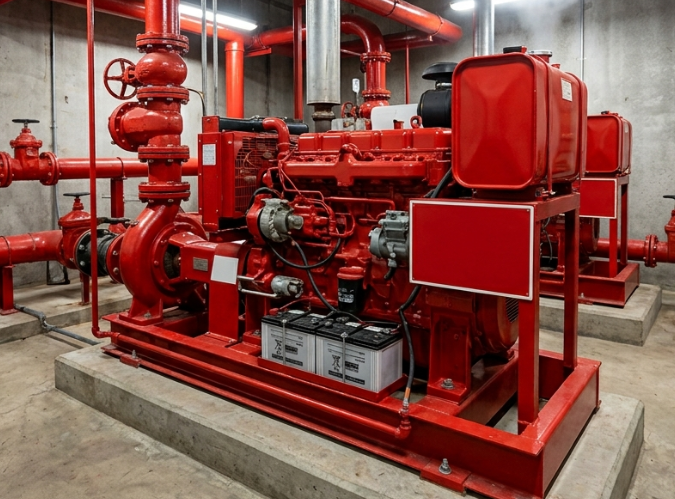
The Fatal Paradox of Emergency Fire Pumps: Long-Term Standby vs. Instant Response
Why is starting an emergency fire pump more challenging than starting standard industrial equipment? The answer lies in its unique operating pattern:
Daily Production Equipment: Operates frequently; failures are identified and fixed immediately; starting risk is low.
Emergency Fire Pump: Remains idle 99% of the time, yet must achieve a 100% successful start rate during the 1% critical moment.
Under this operational mode, traditional electric starting methods expose four core vulnerabilities:
| Vulnerability Factor | Hidden Risks of Traditional Electric Starting | Impact on Emergency Response |
| Battery Depletion | Self-discharge over time, missed maintenance, natural battery aging | Cannot deliver initial cranking current; starter motor lacks power |
| Extreme Cold | Increased oil viscosity (higher resistance) + sharp drop in battery output | “Double degradation” leads to insufficient cranking torque and ignition failure |
| Long-Term Inactivity | Oxidation of electrical contacts, wiring deterioration, control module faults | Hidden static faults remain undetected until total failure occurs in a crisis |
| Fragile Chain | Relies on batteries, relays, motors, and chargers working together | Any single point of failure (SPOF) causes complete system breakdown |
Over-relying on a single electric starting method in high-risk industrial scenarios represents a significant safety hazard.
What Is a Mechanical Spring Starter?
A Mechanical Spring Starter is a device that stores mechanical energy in internal springs and releases it to rotate the engine crankshaft when starting a diesel engine.
Its basic operating sequence is:
Store Mechanical Energy → Compress Spring → Release Energy → Rotate Crankshaft → Engine Start
Unlike electric start systems that rely on battery power at the moment of ignition, a spring starter stores its energy in a spring mechanism ahead of time. When triggered, the stored mechanical energy releases through a drive mechanism directly to the crankshaft, bringing the diesel engine up to its required starting speed.
Consequently, mechanical spring starters function as an independent or backup starting method for diesel engine applications.
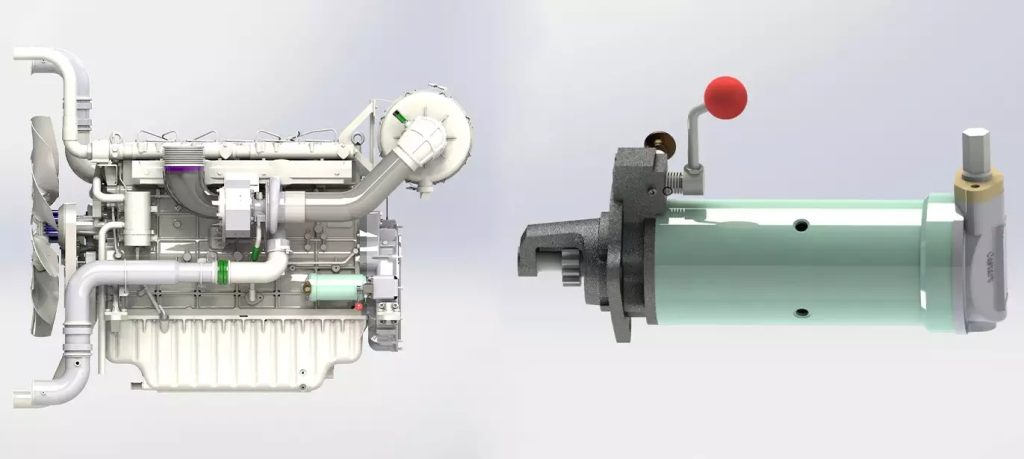
The Relationship Between Spring Starters and Emergency Fire Pumps
Before evaluating spring starters, it is essential to clarify their exact function in a fire protection system: they do not drive the pump directly; they provide the initial cranking power for the diesel engine.
The power transmission chain is structured as follows:
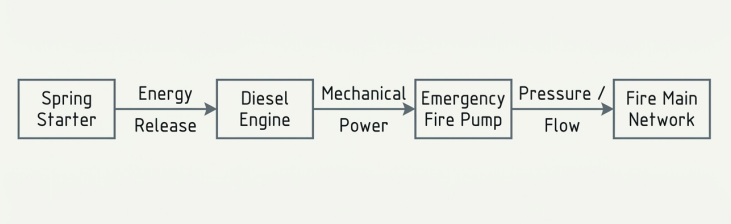
Emergency Fire Pump: The destination (delivers water for firefighting).
Diesel Engine: The heart (provides continuous mechanical power).
Mechanical Spring Starter: The pacemaker (activates the engine at the critical moment).
Because a diesel engine serves as the power source, starting the engine is the first gate in the safety chain. In high-risk industrial settings requiring maximum safety redundancy, spring starters serve as a key emergency solution due to their purely mechanical storage and zero reliance on external power.
How Spring Starters Compare to Traditional Starting Methods
In industrial diesel applications, common starting power sources include electricity, compressed air, hydraulic power, and mechanical energy storage. Understanding these options helps engineers design proper redundant systems.
| Starting Method | Energy Source | Core Components | Extreme Environment Suitability | Backup Defense Evaluation |
| Electric Start | Battery / Electricity | Battery, charger, relay, starter motor | Vulnerable to cold discharge, humidity corrosion, and self-discharge | Standard option, but carries electrical single-point failure risks |
| Air Start | Compressed Air | Air receiver, air motor, compressor, valves | Requires sealed air lines and pressure maintenance; risk of freezing in cold | Strong power, but heavy system requiring ongoing air supply upkeep |
| Hydraulic Start | High-Pressure Oil | Accumulator, hydraulic motor, manual/electric pump | Highly adaptable, but involves complex piping and leakage risks | High starting torque for large-displacement engines; higher cost |
| Mechanical Spring Start | Spring Energy Storage | Pure mechanical spring structure, manual winding mechanism | Unaffected by low temperatures, moisture, or electrical/air/hydraulic faults | Pure mechanical black start, zero external power dependence, ultra-reliable |
An Optimal Supplement, Not a Universal Replacement
No single starting method fits every application. Mechanical spring starters are not designed to eliminate all other systems; their core value lies in providing a purely mechanical storage option independent of electrical, pneumatic, or hydraulic power.
Engineering selection must evaluate engine displacement, required starting torque, ambient temperature, installation space, explosion-proof requirements, and fire safety codes (such as NFPA 20). For small-to-medium emergency fire pumps—or as a second starting defense for large-displacement units—spring starters provide significant safety advantages.
Why Emergency Equipment Benefits from Mechanical Spring Starters
Pure Mechanical Pre-Storage (Decoupled from Instant Electricity)
Instead of requiring batteries to discharge hundreds of amperes instantly, spring starters store energy beforehand. High-strength springs are compressed manually or via auxiliary mechanisms to lock energy in place. When needed, the power releases instantly without relying on chemical battery activity.
Independence from Local Infrastructure (Ideal for Remote Sites)
In remote mines, off-grid oil fields, coastal docks, and international field projects, electrical power may be unreliable and battery maintenance costly. Spring starters require no external electrical or air supply, providing decentralized operational capability.
Optimal Fit for Long-Term Standby Equipment
Emergency fire pumps remain idle for 99% of their lifespan. Batteries naturally self-discharge over time, whereas high-quality mechanical springs maintain stable physical properties during storage. Regular manual cranking and lubrication checks ensure the mechanical components remain in peak condition.
Double Redundancy Design
To eliminate single points of failure, combining a primary electric starter with a backup spring starter creates a dual-starting safety configuration. If the electrical system fails completely, the mechanical starter remains ready as the final backup option.
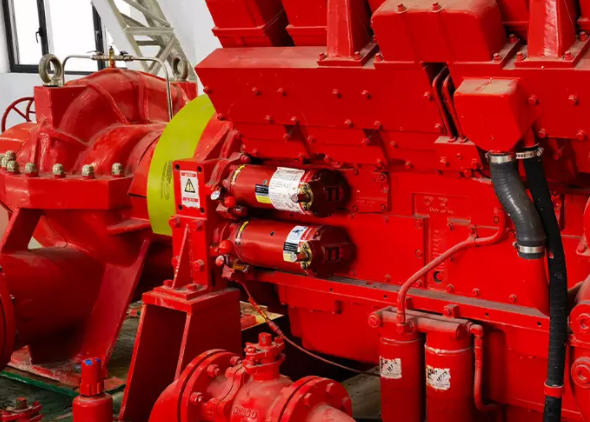
High-Risk Scenarios Requiring Spring Starter Configurations
Mining and High-Altitude/Cold Extraction Zones
Pain Points: Dust, humidity, severe vibration, and extreme cold. Battery discharge capacity drops drastically in cold conditions, while vibration loosens electrical connections.
Application Value: Pure mechanical structures are immune to low temperatures, dust, and heavy vibration, ensuring immediate engine ignition at remote mine sites.
Oil, Natural Gas, and Offshore Platforms
Pain Points: Refineries, LNG terminals, and offshore platforms contain Zone 1 / Zone 2 hazardous areas where electrical sparks present explosion risks and salt spray corrodes wiring.
Application Value: Spring starters feature spark-free explosion-proof designs and corrosion-resistant housings that meet NFPA 20 and marine/offshore class society standards.
Power Plants and Heavy Industrial Complexes (Black Start Capability)
Pain Points: Plant fires can trigger widespread blackouts. If the primary grid fails and emergency power is lost, electric starting systems become inoperable.
Application Value: Operating with zero electrical dependence, spring starters provide independent black start capabilities during severe power disruptions.
Remote Areas and Unmanned Facilities
Pain Points: Pumping stations along remote pipelines often operate far from power networks without full-time staff. Replacing batteries and maintaining chargers creates high logistical costs.
Application Value: Eliminating battery replacement reduces Total Cost of Ownership (TCO) for unmanned sites while removing battery-depletion hazards.
Engineering Selection Criteria for Spring Starters
Selecting a mechanical spring starter requires verifying six critical engineering parameters:
Engine Parameters (Physical Compatibility): Check engine brand, exact model, flywheel housing dimensions (such as SAE standard), number of teeth in ring gear, module, and direction of rotation (CW/CCW).
Torque and Energy Requirements: Determine compression ratio in the engine’s cylinders, oil viscosity, and minimum operational temperatures, ensuring that the maximum release torque of the starter is greater than the engine’s ignition threshold.
Space and Mounting Interfaces: Confirm adequate clearance around the flywheel housing for the starter dimensions and the manual winding handle’s operating radius. Match drive pinion teeth, module, and mesh depth to the flywheel ring gear.
Environmental Conditions: Select spark-free models for hazardous oil/gas areas, apply salt-spray resistant coatings for marine environments, and verify grease temperature ratings for extreme climates.
Operation Cycles: Consider manual winding operation effort and time taken, and determine whether additional auxiliary winding operation is needed for quick consecutive startups.
Compliance with Standards: Ensure that the arrangement meets requirements of NFPA 20 (Standard for the Installation of Stationary Pumps for Fire Protection) and appropriate maritime classification organizations (e.g., CCS, DNV, ABS).
Cqstart Mechanical Spring Starters: Reliable Safety Solutions for Diesel Fire Pumps
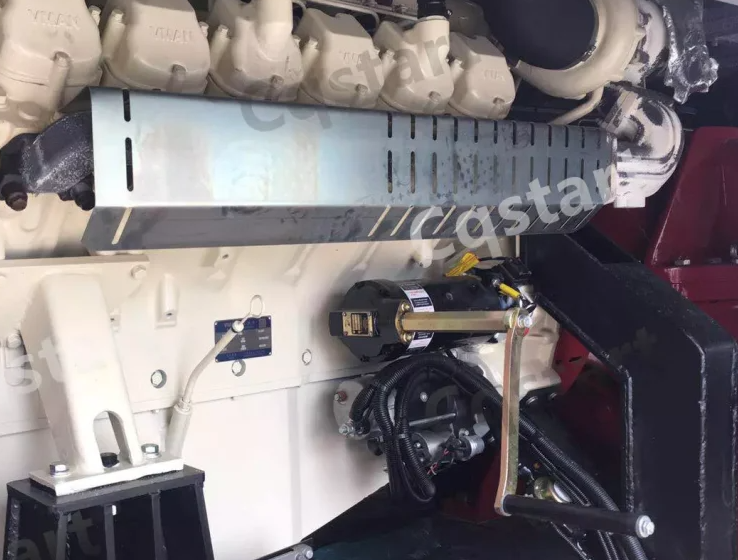
Cqstart provides spring starter solutions designed for industrial and hazardous applications worldwide.
Utilizing high-strength mechanical energy storage, Cqstart spring starters lock energy within an internal spring mechanism. In an emergency, a single release mechanism engages the diesel engine immediately. Independent of batteries, air compressors, or hydraulic lines, Cqstart starters serve as reliable primary or backup starting systems for fire pumps, mining equipment, offshore platforms, and remote installations.
Key Advantages of Cqstart
Engine Matching: Compatible with mainstream diesel engines. Custom CAD verification and torque matching are performed using engine displacement, SAE flywheel housing specs, tooth counts, and rotation parameters.
Black Start: Completely independent of electricity and without sparks, no failure modes involving batteries.
Tough Conditions: Corrosion-resistant and explosion-proof designs available for high vibration in mining applications, salt spray environments at sea, and low temperature situations.
Engineering Assistance: Total engineering support according to standards and marine class society specifications throughout selection and installation process.
Conclusion
The reliable operation of an emergency fire pump depends on both the pump itself and the starting system of its driving diesel engine. Alongside electric, pneumatic, and hydraulic starters, Mechanical Spring Starters offer a dependable, independent option for emergency equipment.
If you are evaluating spring starting options for diesel engines, emergency fire pumps, or standby generators, contact Cqstart with your engine model, application parameters, and environmental requirements for a tailored engineering assessment.