
The generator is dead. The batteries are flat. The grid went down an hour ago. Turn the key and nothing. That’s the end of the story for many engines. That is exactly when a spring starter motor comes into play. One guy cranks it by hand . The effort is stored in a mechanical spring. A single release cranks a diesel engine to starting speed without ever touching a battery or an air receiver.
What Is a Spring Starter Motor and What Does It Actually Do?
A Mechanical Starting System Powered by Human Input
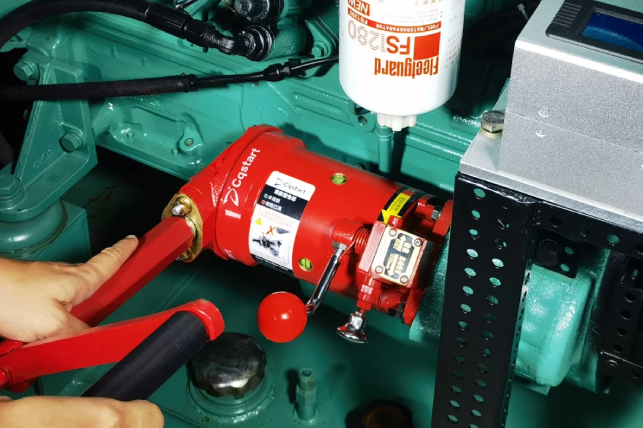
A spring starter is not an electric motor, despite its name. It is a device for storing energy. It is an energy-storage device. Someone cranks it by hand, the effort loads a set of disc springs, and the energy waits until it is needed. Cqstart’s design converts manual cranking into spring potential energy that is released all at once to start the engine.
What Makes It Different from a Regular Electric Starter
Electric starters draw current from a battery at the moment of cranking so they’re only as reliable as the battery, its cables and the charge left in it. Energy stored by hand used by the spring starter before. The source differ, but the job is the same: turn the flywheel fast enough for the engine to fire.
How Does Manual Engine Starting Work with a Spring Starter?
The sequence is short: wind → store → release → engage → fire.
Step 1 – Winding the Starter to Store the Mechanical Energy
The operator turns the crank. Each turn adds energy to the spring pack. The effort is spread over many turns, rather than being asked for in one turn. The winding time is dependent on model and engine size so check the data sheet don’t assume.
Step 2 – Releasing the Stored Spring Energy
A release mechanism lets the stored energy out in one go. Speed matters here. A diesel relies on compression to ignite its fuel, and a slow, gentle turn will not get it there.
Step 3 – Transmitting Torque to the Engine Flywheel
The released energy drives a pinion that meshes with the flywheel ring gear. Cqstart uses a pre-engage design, so the pinion is already in position before release. Once the flywheel reaches starting speed and the engine fires, the starter has done its job and can be wound again.
When Is a Manual Spring Starter a Practical Starting Solution?
Not every engine needs one. The case is strongest where a normal start can fail and failure is expensive.
When Battery Power Is Unavailable
Batteries self-discharge, age and weaken in the cold, and emergency units often get little maintenance. Fire-pump engines show how seriously starting power is taken: Hubbell’s Metron controller catalog describes cranking as six 15-second periods separated by rest periods, a sequence that only works if the batteries are in good shape. A spring starter does not replace good battery discipline. It gives you another route when the batteries let you down.
When External Starting Infrastructure Is Limited
No compressor, no charger, no grid? A spring starter needs a person and time to wind. That is the whole dependency list.
In Remote or Demanding Operating Environments
Temperature extremes are one reason operators look at non-electric starting. Power & Motion reported that barge operator ACBL turned to non-electric systems, both spring and hydraulic, because electric starting struggled in extreme conditions. Cqstart also lists ATEX locations such as oilfields, mines and chemical plants among its applications. Confirm the certification your own site requires.
When Independent Emergency Starting Is Required
Lifeboat engines, emergency generators and fire pumps need a start path that shares nothing with the primary one. Whether a spring starter satisfies a specific code is a separate question, and we cover it in our article on the NFPA start requirement.
Is a Spring Starter Motor Suitable for Your Diesel Engine?
Fit decides everything. Run four checks before you request a quote.
Check Engine Displacement and Starting Requirements
Cqstart’s spring starter range runs from engines under 2 L up to 30 L, with a group system for displacements up to 50 L. Displacement is only a first filter. Starting load also depends on compression, oil condition and temperature.
Verify Flywheel Housing and Mounting Compatibility
Confirm the housing bore, ring gear and available space. Cqstart notes that a dual- or multi-bore housing can carry the spring starter beside the electric one as a standing backup, while a single-bore housing usually means fitting it only when needed.
Consider Operating Conditions and Starting Frequency
A unit kept for rare emergencies has different needs from one used for routine starts. Note the temperature range, the expected number of starts and who will operate it.
Consider Operating Conditions and How Often You Start Up.
A unit used for routine starts has different needs than one reserved for rare emergencies. Note the temp range, expected number of starts and who will operate it.
Check Whether Additional Support Is Needed for Electronic Engines
An engine with an ECU needs electrical power even if the flywheel is turning. Cqstart pairs its spring starter with an M-GEN manual generation unit for battery-free black starts on such engines. Ask early whether your engine falls in this group.
Choosing a Spring Starter Motor Supplier for Long-Term Reliability
Check the product range and engine compatibility
Find a supplier whose range covers your engine size . Cqstart’s lines overlap (the W series is 1-30 L for example) so ask what model they would actually recommend, and why.
Examine testing procedures and performance history
What test procedure was used ? Are results traceable to each unit ? Can you see them ? A supplier that tests each and every unit should be ready to provide the records.
Installation Guide and Technical Assistance
Before you buy, ask for installation drawings, adaptation support and after sales contacts. Cqstart, based in Chongqing, has built spring starters since 2008 and has developed hundreds of engine applications.
Conclusion
Manual engine starting has one job: to work when everything else has failed. A spring starter motor does that by storing its energy in a spring, rather than a battery. Engine size, mounting, operating conditions and the rest of the starting system still determine whether or not it suits your equipment. Send your engine details to the Cqstart team and they will be able to help you check the fit.