
When a battery is flat, an air tank is empty, or a hazardous area rules out electrical equipment, a diesel engine still has to start. That is the job of the spring starter. It works on a simple idea: store energy by hand, then release it in seconds. But whether it actually starts your engine depends on more than spring size. This guide explains how a mechanical starter works and which five factors decide its performance.
How a Spring Starter Works in Three Steps
A mechanical spring starter is a hand-wound setup. It stores energy in a spring, then uses that energy to spin a diesel engine’s flywheel ring gear. It works a bit like winding a clock. You put in effort little by little, then the stored energy comes back fast.
Step 1: Winding Stores the Energy
The operator winds the spring by hand, converting muscle effort into elastic energy. US patent 5,970,940 describes this basic architecture: a spring that stores energy, a means of loading it, and a drive that converts the released energy into a starting impulse. Mechanical starters of this kind are particularly suited to compression-ignition engines, which do not need an electrical system to keep running.
Step 2: Engine Release Turns
When the operator triggers release, the spring unwinds through a gear train into the ring gear and turns the crankshaft.
Step 3: Disengage When Ignition
Once the engine starts and runs, the starter drive disengages so the engine doesn’t spin the starter.
What “Starting Performance” Really Means
A diesel engine starts only when the starter beats the resistance inside it and brings it to ignition speed. Two things matter: torque to break through compression and friction, and speed high enough for the engine to fire.
The problem is that spring energy is finite. How much rotation a spring starter can provide is limited by how far the spring can reach before it runs out of stored energy. The spring must build up enough tension to overcome the compression force of the piston before it releases and turns the engine . A spring-assist patent ( US 6,782,863 ) makes the same point from the other side . That short window means delivering enough energy at enough torque for good starting performance.
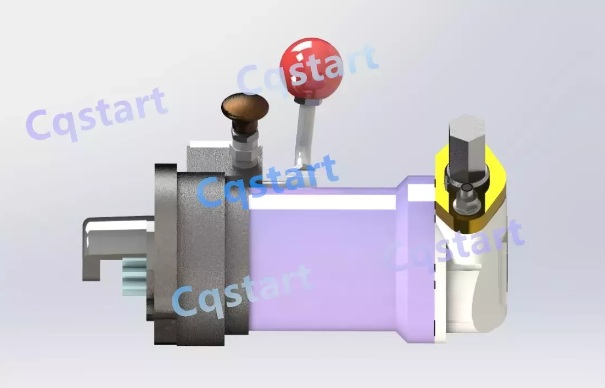
Five Factors That Determine Starting Performance
1. Stored Energy: Spring Design and Wind-Up
For a linear torsion spring, stored energy follows E = ½kθ², where k is the spring rate and θ is the wind-up angle. Doubling the wound angle on the same spring quadruples the stored energy, which is why winding fully matters. Spring material and dimensions set the ceiling.
2. Torque Delivery: Release of energy
Stored energy is only one part of the story. The torque of an unwinding linear spring diminishes. If the starter has all kinds of energy but not enough torque at that critical first moment, it may not get past the first compression stroke.
3. Gear Ratio: Speed and Torque
Gearing is torque multiplier, speed divider. With heavy, high compression engines a higher ratio is desirable . It slows down cranking . Designers trade these two off for each class of engine.
4. Engine Load: Displacement, Compression, Friction and Inertial
Bigger engines have larger pistons with more friction, heavier flywheels, so they need more energy and torque. That’s why displacement is the main sizing reference (see next section).
5. Conditions and Fit: Temperature, Lubrication, and Ring Gear Match
Cold oil is thicker and raises friction. Ring gear tooth count and module, and SAE mounting compatibility, must also match, or even a powerful starter will not engage properly. A fully mechanical design is less exposed to temperature swings than battery-dependent systems.
| Factor | Effect on starting | What to confirm when selecting |
| Spring energy | Sets total cranking capacity | Rated for your displacement |
| Torque curve | Decides first-stroke success | Manufacturer’s torque data |
| Gear ratio | Balances torque and speed | Suitability for engine type |
| Engine load | Raises required energy | Displacement, compression ratio |
| Conditions and fit | Affects friction and engagement | Ring gear, SAE flange, temperature |
Why Engine Displacement Drives Spring Starter Selection
More displacement means more resistance, so larger engines need larger starters. Cqstart’s range follows this pattern, based on our published specifications:
| Series | Displacement | Weight |
| 7 Series | Under 2L | 11 kg |
| 1 Series | 4–7.5L | 18 kg |
| 3 Series | 13–16L | 26 kg |
| 6 Series | 16–30L | 27 kg |
| 0 Group System | Up to 50L | 50–55 kg |
Displacement is the beginning, not the end. The choice is refined by the compression ratio, the ring gear specification, and the ambient conditions.
Air and Hydraulic Starting vs. Spring Starter
All three methods are suitable for starting diesel engines. Marine suppliers catalog hydraulic, pneumatic and spring types and describe them as suitable for independent or black-start use for fire pumps, emergency generators and compressors.
| Spring starter | Air starter | Hydraulic starter | |
| External energy source | None (hand-wound) | Compressed air | Hydraulic power |
| Extra equipment | None | Compressor, tanks | Hydraulic generator, tanks |
| System cost | Lower | Higher | Higher |
| Hazardous areas | Naturally explosion-proof, pre-engaged | Varies by design | Varies by design |
| Limitation | Limited cranking duration per wind-up | Needs air supply | Needs hydraulic supply |
A spring starter needs no compressor, gas tank or hydraulic generator reducing system cost and maintenance. The trade-off is limited cranking time per wind-up so it’s best for reliable one-shot starts.
How to Pick the Best Spring Starter
Prepare these five details before requesting a recommendation:
- Engine displacement
- Engine model and ring gear specification
- Mounting interface (SAE standard)
- Operating environment: temperature, salt spray, hazardous areas
- Whether customization is needed
Standard models usually ship in 3-5 workdays, and customized versions in 2-4 weeks, with design support included.
FAQs
How long does it take to wind a spring starter ?
A full operation takes about 30 seconds, and around 10 seconds for small models.
Can a spring starter work in extreme cold?
Its mechanical structure is not significantly affected by temperature changes, though very cold, thick oil still raises engine resistance. Always size for your coldest conditions.
What size spring starter do I need?
Start with engine displacement, then confirm ring gear, mounting, and environment with the supplier.
Is a spring starter safe in hazardous areas?
Its pre-engaged design is naturally explosion-proof, making it suitable for hazardous environments.
Conclusion
Starting performance comes from five things working together: stored energy, torque delivery, gear ratio, engine load, and operating conditions. Match them to your engine and a mechanical starter delivers dependable starts with no external power. To get a recommendation, send your engine model and displacement to Cqstart through our Contact Us page, or browse the spring starter range.