
In extreme low-temperature or explosion-proof environments such as offshore oil platforms, ships, ocean-going fishing boats, underground mines, and emergency fire pump stations, traditional battery-starting or compressed-air starting systems often fail due to battery depletion, air line leaks, or the risk of electrical sparks.
As a purely mechanical, spark-free emergency starting device that requires no external energy source (such as batteries or air supply), the Mechanical Spring Starter instantly releases the potential energy stored by human effort in a high-strength spring group to ensure that a diesel engine can “fire up at a single strike” under extreme or emergency working conditions.
Mastering how to operate a spring starter safely and correctly is crucial for shipowners, engine room engineers, on-site operators, and equipment maintenance teams. This guide provides a detailed breakdown of the standard operating procedures, key safety precautions, and common troubleshooting for spring starters.
What is a Spring Starter? How Does It Work?
A spring starter is a completely mechanical device that entirely replaces traditional electric starter motors or pneumatic starter motors.
So, how does a spring starter work? It does not require any cables, batteries, or air tanks. Instead, it relies on manual cranking of the handle to compress and store mechanical energy in a built-in, high-stress Belleville spring group. Once energy storage is complete, simply pushing or pulling the Trip Lever instantly releases the spring energy, driving the drive gear to engage the engine flywheel ring gear, thereby starting the diesel engine instantly.
How to Safely Operate a Spring Starter?
Pre-Operation Checklist:
Confirm that the diesel engine fuel pipelines are unobstructed, the fuel supply valve is open, and the engine shut-off switch is reset.
Check that the diesel engine oil level is normal and that the engine crankshaft can rotate normally without jamming.
Clear all debris around the engine belts, flywheel cover, and rotating parts, ensuring personnel are at a safe distance.
Step 1: Pre-Start Visual Inspection
Before winding, carefully inspect the spring starter housing for cracks and check whether the mounting bolts are loose. Confirm that the Trip Lever is in the untriggered/reset state.
Step 2: Engage and Secure the Cranking Handle
Locate the Winding Arbor at the rear or side of the starter. Smoothly insert the ergonomically designed Cranking Handle into the winding arbor hole, ensuring the handle is fully seated and engaged to prevent it from slipping or falling off during the winding process.
Step 3: Wind the Starter to Store Energy
Rotate the handle in one direction continuously until all internal springs are compressed.
Watch for Winding Indicator: While rotating the handle, watch carefully through the Winding Indicator window in the starter housing. Stop rotating the handle when the needle/color changes its position from red/EMPTY to green/FULL (or when you hear the “Click” sound due to slipping of the over-winding clutch).
Anti-Backlash Safety Mechanism: High-quality industrial-grade spring starters (such as the Cqstart brand) are equipped with a patented anti-backlash mechanism. During winding, even if the operator accidentally lets go of the handle, the handle will not reverse at high speed, effectively protecting the operator’s arm safety.
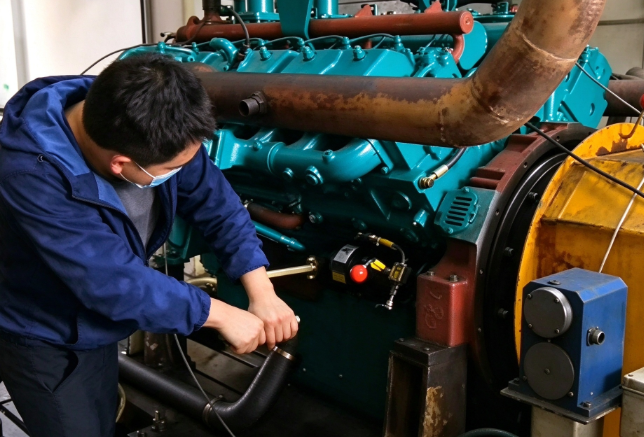
Step 4: Remove the Cranking Handle (Crucial Safety Rule)
Once the spring starter is fully charged with energy, be sure to remove the handle from the winding arbor and store it securely in the nearby handle bracket.
Safety Tip: Although modern spring starters feature automatic disengagement protection, removing the handle before releasing energy is a mandatory safety standard in industrial operating procedures.
Step 5: Trip the Lever to Crank the Engine
Re-confirm that no personnel are standing near the rotating parts of the diesel engine. Use your hand to decisively and smoothly push or pull the Trip Lever. The spring energy is instantly released, and the drive gear automatically engages the flywheel and drives the diesel engine at high speed to complete engine startup.
Please watch the demonstration video below to gain a direct understanding of how to operate a spring starter:
Mechanical Spring Starter: Key Safety Precautions and Best Practices
To ensure on-site operation safety and maximize equipment service life, strictly observe the following core specifications during daily use:
Strictly Control the Winding Limit (Never Overwind)
Closely monitor the winding indicator during winding operations. Once the pointer enters the green full zone, or you feel the overload clutch begin to slip, stop applying force immediately. Do not force or over-crank. Forcing continued winding will cause irreversible deformation or fatigue fracture of the internal springs, severely shortening the equipment’s service life.
Prohibit Operation During Power Running (Strictly Forbidden to Mis-Trip While the Engine is Running)
When the diesel engine is running, idling, or just shut down and still rotating by inertia, it is strictly prohibited to push/pull the trip lever or insert the handle. Forcing a linkage operation under these conditions will cause a violent collision between the starter gear and the flywheel ring gear, leading to severe gear clashing or even damage to the transmission mechanism.
Ensure Match Between Model and Environment (Precisely Select Torque Specifications)
When selecting equipment, you must ensure that the output torque of the spring starter matches the displacement of the diesel engine and the operating ambient temperature. If the starter torque specification is too small, it will not only fail to smoothly start the engine in extreme cold or high-load conditions, but it will also easily cause the starting mechanism to operate under long-term overload.
Utilize Decompression Valves to Assist Starting (Recommended for Large Displacement and Extreme Cold Environments)
For large-displacement diesel engines or operation in extremely cold low-temperature environments, it is recommended to open the diesel engine decompression valve after winding is complete and before triggering the start. This effectively releases the initial compression resistance inside the cylinder, making the starting process smoother while reducing the instantaneous shock load on the spring starter.
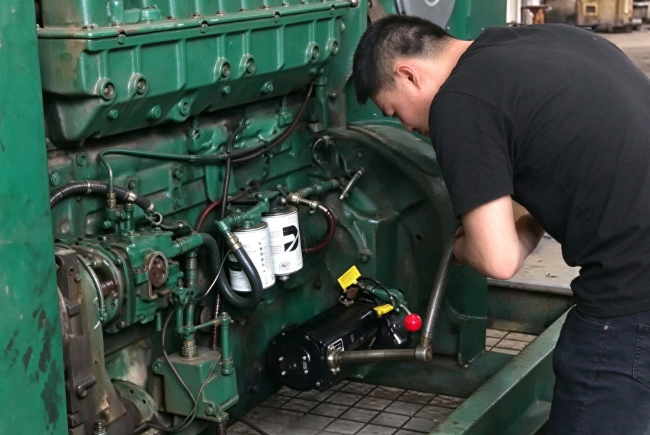
Mechanical Spring Starter Common Operational Faults Rapid Troubleshooting Guide
A mechanical spring starter failing to work properly does not necessarily mean the starter itself is faulty. Engine condition, installation, operation sequence, and product adaptability can all affect starting performance. When abnormalities occur on-site, refer to the following table for rapid troubleshooting and handling:
| Symptom | Possible Cause | Recommended Action |
| 1. Cranking the handle is extremely heavy or jammed | – Excessive engine seizure resistance – Foreign matter jamming the drive gear or internal mechanism – Internal energy storage mechanism lagging | – Manually turn the engine over to check if the crankshaft rotates freely – Check for foreign matter jamming the drive gear area – Do not force over-cranking; have a professional engineer inspect it |
| 2. Engine does not turn after pressing the trip lever | – Spring energy not fully stored – Fuel line blocked or insufficient fuel supply – Starter model too small, torque not matched – Actual engine starting resistance/load too high | – Rewind the handle until the indicator enters the green zone completely – Check if the diesel engine fuel supply valve and oil lines are unobstructed – Re-verify the match between the starter torque model and engine displacement – Use in conjunction with a decompression valve in large-displacement/low-temperature environments |
| 3. Handle reverses when released during winding | – Internal one-way stop pawl worn – Anti-backlash mechanism failed | Stop use immediately, do not attempt to force the handle down by hand, and contact a factory-authorized engineer to replace the internal pawl or repair it. |
| 4. Starting mechanism fails to engage properly | – Incorrect operation sequence – Abnormal connection mechanism or improper installation | Stop operation, re-verify the operating procedures and installation requirements against the manual, and check whether mechanical connection parts are properly seated. |
| 5. Abnormal noise during operation | – External fixtures or connection parts loose – Internal component wear or mechanical failure | Stop use immediately, check the status of all fasteners and exposed transmission parts; if the abnormal noise comes from the inside, contact after-sales service for inspection and repair. |
| 6. Starter fails to return to the specified state (fails to reset) after starting | – Reset procedure for the corresponding model not completed – Internal reset spring or mechanism abnormal | Re-execute the reset procedure according to the manual steps; if it still cannot reset, do not force a second trigger, and contact technical personnel for handling. |
Tip: Before performing any maintenance or disassembly, always confirm that the spring energy inside the starter has been completely released (in an un-energized state) and that the diesel engine has completely shut down.
Why Choose Cqstart Mechanical Spring Starters?
In the field of emergency power and critical equipment assurance, Cqstart provides global diesel engine users with high-safety, high-reliability emergency starting solutions through outstanding mechanical engineering design. Our products offer the following core advantages:
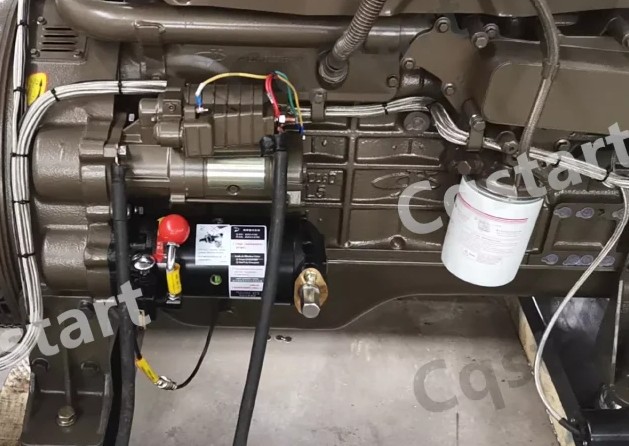
Pure Mechanical Structure, Explosion-Proof with Zero Hazards
With a completely mechanical system design to store and transfer energy, it does not involve any use of batteries, cables, or air sources, hence no possibility of an electrical spark. It is ideal for use in dangerous and explosion-proof settings such as offshore oil and gas installations, mines, and chemical industrial zones.
Patented Anti-Backlash & Simplified Operation
Equipped with an advanced cranking protection mechanism and patented anti-backlash technology, the handle will not reverse and injure operators even if accidentally released during winding. The standardized four-step operating procedure allows easy mastery without professional training.
All-Weather Durability, Zero Maintenance Cost
With good water-resistant, dust-proof, and temperature-resistance ability, it will operate stably under extreme climatic conditions. The high-durability spring group built inside is not prone to energy loss when used for static storage for a long time, and requires negligible maintenance.
Compact Design, Easy Installation and Replacement
The system is compact and lightweight because it uses a design which is based on high power density. Also, the joints and flanges of the device comply with common standards for diesel engines, making its installation very easy, without any modification cost.
High Cost-Performance & Proven Reliability
Compared to expensive and complex air-starting systems, Cqstart provides highly competitive procurement and total cost of ownership (TCO), safeguarding diesel engines to “fire up at a single strike” in critical moments with higher cost-effectiveness.
Ready to Upgrade Your Emergency Starting Backup System?
Mastering the standard operating procedures of a spring starter ensures your diesel engine responds rapidly at moments of crisis when main power fails.
If you need sizing guidance for a specific engine displacement, contact the Cqstart technical engineer team immediately to obtain customized sizing recommendations and official technical support!
FAQs about Operate Mechanical Starter
Can a mechanical spring starter start a diesel engine without a battery?
A mechanical spring starter can start the engine without relying on a battery to drive an electric starter motor to provide cranking power. However, whether the engine can run completely without any power source also depends on the fuel system, control system, and other equipment configurations.
What should I do when a mechanical spring starter fails to start the engine?
First, ensure that the starting device is used as directed in the manual, and check the compatibility between the product and engine. When the engine cannot start after all these steps, diagnose other systems based on the manufacturer’s troubleshooting guide for the engine. Never force anything if there is abnormal resistance or noise.
How to choose a suitable mechanical spring starter for an engine?
Choice should take into account factors such as engine size, model, installation fittings, actual starting requirements, and operating conditions. Supply information to the supplier prior to purchasing in order to ascertain if the model is appropriate.
How to obtain technical support for Cqstart mechanical spring starters?
You can provide Cqstart with the engine model, displacement, application scenario, mounting interface, and related starting requirements. This information helps evaluate product compatibility and further determine the suitable starter model.