
When a fire breaks out, a diesel fire pump engine gets exactly one job: start immediately, every single time. NFPA 20 was written around that reality, setting strict rules for cranking time, attempt counts, and system redundancy. For engineers evaluating a mechanical spring starter as an alternative to batteries, air, or hydraulic systems, the real question isn’t whether it’s simple and low-maintenance — it’s whether it can actually pass NFPA’s demanding starting requirements. Here’s what the standard requires, and how spring starters measure up.
What Does NFPA 20 Actually Require for Diesel Engine Starting?
NFPA 20 governs the installation of stationary fire pumps, and its diesel engine rules are built around one main idea, like the engine has to get to rated speed really fast after a start signal, with no space for hesitation.
In practice, this means diesel fire pump engines are required to reach rated speed within 20 seconds of an automatic start signal. If the engine doesn’t fire during the programmed cranking cycle — typically structured as a series of automatic and manual attempts — the controller must trigger a failure alarm so the building’s emergency procedures can kick in immediately. Testing protocols commonly involve six automatic and six manual start attempts, with each individual crank cycle lasting only a few seconds on modern diesel engines.
The 2019 edition of NFPA 20 added further clarity by formally defining primary and secondary cranking systems, requiring that any engine fitted with more than one starting method clearly distinguish which system is primary and which is backup. This reflects the standard’s broader emphasis on redundancy: a fire pump engine can’t depend on a single point of failure, especially not one — like a battery — with well-documented weak spots in cold weather or after long idle periods.
Put simply, NFPA 20 isn’t just testing whether an engine can start. It’s testing whether it can start fast, repeatedly, and without depending on a power source that might already be compromised when it’s needed most.
What Is a Mechanical Spring Starter, and How Does It Work?
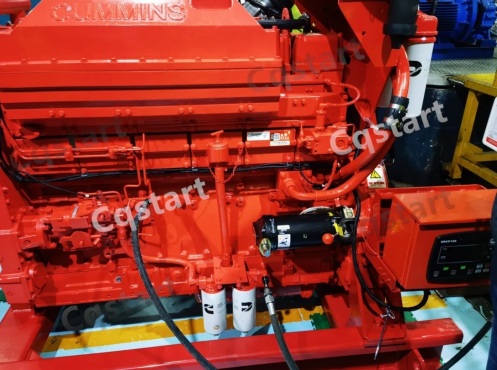
A mechanical spring starter is a purely mechanical energy-storage device. A hand crank or lever winds a heavy-duty spring, storing kinetic energy. When released, that stored energy drives a pinion into engagement with the engine’s flywheel ring gear, cranking the engine to firing speed in a single, controlled burst — no electricity, no compressed air, and no hydraulic fluid involved anywhere in the process.
That’s the fundamental difference between spring starters and the three other systems NFPA 20 recognizes. Battery-electric starters rely on charge retention and a functioning starter motor. Air starters need a compressor, storage tank, and enough reserve pressure for repeated cranking cycles. Hydraulic starters depend on accumulators holding pressurized fluid. A spring starter needs none of that supporting infrastructure — the energy is stored mechanically and released on demand, independent of ambient temperature, electrical faults, or air-system leaks.
Can Mechanical Spring Starters Meet NFPA Start Requirements?
The short answer is yes, and the reasoning maps directly onto what NFPA 20 actually tests for.
Engagement speed. A properly sized spring starter completes a full cranking operation in roughly 10 to 30 seconds depending on the model, which fits comfortably within the standard’s start-and-reach-rated-speed window. Because the energy is already stored before the crank cycle begins, there’s no ramp-up delay the way there can be with a depleted battery or a partially pressurized air tank.
No dependency on batteries or compressed air. This is arguably the most important point of alignment. NFPA-focused engineering guidance repeatedly flags battery discharge and cold-weather performance loss as recurring failure modes in fire pump readiness — precisely the vulnerabilities a purely mechanical system sidesteps by design, since it stores energy without any electrochemical or pneumatic component to degrade over time.
Environmental resilience. Fire pump rooms are not always climate controlled, and in marine or industrial plants, equipment is getting hit with salt spray, wetness, and harsh temperature swings, on a regular basis. A sealed corrosion-resistant mechanical mechanism is basically way less vulnerable to those conditions than a battery bank or the air compressor’s moving bits.
Repeatable cranking attempts. Since winding the spring and releasing it are two separate steps, with the operator doing each one, a spring starter can be re-wound and fired again to match multi attempt testing routines. This can be done without having to wait for a recharge sequence , the way an air setup would while it’s waiting on compressor recovery time.
Put together, these traits mean a correctly specified mechanical spring starter can meet NFPA 20’s main purpose: fast, dependable, and consistent starting that doesn’t just fold under the same failure situations the standard was built to stop.
Spring Starter vs. Other NFPA-Compliant Starting Systems
| Factor | Spring Starter | Battery/Electric | Air Starter | Hydraulic Starter |
| Auxiliary equipment needed | None | Charger, battery bank | Compressor, air tank | Accumulator, hydraulic station |
| Cold-weather reliability | High | Reduced | Moderate | Moderate–High |
| Maintenance cost | Low | Moderate | Moderate–High | Moderate–High |
| Installation complexity | Simple | Simple | Complex | Complex |
| Corrosion/salt spray resistance | High (sealed design) | Low–Moderate | Moderate | Moderate |
Air and hydraulic systems remain common where existing plant infrastructure already supports them, and NFPA 20 explicitly recognizes both as valid primary or secondary systems. But for standalone installations — remote pump houses, marine engine rooms, or sites where minimizing auxiliary infrastructure matters — a spring starter often achieves the same compliance outcome with meaningfully less equipment to install, power, and maintain.
Where Mechanical Spring Starters Are Used
Beyond stationary fire pumps, mechanical spring starters are widely deployed in marine engine rooms, military and ATEX (explosion-hazard) environments, and emergency rescue equipment — settings where electrical dependency or ignition risk make traditional starters impractical. In each case, the same properties that support NFPA compliance — speed, independence from external power, and environmental durability — are what make the technology suitable in the first place.
A mechanical spring starter can meet NFPA 20’s start requirements when it’s correctly sized and installed — its cranking speed fits within the standard’s time window, and its independence from batteries and compressed air directly addresses the failure modes NFPA 20 is most concerned about. For engineers who are evaluating a diesel fire pump starting scheme, that mix of regulatory alignment, dependable operation, and low maintenance burden is honestly worth a closer look. it’s not just about checking boxes, more like keeping the whole thing dependable when conditions get complicated.
Note: Specific cranking-time and attempt-count figures vary slightly between NFPA 20 editions (2016, 2019, 2022). Always confirm requirements against the current edition applicable to your jurisdiction and project.