
The grid goes down at 2 AM and the emergency generator, which last ran five weeks ago, has to start on the first try. And when it fails, the weakest link can be the quietest part of the system: the battery. A mechanical spring starter provides a second way for a standby diesel engine to crank that does not draw on battery charge. It will not cure fuel, lubrication or compression problems and somebody has to be on site to wind it up. This guide tells you where it helps and how to choose one.
Why Standby Diesel Engines Fail to Start
Emergency generators, fire pump engines, marine emergency sets and industrial backup units sit idle for long periods of time, then get one job that can’t wait. This is reflected in the test rules. NFPA 110 mandates monthly load exercises of at least 30 minutes per Minnesota Department of Health guidance, and fire pump controllers such as Hubbell’s Metron FD2 do so by cycling through six 15-second crank periods, alternating between two battery sets. Both assume repeated cranking, battery powered.
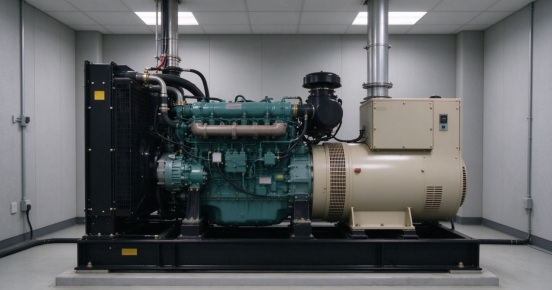
Common Starting Risks, and Which Ones a Mechanical Starter Hits
Not every failed beginning points to the starter itself. First, sort the risks.
| Risk | Where it sits | Can a spring starter help? |
| Battery self-discharge or aging | Cranking energy source | Yes: cranking no longer depends on battery charge |
| Poor battery maintenance | Cranking energy source | Yes, but the starter still needs periodic inspection |
| Corrosion and humidity | Starting system and environment | Partly: depends on the starter’s own protection; cables and engine parts are unaffected |
| Degraded or contaminated fuel | Engine | No |
| Lubrication, compression, wear | Engine | No |
| Missed inspections and test runs | Management | No, and the starter needs its own checks |
Cranking Problem or Engine Problem?
When the engine does not turn or turns slowly, the first suspect is cranking energy or torque. If it spins fast but will not fire, look at fuel, air and compression; a different starter will not help. Cqstart’s guide to diesel engines that won’t turn over covers diagnosis.
What a Mechanical Spring Starter Adds to a Backup Starting System
A Battery-Independent Source of Cranking Energy
An operator winds the spring by handle until one or two red springs show in the viewing window, removes the handle, and pushes the trip lever to release the energy through the pinion into the flywheel ring gear. The design is all mechanical, no batteries, no electrical power, no outside pneumatic or hydraulic systems, says Cqstart.
Working with an Existing Electric Starter
It can be a stand-alone backup, but it is dependent on the flywheel housing, ring gear access and mounting position if it fits beside or instead of an electric starter. Check this out for every engine.
Cqstart describes the design as purely mechanical, with no batteries, electrical power or external pneumatic or hydraulic systems.
What It Doesn’t Do
It does not correct for fuel, lubrication or compression faults and it requires a person to be at the engine so it is only applicable to attended sites, not remote unattended starts. “No battery” only means no cranking power; an electronically controlled engine may still need power for its control unit or for stopping functions.
Where Mechanical Starting Is Suitable for Standby Applications
Diesel Standby Generators
Batteries can be left unattended for months between tests. If a failed start coincides with an outage, a spring starter provides on-site personnel with a manual way to crank.
Pumps Fire Engines
The normal practice is to have 2 battery sets and automatic cranking sequences. Think of a mechanical starter as something to consider with your engine supplier and authority having jurisdiction, not as an assumed substitute. See Cqstart’s article on the NFPA start requirement.
Emergency Marine Generator Sets
Salt air and humidity corrode electrical connections. One of the applications mentioned by Cqstart is for marine use, and it describes coatings that resist oil, water and salt spray.
Backup Power Systems for Industry
At remote pump stations or plants compressed air or dependable charging may not be available. A manual starter that stands on its own eliminates that dependence.
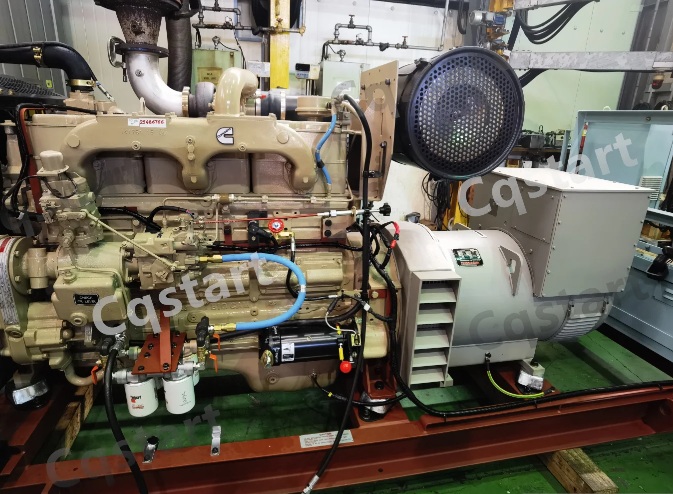
How to Choose a Mechanical Spring Starter for a Standby Diesel Engine
Displacement is only the first filter. A suitable starter must also match the engine’s model, ring gear, mounting interface and starting requirement.
Key Selection Factors
| Factor | What to confirm |
| Engine make, model, cylinders | Exact model; series ranges overlap |
| Starting torque and energy | Manufacturer data, including cold-start conditions |
| Ring gear and pinion | Tooth count, module and engagement |
| SAE flange and space | Flange size, plus clearance for winding handle, viewing window and trip lever |
| Starting attempts | How many starts your procedure needs |
| Environment | Marine, hazardous area, temperature, corrosion |
| Control system | Power needed for control unit, stop and fuel functions |
What to include when asking for a starter recommendation
Cqstart will ask your engine maker, model, displacement and mounting specs up front. If you also can provide pictures or drawings of the flywheel housing, your required starting cycles and site operating conditions, our team can evaluate your case faster and provide you a more suitable recommendation.
Build a sound backup initiation strategy
Here are four simple practices that will enable you to create a solid backup engine: 1. Remain prepared 2. Use a separate primary power source 3. Pair the starter with your engine 4. Regularly inspect all components including the starter.
FAQ
If you are planning a backup starting solution, send your engine make, model, displacement and mounting details through the Spring Starter page or contact page, and Cqstart can review a suitable option.