
The initial reaction when a diesel engine won’t turn over is usually “dead battery” — however, that assumption leads to lots of people searching for the wrong solution. In many instances, the issue isn’t one of a lack of power; it’s an inconsistency between the amount of torque the engine’s starting system is able to give and how much the engine needs to overcome mechanical and compression resistance. Then, we’ll go over the concept of what “starting torque” actually means and how to distinguish the difference between a torque issue and other reasons, and what you can do to fix it.
What Is Starting Torque?
Cranking speed (RPM) and the starting torque are two distinct things that can lead to mistakes. RPM is the measure of whether the engine is spinning sufficiently fast to attain ignition temperature via compression, typically between 150-250 RPM for the majority of diesel engines. Torque, however, is the measure of whether the starting system is able to exert enough force to keep the crankshaft moving in the first place, despite the force generated by the engine.
This resistance is significant in diesel engines, particularly due to the compression ratio. Diesel engines operate at compression ratios of around 16:1-22:1, in contrast to 8:1-12:1 in gasoline engines – almost the same. Each degree of crankshaft movement during the compression stroke forces back against the starter using the force of a real mechanical resistance, and this resistance varies according to engine displacement and the number of cylinders. A larger, higher compression diesel engine will require greater torque to turn than a gasoline engine that is smaller regardless of the temperature or oil condition are part of the equation.
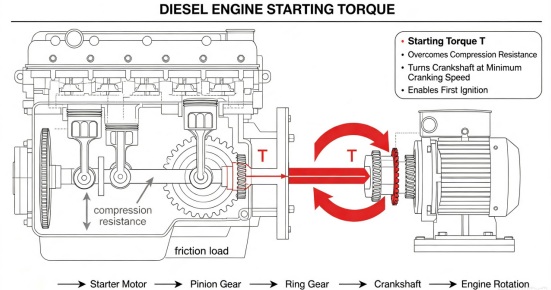
The Two Sides of the Torque Equation: Supply vs. Demand
Diagnosing a torque problem comes down to comparing what your starting system can supply against what your engine demands — and a mismatch on either side produces the same symptom: an engine that won’t turn over.
Torque Supply — What the Starting System Can Deliver
On the supply side, three things matter: battery Cold Cranking Amps (CCA) rating, starter motor torque output, and — for engines equipped with one — the mechanical energy a spring starter can deliver independent of the electrical system. CCA specifically measures how many amps a fully charged 12-volt battery can deliver for 30 seconds at 0°F while maintaining at least 7.2 volts — a standardized worst-case benchmark, not a real-world guarantee.
Torque Demand — What the Engine Requires to Turn Over
On the demand side, compression ratio, displacement, and oil viscosity all drive up the torque required to crank. As a rough industry rule of thumb, diesel engines require approximately double the CCA per cubic centimeter of displacement compared to gasoline engines, precisely because of that higher compression ratio. Cold oil compounds this further — as temperature drops, oil thickens and increases internal friction, meaning the same engine can demand significantly more torque to turn over on a cold morning than it did the day before in mild weather.
Signs You’re Dealing With Insufficient Torque
Slow, Labored Cranking Sound (Not Complete Silence)
A torque shortfall typically sounds like a slow, straining crank rather than dead silence. Complete silence when you turn the key usually points to a wiring, relay, or connection issue — a torque problem still tries to turn the engine, it just can’t generate enough force to do it properly.
Starter Engages But the Engine Barely Rotates
If you sense or feel the starter motor kicking in but the crankshaft is moving sluggishly or is not moving at all, it’s probably a sign of an imbalance in supply and demand rather than an electrical disconnect that is dead.
Intermittent Failures That Correlate With Temperature
If starting failures cluster on cold mornings but the same engine starts reliably in warmer conditions, torque demand rising with cold, thickened oil — combined with reduced battery output at low temperature — is almost certainly the underlying pattern.
How to Diagnose Insufficient Starting Torque Step by Step
Step 1 — Measure Battery Voltage Under Actual Cranking Load. A battery may be healthy at rest but still drop considerably when the starter draws actual current. Tests under load, and not just at rest, can reveal whether the battery is able to deliver its output at the time it is needed.
Step 2 — Check Oil Viscosity Against Ambient Temperature. Cold-weather research shows that a battery can lose up to 50% of its rated cranking power at 0°F compared to 32°F, while the engine simultaneously demands significantly more torque due to thickened oil — a genuine double penalty that hits hardest exactly when starting reliability matters most.
Step 3 — Inspect for Mechanical Binding or Accessory Drag. Seized accessory belts, worn bearings, or long-term idle storage can quietly add mechanical resistance that increases torque demand independent of temperature or oil condition.
Step 4 — Compare Starter Motor Torque Rating to Engine Requirements. If the starter motor’s torque specification was undersized for the engine’s displacement and compression ratio from the start, no amount of battery maintenance will fully resolve chronic turning-over issues.
Common Root Causes of Insufficient Starting Torque
The diagnostic steps above typically trace back to one of a few root causes: an undersized or mismatched starter motor relative to engine displacement, battery voltage sag under load (a distinct issue from a battery that’s simply dead), cold weather thickening engine oil beyond what the starting system was sized for, or a starter specification that was never correctly matched to the engine in the first place.
Solutions: Closing the Torque Gap
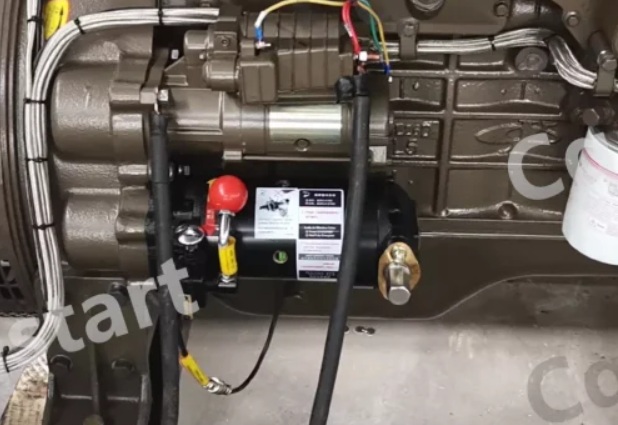
Addressing a chronic torque shortfall usually means matching the fix to the specific gap identified. Undersized starter motors must be replaced with properly sized units matched to the engine’s displacement and compression ratio. For operation in cold climates, choosing engine oil with viscosity rated for the ambient temperature or installing block heaters can reduce cranking resistance before ignition. For engines where starting failures recur despite addressing battery and oil factors — particularly in critical applications like emergency generators or marine engines — a mechanical spring starter offers a torque supply that doesn’t depend on battery condition, voltage sag, or cold-weather chemistry at all, delivering consistent mechanical force regardless of what’s happening to the electrical system.
FAQ
What causes insufficient cranking torque in cold weather?
The cold weather can result in an additional burden for batteries: output declines (often a loss of up to half the rated cranking capacity at 00°F) as engine oil becomes thicker and increases the amount of torque required in order to rotate the shaftand both are working against your system simultaneously.
How can I tell whether my starter motor has enough torque to run my engine?
Check the starter’s torque output to the cranking torque requirements; that takes into account the compression rate, displacement and the operating temperature range typical to it.
Can a battery show full voltage at rest but still cause a torque problem?
Yes — a battery can read normal voltage when idle but sag significantly under the heavy current draw of actual cranking, which is why load testing is essential rather than relying on a resting voltage reading alone.
Is a mechanical spring starter a solution for chronic starting torque issues?
For engines with recurring torque-related starting failures, a spring starter provides a mechanically stored, battery-independent torque source, making it a reliable backup or primary option where consistent starting is critical.
A diesel engine that won’t turn over isn’t automatically a dead-battery problem — it’s often a torque supply-and-demand mismatch that deserves a more systematic diagnosis. For critical equipment where starting failures aren’t an acceptable risk, Cqstart’s mechanical spring starters deliver reliable starting torque independent of battery condition or ambient temperature.