
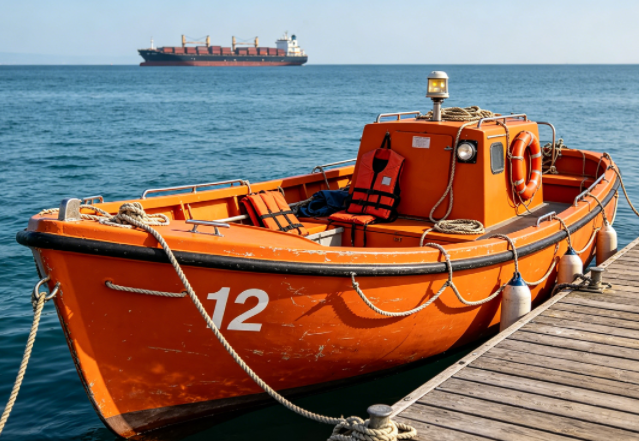
During maritime voyages, the lifeboat is one of the most critical emergency lifesaving appliances onboard a vessel. In emergencies such as shipboard fires, collisions, groundings, or flooding, lifeboats serve as the absolute last line of defense for crew safety.
In accordance with the regulations of the International Maritime Organization (IMO) and the International Convention for the Safety of Life at Sea (SOLAS), vessels must regularly inspect and test-run lifeboat engines to ensure they can start instantly and operate normally in an emergency. However, during actual ship operations, lifeboat engine starting failure remains one of the most frequent equipment deficiencies.
What exactly causes a lifeboat engine to fail to start? How can the crew quickly troubleshoot and resolve these issues? This article provides an in-depth analysis of the 9 common reasons for ship’s lifeboat engine starting failure, along with practical troubleshooting steps and preventative maintenance recommendations.
Reason 1. Battery Depletion, Aging & Plate Sulfation
This is the most common failure. Lifeboats remain hooked to davits for extended periods. However, despite being fitted with floating chargers, constant overcharging or undercharging will result in sulfation of the battery plates, thereby leading to high internal resistance.
Symptom: Voltage is static at normal level, e.g. 24V; however, the instant the starting button is pressed, cranking voltage falls abruptly to render the motor ineffective at starting.
Emergency Response: Changeover to No. 2 Battery Bank immediately; in case both banks have been exhausted, connect jumper wires to receive emergency power from the mothership or a portable jump-starter, or employ a mechanical spring starter.
Reason 2. Terminals Corrosion & High Contact Resistance
The marine atmosphere, which is marked by the presence of a lot of salt and humidity, is naturally an enemy of electrical equipment. The terminals of batteries, starter relays, and ground wires are susceptible to corrosion and rusting, which create a green coating of copper oxide or white sulfate. The result is too much contact resistance such that even if you have fully charged batteries, the current will not freely flow through to start the motor.
Emergency Response: Scrape off the oxide using a wire brush or sandpaper. Then secure the terminals and use petroleum jelly.
Reason 3. Starter Motor Solenoid Burning & Carbon Brush Wear
The contacts inside the solenoid switch of traditional electric starters generate arcs during repeated ignition, leading to contact erosion, sticking, or jamming over time. Moreover, there can be problems with loose carbon brushes that can generate clicks without turning the motor.
Emergency Response: Knock on the housing of the starter motor using a hammer. In case of serious emergencies where safety against explosion can be guaranteed, connect the two major terminals on the starter motor using a screwdriver or a spanner.
Reason 4. Air Lock in Fuel Lines
Diesel engines require absolute airtightness within the fuel system. Air can easily enter the lines during routine fuel filter replacements or after long periods of idleness. Since air is compressible, air is compressed during the operation of the fuel injection pump. The consequence is that fuel does not reach the valve opening pressure and therefore the fuel cannot be atomized; hence, there is cranking without ignition.
Symptom: The starter motor cranks powerfully, but the engine emits no smoke and shows no signs of catching fire.
Emergency Response: Loosen the bleeding screw on the fuel filter or high-pressure fuel pump, repeatedly press the priming pump until the outflowing diesel is continuous and completely bubble-free, then lock the screw.
Reason 5. Fuel Contamination, Waxing, or Condensation Water
The Marine Gas Oil (MGO) in the lifeboats’ tanks has a relatively long replacement schedule. As a result of changes in ambient temperatures, there is significant water accumulation in the tanks that gets deposited at the base. If not removed on a timely basis, it enters the fuel pump where precision elements rust up and freeze. In addition, while traveling in colder regions, without using diesel with low pour point, there is a risk of wax crystal formation (i.e. waxing), completely clogging fuel lines.
Symptom: The engine starts shaking and stalls right away; the exhaust emits white smoke.
Emergency Measures: It is necessary to open the water separator drainage valve to drain all water and sludge. In case of waxing of the diesel fuel, immediately use a cabin heater or pour warm water to melt it.
Reason 6. Air Louver Closed or Exhaust Blockage
For purposes of preventing exhaust gas backflow and entry of seawater into the lifeboat, fully enclosed lifeboats are provided with separate air inlet louvers and exhaust non-return valves. In case the crew member fails to open the air inlet louver prior to ignition or the exhaust storm valve gets jammed due to its infrequent use, the engine stops due to lack of oxygen.
Symptom: The engine runs well and may even start momentarily, but stops immediately during emission of black smoke from the exhaust.
Emergency Action: Open the air inlet louvers by 100%, and manually release the stuck exhaust non-return valve through the rear portion of the boat.
Reason 7. Safety Interlocks & Emergency Stop Not Reset
Modern lifeboats feature strict mechanical safety interlocks. The most typical is the gearbox neutral interlock: if the gear lever is not 100\% in the neutral position, the safety microswitch cuts off the starting circuit. Additionally, if the remote fuel emergency cut-off wire or mechanical emergency stop valve pulled during a previous drill was not manually reset, the fuel pump rack will remain at “zero fuel position.”
Symptom: The starting circuit is completely unresponsive, or the motor cranks but no fuel is supplied.
Emergency Action: Confirm 100\% that the gearbox lever is perfectly centered in neutral, and go to the engine side to manually push the fuel cut-off valve back to its reset position.
Reason 8. Sticky Governor & Fuel Control Rack
The mechanical governor of a lifeboat diesel engine contains a complex arrangement of flyweights and linkages. Due to long-term exposure to humid air and a lack of frequent operation, the internal fuel control rack can easily seize in the “Stop” position due to oil sludge or minor rust, preventing the injectors from delivering fuel during startup.
Symptom: The motor cranks frantically and the fuel lines are clear of air, but the injectors do not spray.
Emergency Action: Remove the side protective cover of the engine, spray WD-40 or a penetrating lubricant generously onto the linkages, and manually cycle them back and forth until the rack moves smoothly and springs back freely.
Reason 9. High Oil Viscosity in Cold Weather
On Arctic routes or in winter high-latitude navigation zones, if the lifeboat space heater is not turned on, the engine oil becomes as thick as honey. This creates immense viscous drag. At this point, the traditional electric starter motor must fight both a chemically weakened battery and extreme mechanical resistance, failing to reach the minimum cranking speed required for diesel compression ignition.
Symptom: The motor turns extremely slowly, failing to reach starting RPM.
Emergency Action: Turn on the lifeboat cabin space heater, or safely apply localized external physical heat to the engine oil pan. Alternatively, deploy a mechanical spring starter to help start lifeboat engine in cold weather easily.
How to Prevent Lifeboat Diesel Engine Starting Failures?
To ensure the lifeboat engine fires up on the first attempt during an emergency or a Port State Control (PSC) inspection, shipping companies and crew must strictly execute the following preventative maintenance procedures:
Strictly Execute SOLAS Test Runs
For weekly inspection, the engine is required to be started and run idle for at least 3 minutes. For monthly inspection, wherever feasible, it is recommended that the lifeboat be taken into the water and ahead/astern gear testing be done to avoid governor and transmission rusting.
Anti-Salt Spray Circuit Maintenance
The terminals of the batteries and starter motor must be regularly cleaned with dielectric grease applied on them. The voltage during cranking must be measured monthly using a multimeter. In case of a 24V system, if the cranking voltage is below 18V, then the batteries must be replaced.
Strengthen Fuel & Drainage Management
Check the primary fuel filter weekly and promptly drain condensation and impurities from the bottom of the water separator. Before entering frigid sailing zones, completely switch over to low-pour-point diesel (e.g., -35# MGO) and low-viscosity engine oil.
Exercise Linkage Mechanisms
Regularly apply penetrating lubricants to the external linkages of the mechanical governor, throttle cables, and emergency stop valve shafts. Manually actuate them back and forth to ensure flexible, resistance-free movement.

Lifeboat Starting Systems: Traditional Modes vs. Mechanical Spring Starters
To cope with emergencies, SOLAS Chapter III explicitly mandates that lifeboat engines must be equipped with two independent starting systems.
Many vessels configure a “Dual Battery Bank (Battery 1 + Battery 2)” to satisfy these two options. However, this setups harbors a fatal blind spot: in the event of a total shipboard blackout, cabin flooding, or a burnout of the main charging panel, both electrical systems will fail simultaneously.
Compared to traditional starting methods, the Mechanical Spring Starter is rapidly becoming the golden standard for global shipowners looking to eliminate PSC detention risks:
| Features | Electric Starter | Hydraulic/Air Starter | Spring Starter |
| External Energy Dependency | Relies on chemical batteries & mothership grid charging | Relies on accumulator pressure & air compressors | Zero Reliance (Purely mechanical manual energy storage) |
| Environmental Adaptability | Performance plummets in low temps; highly vulnerable to salt spray | Valves prone to air/oil leaks; complex system | Stable output from -20°C to +50°C; unaffected by environment |
| Maintenance Cost | Requires regular specific gravity tests; mandatory battery replacement every 2-3 years | Requires regular pressure checks & high-pressure seal replacements | Virtually maintenance-free (“Install and Forget”) |
| Explosion-Proof Performance | Risks electrical sparking; not suitable for hazardous zones | Relatively safe | 100% purely mechanical explosion-proof; extremely safe |
Why a Spring Starter is the “Ultimate Life Insurance” for Your Lifeboat
As a purely mechanical, highly reliable emergency backup starting system, the spring starter stores energy via a manual winding handle. With a single button press, it releases immense instantaneous torque to drive the diesel engine flywheel. It provides three core assurances for your fleet:
100% Elimination of PSC Detention Risks due to Electrical Defects:
During a surveyor’s inspection, even if the batteries are completely dead due to corrosion, sulfation, or depletion (Reasons 1, 2, 3), the crew can switch to the spring starter and manually start the engine within seconds, demonstrating flawless compliance.
Powerful Compression Ignition under Extreme Environments
Even in the face of a total ship blackout or freezing conditions (Reasons 9), the physical potential energy of the spring never degrades. It delivers an initial cranking speed far exceeding that of an electric motor, instantly tearing through viscous oil to reach compression ignition temperatures.
Ultra-Low Total Cost of Ownership (TCO)
Featuring a fully enclosed mechanical structure with internal components specially treated against corrosion and salt spray, it requires no day-to-day inspections or charging after installation. It represents the perfect “lifetime” emergency asset.
Assisted Mechanical Troubleshooting
For issues like a seized governor rack (Reasons 8) or un-reset mechanical interlocks (Reasons 7), the manual cranking/winding handle of the spring starter allows marine engineers to feel mechanical resistance directly before attempting a start, thereby detecting latent mechanical jams in advance.
Looking for a Reliable Lifeboat Spring Starter? Contact Cqstart!
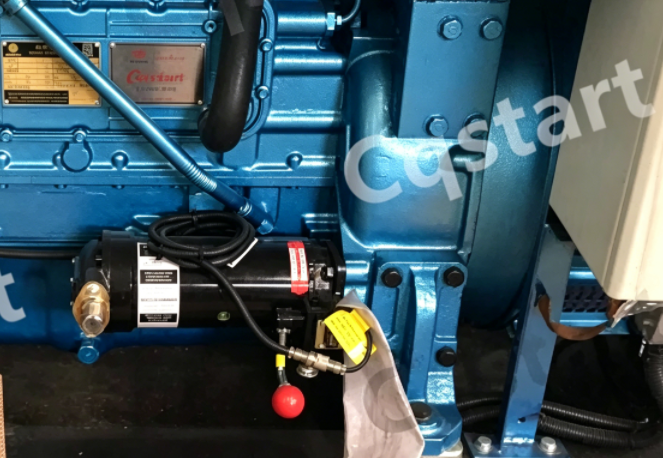
As a world-leading mechanical starting solution, the Cqstart Mechanical Spring Starter utilizes the principle of pure mechanical manual energy storage and one-button release to output high-burst torque to drive the engine flywheel. It serves as the ultimate weapon to resolve lifeboat starting failures.
Extreme High/Low Temperature Resistance:
With a purely mechanical structure, its performance is completely unaffected by temperature. It thoroughly solves the pain point in polar or frigid routes where chemical batteries lose half their efficiency and fail to crank engines with highly viscous oil.
Triple-Proof Design (Waterproof, Oil-proof & Salt Spray-proof):
The exterior is coated with a unique eco-coating material, whereas the interior is completely protected against corrosion. The device can survive in extremely challenging environments with factors like saltwater spray, moisture, and oil contamination without being affected by any flaws of electric motors and terminals.
Easy to Install & Operate:
Engineured with standard SAE specifications, it can be easily bolted on. Standard models can complete manual energy storage and starting within 30 seconds, while micro models require only 10 seconds.
Cost-Effective & Zero Maintenance:
In this case, there is no need to have air compressors, air tanks, or hydraulic generators, thus reducing the total purchasing cost compared to the pneumatic or hydraulic system. The durable and anti-corrosive design ensures that the operating costs after purchase are close to zero.
Purely Mechanical Explosion-Proof Safety:
Employing an advanced pre-engaged design, the starting process generates absolutely no electrical sparks. Possessing natural explosion-proof attributes, it is the perfect choice for lifeboats on oil tankers and chemical carriers.
Don’t let a minor battery failure turn into a PSC detention and off-hire loss costing tens of thousands of dollars!
Contact Cqstart today. Provide your lifeboat diesel engine model to receive a complimentary customized compatibility datasheet and an exclusive quotation.