
Starting systems play an essential role when selecting and maintaining industrial diesel engines, marine vessels or emergency generator sets. A reliable starting system could make the difference between smooth operation and catastrophic failure; air starter vs electric starter debate has long dominated engineering conversations. And for good reason.
Both options have their strengths. Pneumatic starters deliver massive torque and handle hazardous environments beautifully. Electric starters are cheap, widely available, and familiar to just about every technician out there. But there’s a third route that doesn’t get as much attention: mechanical spring starters. These are worth a serious look if you want to cut your dependency on batteries, compressors, or other supporting energy systems.
This guide breaks down how pneumatic and electric starting systems actually work, where they fall short, and how they stack up against each other. We’ll also cover when a spring starter might be the smarter play. Let’s get into it.
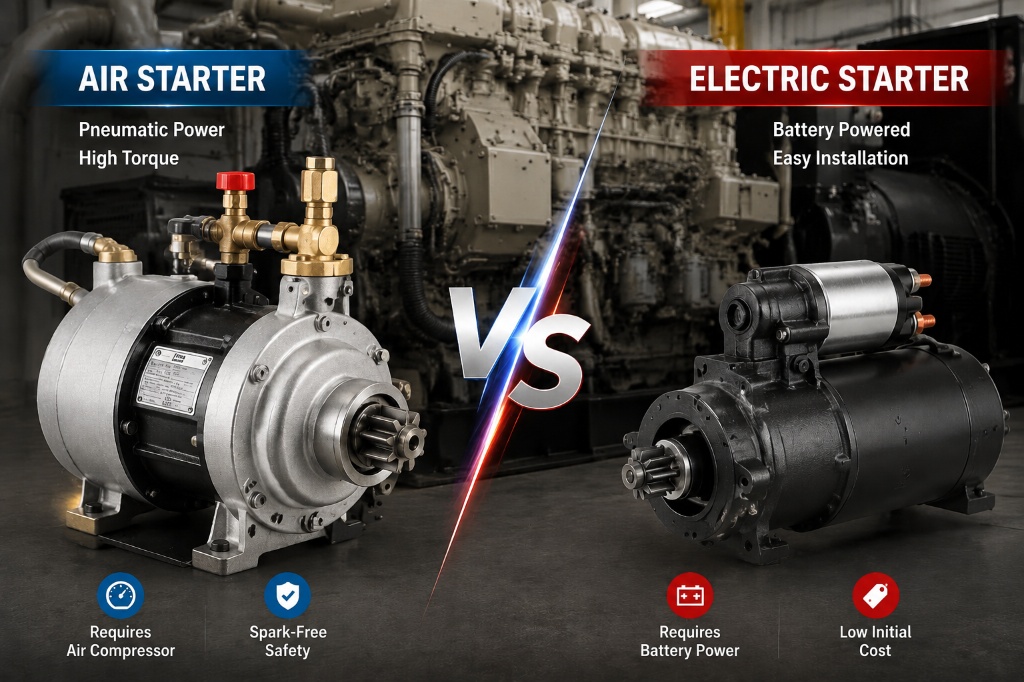
How Engine Starting Systems Work
Before we compare, let’s make sure we’re on the same page about what’s happening under the hood when you hit that start button.
Air Starter Working Principle
Pneumatic starting systems use compressed air to force a turbine or set of vanes into motion, producing mechanical torque to turn over an engine.
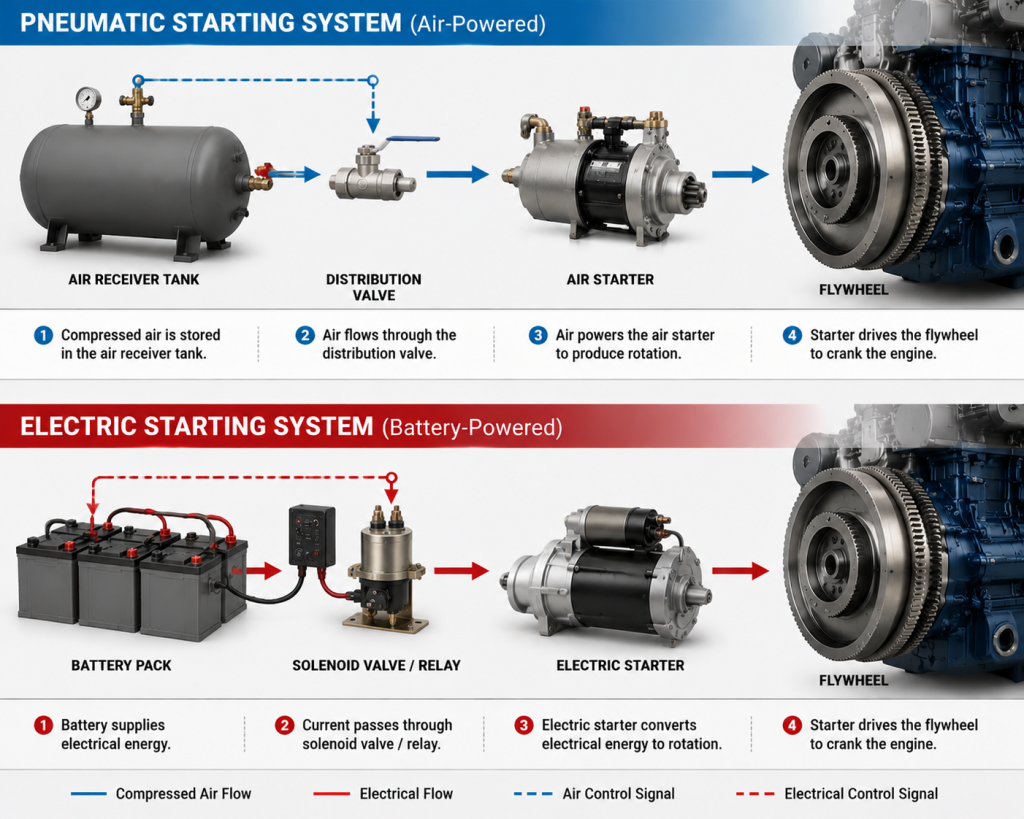
Here’s how it works: When you open the control valve, high-pressure air from your compressed air system rushes into the starter housing and strikes its turbine blades or vanes inside, causing them to spin at high speed. From there, a planetary gear train steps up the torque, and the drive gear shoots forward to engage the engine’s ring gear. The engine turns over, and you’re off and running.
You’ll see these most often on large marine main and auxiliary engines, offshore drilling platforms, and mining or oil and gas equipment where there’s already a central air system in place.
Electric Starter Working Principle
Electric starters convert electrical energy into mechanical motion.
Simple enough. When you trigger the start signal, the solenoid closes a heavy-duty circuit, and that pulls in the pinion gear to mesh with the flywheel ring gear. The battery dumps a massive current through the DC motor, which spins up and delivers torque through a gear reduction set. That torque gets the diesel spinning until it reaches self-sustaining speed.
These are everywhere. Standard land-based generator sets, construction machinery, backup power systems with stable grid access—you name it.
Air Starter vs Electric Starter: 6 Key Differences
Let’s get into the meat of it. Here’s where these two systems really diverge.
1. Safety & Hazard Compliance
Safety should not just be considered an add-on when working in hazardous areas containing flammable gases or dust; it must be an integral component of all aspects of operations.
Air starters provide an advantage in this regard; without electrical contacts or sparks to worry about, these starters rely solely on airflow for propulsion – making complying with ATEX or similar explosion-proof standards simpler and faster than ever before.
Electric starters feature brushes and contacts that create sparks when engaged, which is fine in clean environments; however, for hazardous ones you will require explosion-proof certification or specially protected enclosures which adds cost and complexity.
2. Reliability in Extreme Conditions & Long-Term Standby
Temperature extremes are tough on equipment. But here’s something that doesn’t get enough attention: long-term standby reliability. That’s where a lot of systems fail, not because the starter itself broke, but because the supporting energy source degraded over time.
Air starters don’t suffer from battery chemistry issues. That’s a big plus. But in cold, humid environments, you’ve got a different problem. The rapid expansion of compressed air causes a temperature drop, and that can lead to ice forming in the valves and lines. And if the system sits idle for months, those air line fittings can develop tiny leaks from vibration or thermal cycling. Pressure bleeds off slowly, and when you need it most, there’s not enough air to turn the engine.
Electric starters are sensitive to temperature too. In extreme cold, battery capacity drops sharply. In long-term standby, lead-acid batteries self-discharge and suffer from sulfation on the plates. If you don’t have a float charger maintaining them, you’re rolling the dice.
3. Starting Torque and Engine Size
Torque requirements increase with engine displacement. That is when things can get exciting!
Air starters boast an ideal power-to-weight ratio. Their compact form factor and torque output makes them a suitable solution for medium and large-bore diesel engines alike.
Electric starters run into trouble with larger engines. To start up a large-bore diesel, multiple starter motors and an ample battery bank may be needed, with each motor limited by size, heat dissipation capacity, and current-carrying capacities of cables.
4. Starting Speed & Response Time
In emergency generator or fire pump applications, every second matters.
Air starters respond fast when there’s adequate pressure in the tank. You open the valve, and torque hits the flywheel almost instantly. The engine accelerates quickly.
Electric starters depend heavily on battery condition and cable resistance. With a healthy battery, they’re quick. But if voltage sags under load, the cranking speed drops, the start cycle drags out, and sometimes it fails outright.
5. Maintenance Requirements
Different systems, different maintenance headaches.
Air starters have long service lives on the starter itself. But the air prep system needs regular attention. You’re checking filters, regulators, lubricators, draining condensate, and replacing filter elements. It’s not hard, but it’s ongoing.
Electric starters need less work on the motor. But the batteries are a constant expense. You’re monitoring charge levels, checking electrolyte in flooded cells, and replacing the whole bank on a scheduled basis regardless of condition.
6. Initial Investment and Total Cost of Ownership (TCO)
Here’s where a lot of buyers get tripped up. They look at first cost and stop there.
Air starters are moderately priced as components. But the system investment is substantial. You need a compressor, receiver tank, control valves, and piping. All of that adds up. On the flip side, ongoing maintenance costs are predictable and manageable.
Electric starters are cheap to buy and easy to source. That’s the upside. The downside? Battery replacement costs hit you repeatedly over the life of the equipment. If you’re running a large bank of batteries, those costs accumulate fast.
Hidden Limitations of Electric and Air Starters
Here’s the reality that often gets overlooked. Most start failures in emergency systems don’t come from a broken starter. They come from degradation in the supporting energy source.
Let’s look at the infrastructure dependencies for each.
Infrastructure Dependencies of Air Starters:
A pneumatic starting system isn’t just the starter. It’s a whole ecosystem. You need an air compressor, receiver tank, control valves, and a network of piping. That’s a significant footprint, and it’s not cheap to install.
And here’s the kicker. If no one’s checking the system regularly, slow leaks at fittings or valve seats can bleed pressure down over time. When the power goes out and you need that engine to start, the tank might not have enough pressure to do the job. It happens more often than people admit.
Infrastructure Dependencies of Electric Starters:
Electric starters need batteries, float chargers, and heavy-gauge cables. That’s straightforward, but it’s not trouble-free.
In unattended sites or harsh weather, batteries self-discharge. Chargers fail. Connections corrode. When you lose utility power and the generator needs to start, a dead battery bank is a showstopper.
Is a Mechanical Spring Starter a Practical Alternative?
If you want to cut the umbilical cord to external power sources and simplify your starting system, a mechanical spring starter is worth a close look.
How a Spring Starter Works
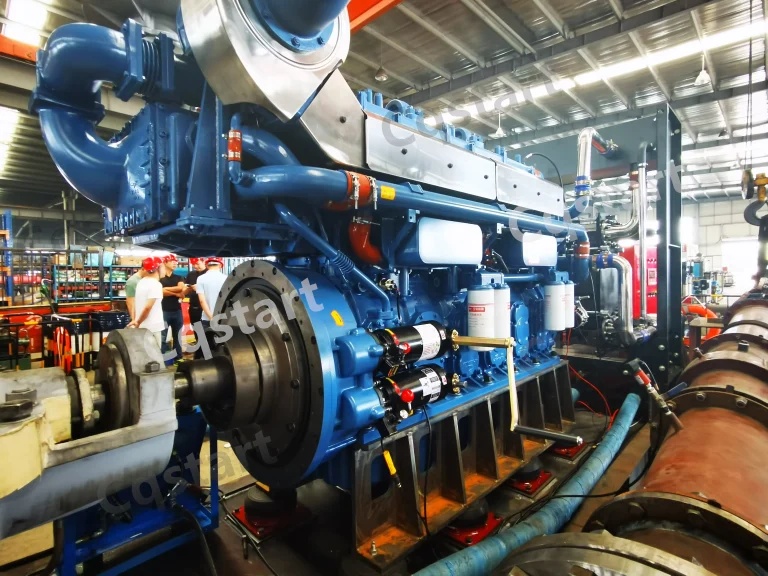
Spring starters differ from conventional air or electric starters in that they store mechanical energy in an easily wound high-strength steel spring, which then releases that stored energy when released by hand winding. When released, that stored energy turns over your engine.
This process entails four steps.
Manual Winding: When manual winding a drive shaft, the operator uses a crank handle to manually turn it. Although this takes some effort and time, it should still be possible.
Spring Energy Storage: By compressing heavy-duty mechanical springs with winding action, potential energy is stored away.
Release Mechanism: Pull the release lever, and the locking mechanism lets go.
Gear Engagement and Cranking: The spring releases, the drive gear extends, meshes with the flywheel, and the engine spins.
Why Spring Starter Reduces System Dependency
Here’s where this approach shines, compared to pneumatic and electric systems.
No battery dependency. No self-discharge, no sulfation, no temperature-related capacity loss. The energy is stored mechanically, not chemically.
No compressed air infrastructure. No compressor, no tank, no piping, no leaks, no freezing. It’s just the starter mounted directly to the engine.
Independent starting capability. As long as there’s someone on-site to wind it up, you can start the engine. Period. No external utilities required.
Companies like CQStart specialize in mechanical spring starter for diesel engines that aren’t well-suited for battery or compressed air starting. They offer rugged, field-proven solutions that many operators turn to for critical backup applications.
One thing to keep in mind: spring starters aren’t universal. They need to be sized correctly for the engine’s displacement, torque requirements, and operating environment.
Air Starter vs Electric Starter vs Spring Starter: Technical Comparison Matrix
Here’s a side-by-side look at how the various engine starting systems compare across key criteria.
| Feature | Air Starter | Electric Starter | Mechanical Spring Starter |
| External Power Requirement | Compressed air supply | Battery charging | No external power |
| Supporting Equipment | Compressor & air tank | Battery system & charger | Minimal external support system |
| Typical Engine Application | Large diesel engines | Small to medium engines | Small/medium & emergency backup |
| Hazard Protection | Excellent (Pneumatic) | Standard (May require special protection) | Suitable for spark-free mechanical applications |
| Main Maintenance Focus | Air system, FRL & pressure | Battery condition & electrolyte | Mechanical inspection & lubrication |
| Independent Starting Capability | Dependent on air tank pressure | Dependent on battery charge | High (Requires manual preparation) |
| System Footprint | Large (Requires compressor/tank) | Small (Requires battery space) | Compact (Direct flange mount) |
| Cost Consideration | High initial system investment | Low initial cost; ongoing battery cost | Moderate initial cost; low maintenance |
How to Choose the Right Engine Starting System?
When it’s time to make a decision on your diesel engine starting system, here are four dimensions that should drive your thinking.
Engine displacement and starting torque requirements.
If you’re starting a large-bore diesel in marine or heavy industrial service, pneumatic starters are the conventional choice. For smaller engines or as a backup in larger systems, electric or spring starters can make sense. Match the starter to the torque curve, plain and simple.
Site infrastructure and available utilities.
If your facility already has a central compressed air system, adding a pneumatic starter has a low marginal cost. If you’ve got stable grid power, electric is the most convenient play. If you’ve got neither air nor power, a spring starter gives you independent starting without building new infrastructure.
Operating environment and safety standards.
In hazardous areas, go with air or mechanical spring starters. They don’t generate sparks. Electric starters can be used with additional protection, but that adds cost and complexity.
Required standby reliability level.
For emergency generators or marine applications where a single point of failure isn’t acceptable, consider adding a spring starter as a secondary backup. That gives you a second path to start even if the primary system fails.
When Should You Consider a Spring Starter?
Spring starters aren’t for everyone. But in certain scenarios, they’re a game-changer.
Remote and unattended locations.
Think pipeline valve stations, remote pumping sites, or telecom shelters in the middle of nowhere. There’s no stable grid power, and nobody’s visiting every week to check batteries or run compressors. A mechanical spring starter reduces maintenance overhead and system dependency.
Emergency and marine safety systems.
Marine regulations often require secondary starting capability for lifeboats and other critical safety equipment. If the marine air starting system fails, a spring starter gives you a completely independent backup. It’s pure mechanical fallback.
Hazardous operations without existing air infrastructure.
If you’re in a potentially explosive atmosphere and there’s no central air compressor on site, installing a spring starter avoids the cost and complexity of building an entirely new pneumatic system. You get spark-free starting with minimal installation work.
Final Verdict
So, where do you land? It comes down to what you have available and what you’re trying to achieve.
Choose an Air Starter if you’ve got an existing compressed air system, you’re driving a large engine, and you need spark-free operation. It’s proven and powerful.
Choose an Electric Starter if you’ve got stable grid power, you want low upfront cost, and you’re in a clean environment. It’s simple and familiar.
Choose a Spring Starter if you want true independent starting, you’re tired of battery maintenance and air system leaks, or you need secondary backup for marine or emergency applications. It’s a low-dependency alternative that solves problems the others can’t touch.
At the end of the day, there’s no universally right answer. But understanding the tradeoffs gives you the leverage to make a smart call for your specific application.