
Diesel engines, with their powerful torque and exceptional reliability, are widely used in generator sets, construction machinery, marine vessels, mining equipment, and oilfield machinery. However, no matter how outstanding the mechanical quality of the engine itself may be, the operation of the entire system relies on one crucial core, the battery.
What happens if a diesel engine’s battery dies? Can it still be started? What are the solutions? Are there starting methods that do not rely on a battery?
This article will provide detailed answers to these questions and introduce how to prevent equipment shutdowns caused by battery failures.
Why Diesel Engines Need a Battery?
Many people mistakenly believe that a diesel engine can run on fuel alone, overlooking the highly sophisticated electronic and control architecture of modern diesel engines. The moment you turn the key or press the start button, the battery must provide a continuous supply of power to the following core systems:
- Starter Motor: Requires massive current to overcome extremely high compression ratios.
- ECU (Electronic Control Unit): The core brain directing engine operation.
- Common Rail Fuel Injection System: Controls injection pressure and timing.
- Instruments and Sensors: Monitors safety and protection signals such as water temperature, oil pressure, and RPM.
- Glow Plugs: Essential for preheating and warming up the combustion chamber in cold temperatures.
Therefore, once the battery is depleted or its voltage drops to zero, the entire starting process is completely halted at the very first step.
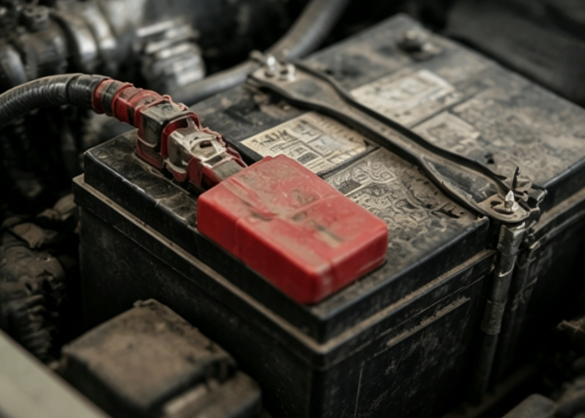
What Happens When a Diesel Engine Battery Dies?
Once the battery power is exhausted, different types of diesel engines may exhibit various symptoms, but most will experience the following issues:
1. Complete Engine Paralysis, Failure to Crank (Engine Will Not Crank)
This is the most direct symptom of a dead battery. Because the battery cannot supply sufficient starting current, the starter motor loses its driving force and cannot rotate the crankshaft, which has massive torque.
In practical operation, this typically manifests as absolute silence or zero response when pressing the start button, or merely a single, faint “click” sound from the starter’s magnetic switch, leaving the entire engine in a state of complete paralysis.
2. Dashboard Goes Blank, Electrical System Paralyzed
When the storage battery is deeply discharged, the low-voltage electrical network of the entire equipment or vehicle will instantly lose power. The most direct visual feedback is that all dashboard power indicator lights go dark, the LCD display turns black, and all electronic control buttons and switches become completely unresponsive. This indicates that the entire electrical system has totally lost its power support.
3. ECU and Core Electronic Control Systems Stop Responding
Modern diesel engines rely heavily on electronic management. A completely dead battery means the engine’s “brain” loses the conditions required to function.
All modules, including the ECU (Engine Control Unit), fuel injection controller, various monitoring sensors, and safety protection systems, will go on strike simultaneously. Without electrical signals, the system can neither process data nor issue control commands.
4. Common Rail Fuel System Cannot Establish Injection Conditions
For modern common rail diesel engines, precise fuel injection is entirely driven by electronic signals. If the battery is dead, the injectors cannot open, and the ECU cannot control injection timing or fuel volume.
Even if the engine is forced to rotate via external mechanical force, fuel atomization and compression ignition conditions cannot be formed inside the cylinders, resulting in a modern diesel engine’s complete inability to start and run without electricity.
5. Sudden Shutdown Brings High Industrial Production Losses
In heavy industry, the cost of a dead battery goes far beyond just “failing to start.” Backup generator sets failing to cut in, oilfield drilling rigs forced to halt, marine auxiliary power loss, and mining machinery interrupting operations can instantly trigger a chain reaction.
For industrial sites requiring 24-hour continuous operation, every sudden shutdown caused by a battery failure translates to massive economic losses and project delays.

Why Do Diesel Engine Batteries Go Dead?
Understanding the causes is essential for early prevention. Below are the most common reasons for diesel engine battery failure:
Natural Battery Aging
Most diesel engine batteries have a service life of 3 to 5 years. As usage time extends, the active materials inside the battery diminish, leading to reduced overall capacity and significantly increased internal resistance.
As starting capability progressively weakens, the battery eventually fails to deliver the massive momentary current required to start a diesel engine.
Prolonged Equipment Storage
If a vehicle or industrial equipment remains idle for several consecutive months, the battery will undergo self-discharge while sitting. As voltage continuously drops, the battery eventually becomes completely depleted, causing the engine to fail to start.
Equipment that does not run frequently, such as emergency generator sets and backup fire pumps, is most vulnerable to this issue.
Extreme Freezing Weather
Low temperatures severely affect the chemical reaction rates inside the battery, noticeably degrading battery performance. Whether in severe cold of -10°C, -20°C, or -30°C, the battery’s output current drops drastically; meanwhile, engine oil thickens in the cold, causing starting resistance to multiply, making winter start failures much more likely.
Alternator Malfunction
Under normal conditions, once the engine starts, the alternator continuously operates to replenish the battery’s charge. If the alternator itself malfunctions and stops generating electricity, the battery not only fails to recover its charge, but the electrical energy consumed by each ignition start goes uncompensated, ultimately leading to the battery being completely discharged and exhausted.
Loose or Severely Corroded Wiring
If battery terminals are exposed to humid or harsh environments for extended periods, they are highly prone to rusting, oxidation, or poor contact.
These visible physical barriers drastically increase circuit resistance, directly affecting the smooth output of high currents and causing the battery to be unable to effectively transmit power to the starter motor even if the battery itself holds a charge.
Can a Diesel Engine Still Be Started with a Dead Battery?
The answer is: Yes, but alternative starting methods are required. Below are traditional solutions and the ultimate reliable method for starting diesel engine without battery.
Traditional Methods:
Jump Start:
While fast and low-cost, its biggest flaw is extreme dependency. It requires another battery, an external power source, or a rescue vehicle. Once you are deep in the wilderness, a remote mining area, or an isolated work site, rescue options are typically nonexistent, rendering the jump-start method useless.
Replacing with a New Battery:
Although this fundamentally resolves battery aging, it is a reactive remedy. At an emergency failure site, procurement costs are high, and standard inventory may not always stock a storage battery of the corresponding specification.
Emergency Booster Pack:
While portable and fast-starting, it is itself an electronic storage device. If left stored for a long time without proper maintenance, it frequently faces the embarrassing situation of being completely drained of its own power. At the same time, when facing heavy-duty diesel engines with massive displacement, portable booster packs often appear inadequate (“all bark and no bite”) and struggle to provide sufficient peak current.
The Ultimate Solution: Mechanical Spring Starter
Because traditional emergency solutions are heavily constrained in critical moments, an increasing number of companies in industries with extremely high reliability demands, such as oilfields, marine engineering, mining, and fire emergency services, are adopting Mechanical Spring Starters as a core backup or primary starting solution.
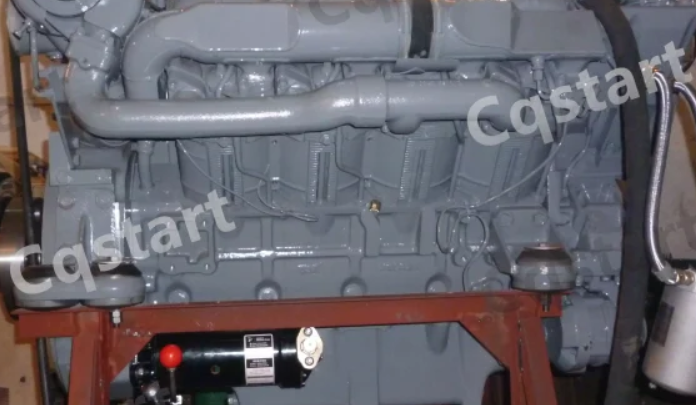
Core Working Principle of Mechanical Starter
The mechanical spring starter completely abandons electrical starting logic. Its core principle relies on pure mechanical energy storage. Operators use a hand crank or lever to convert human labor into mechanical energy, storing it at high intensity inside an internal spring mechanism.
When the engine needs to be started, simply pulling the release handle instantly unleashes massive rotational torque from the spring, directly driving the flywheel and allowing the diesel engine to successfully start within seconds.
Why Is Spring Starter the Ultimate Solution?
Zero Electricity Requirement: Completely eliminates the need for batteries, alternators, or any external power source. It operates normally even if the battery is 100% deeply discharged or completely removed.
All-Weather and Wilderness Ready: Unrestricted by cold weather, long-term storage self-discharge, or remote geographical environments.
Explosion-Proof and Harsh Environment Adaptability: Built on a pure mechanical structure, there is no risk of electrical sparks. It performs exceptionally reliably in high-humidity, flammable, explosive, and harsh environments such as oilfields and mines, making it the ultimate tool to guarantee autonomous self-rescue for critical equipment during extreme power outages.
Which Diesel Engines Are Suitable for Mechanical Spring Starters?
Mechanical spring starters have been widely deployed across multiple industries, including:
- Diesel generator sets
- Oilfield drilling equipment
- Fracking equipment
- Marine diesel engines
- Fire pump engines
- Mining equipment
- Construction machinery
- Military vehicles
- Emergency backup power systems
For equipment frequently operating in the field or lacking timely access to power support, it significantly enhances starting reliability.
Traditional Battery Start vs. Mechanical Spring Starter: Performance Comparison
| Comparison Dimension | Traditional Battery Start | Mechanical Spring Starter |
| Power Dependency | Highly dependent on batteries and circuitry | Completely independent of electricity |
| Extreme / Remote Environments | Heavily limited by temperature and battery charge; prone to failure | All-weather reliable, worry-free in the field |
| Explosion-Proof & Harsh Conditions | Risk of electrical sparks; heavily restricted | Pure mechanical structure; better suited for explosion-proof and high-humidity environments |
| Long-Term Storage Maintenance | Prone to natural discharge; requires regular maintenance | Ready at a moment’s notice; zero self-discharge anxiety |
| Emergency Backup Capability | Dependent on external rescue | Independent and autonomous; instant self-rescue |
How to Prevent and Comprehensively Enhance Equipment Reliability?
To minimize downtime risks caused by sudden battery failures, enterprises and equipment operators must not only perform meticulous daily maintenance but also build a robust “safety defense line” from a system perspective. The following core measures comprehensively enhance the reliability of diesel-powered equipment:
1. Conduct Regular, Comprehensive Battery Health Checks
Battery failure is often a progressive process. It is recommended to use a professional battery tester every 3 to 6 months to perform a thorough “health check” on equipment batteries:
Voltage and Internal Resistance Monitoring: Accurately measure static voltage and internal impedance. Abnormally elevated internal resistance usually predicts that the battery’s lifespan is nearing its end.
Cold Cranking Amps (CCA) Evaluation: Test its instantaneous discharge capacity under load. Once core metrics show a noticeable decline, preventive replacement should be carried out before it completely “goes on strike,” preventing minor issues from turning into major problems.
2. Keep Circuit Wiring Clean and Securely Fastened Daily
Battery terminals and posts exposed to outdoor or high-humidity environments for extended periods are highly prone to electrochemical corrosion, generating a layer of white oxide.
Deep Cleaning: Regularly use a dedicated wire brush and cleaner to remove rust and oxides from the terminals, and apply protective grease.
Fastening Inspection: Ensure all main power cables and grounding wires are securely connected with no looseness. This effectively eliminates high resistance caused by poor contact, ensuring that high currents are transmitted to the starter motor without loss during every ignition.
3. Establish a Scientific Periodic Charge-Discharge and Maintenance Plan
For equipment that normally remains idle or on standby (such as emergency diesel generator sets, fire pumps, and flood drainage pumps), a strict periodic management mechanism must be established:
Regular Operation: Mandate at least one trial run per month (with or without load), letting the engine run long enough for the alternator to adequately replenish the battery.
Install Smart Float Chargers: If equipment is stored indoors long-term or has access to grid power, installing a smart automatic float charger is recommended to ensure batteries remain fully charged and in a healthy “hot standby” state.

4. Install a Mechanical Spring Starter to Build an Ultimate Safety Backup
For critical emergency equipment tied to human safety or high economic value, such as fire pumps, lifeboats, remote deserts, or deep-sea offshore drilling platforms, relying solely on daily maintenance is still not enough to ensure 100% fail-safe operation.
Dual-Insurance Strategy: While retaining the original battery starting system, install a mechanical spring starter as an independent redundant backup solution.
Ultimate Peace of Mind in Extreme Environments: Even if batteries completely burst and fail, cables are accidentally burned, or equipment is stranded in extreme cold deserts or severe power-outage conditions, operators can completely break free from dependence on external power or rescue. Through pure physical hand-crank energy storage, they can achieve a “crank-and-go” start, ensuring core operations and equipment instantly regain power without fail during any emergency.
Summary
When a diesel engine battery dies, the most direct consequence is that the engine fails to start, the electronic control system loses power, and equipment is forced to shut down. For ordinary vehicles, problems can be resolved via jump-starts, battery replacements, or emergency booster packs; however, for critical industrial equipment such as oilfields, ships, mines, and generator sets, relying solely on batteries carries significant downtime risks.
Consequently, a growing number of enterprises are adopting mechanical spring starters as backup or even primary starting solutions. Requiring no batteries and no external power source, they enable diesel engines to start quickly even under extreme environments or total power loss, providing more reliable power protection for mission-critical equipment. If you are looking for reliable mechanical spring starter, Cqstart mechanical spring starter can be your best choice!