
Picture a cargo ship drifting without power at night. The engineer goes down to the emergency generator, reaches for the spring starter handle, and it barely moves. Salt has turned the grease to paste, and the last person to wind it left the company two years ago. A mechanical spring starter needs no battery and no air supply, so people assume it needs nothing at all. It does. Springs fatigue, grease hardens, gears wear. Here is what actually cuts its life short, and how to stop it.
What a Spring Starter Does
A mechanical spring starter is a wound spring with a gearbox. You wind it by hand, which stores your effort as spring energy, and releasing it dumps that energy into the engine flywheel in one burst until the engine fires. That’s the whole trick, and it is why the design turns up on lifeboats, emergency generators, fire pumps and ATEX sites: places where power may be gone exactly when you need to start an engine.
Some of those jobs are regulated. SOLAS expects an emergency generator’s starting arrangements to hold enough stored energy for repeated starts, and hand-operated mechanical starters are one accepted way to meet that. So a seized starter can mean a failed inspection as well as a dead generator.
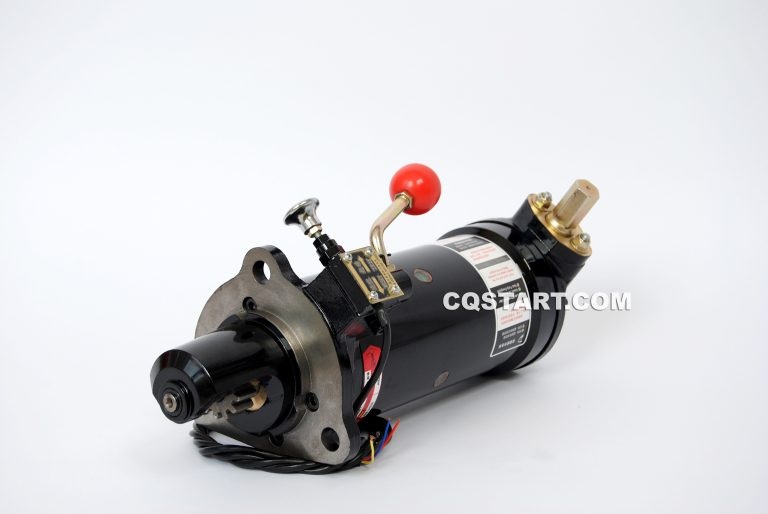
What Wears Mechanical Spring Starter Out
Nothing here is dramatic. It’s slow, cumulative damage.
The spring usually goes first. Every wind and release flexes the metal, and over thousands of cycles it stores a little less than it used to. Material quality decides how fast. Cqstart’s own durability testing shows about 8% energy loss after 5,000 cycles, which is a handy yardstick when you compare suppliers, though it was measured on a test bench, not in a damp engine room.
Next comes friction. The gears and pinion take a hard knock on every release, and rough surfaces or dried-out grease make it worse. Cqstart says its surface treatment cuts friction between parts by around 40%. The same logic holds for any unit: the less metal grinds on metal, the longer it lasts.
Then there is where it lives. Salt air, condensation, dust and big temperature swings all eat at a starter, and marine and oilfield installations get the worst of it. Last is how people treat it. Rushed winding and years of neglect do their damage in different ways, but both end with a unit that won’t turn the engine.
What Failing Looks Like
Starters usually warn you first. This table pairs the common symptoms with the place to look first.
| Symptom | Likely cause | Check first |
| Engine turns slowly or won’t start | Less stored energy, worn spring, poor engagement | Spring condition, pinion engagement |
| Winding feels stiff | Dried or dirty grease, corrosion | Grease condition, rust on moving parts |
| Jamming or poor engagement | Worn gear teeth, misalignment, debris | Pinion and ring gear teeth, mounting |
| Sticks after a long idle spell | Moisture and corrosion | Seals, covers, storage conditions |
If something feels off, stop and look before the next start. Forcing a worn unit tends to turn a small repair into a new purchase.
Habits that Keep Mechanical Spring Starter Working
Wind it the way the manual says
Smooth, steady winding within the stated limit for your model puts the least stress on the spring and ratchet. Skipping steps in the procedure is a quick way to damage a unit that was fine the day before.
Use the grease it was designed for
Check which lubricant the manufacturer specifies, and how much. The wrong grease can stiffen in the cold or run in the heat, and too much of it collects grit. Keep everything clean while you work.
Keep salt and damp away
Covers, intact seals and a quick wipe-down matter most near the sea. Rust tends to start where nobody looks, around fasteners and mounting points, so look there.
Inspect it, and write it down
A two-minute visual check catches loose bolts, rust, chipped teeth and grease leaks. Jot down the date and what you saw. A log shows slow changes that memory won’t.
Test-fire it on purpose
Standby equipment fails from neglect more often than from use. Fire protection already works this way: NFPA 25 calls for regular running tests of diesel fire pump drivers, and the same habit suits a spring starter. A drill is a far better time to find a problem than a blackout.
Store spares properly
Keep them dry and clean, at a steady temperature, away from condensation. A spare on a shelf ages too, so put it on the same inspection schedule as the installed units.
Replace small parts early
A worn tooth or a damaged part won’t heal on its own. Changing it on your schedule costs far less than a failed start at the wrong moment.
A Schedule You Can Copy
| When | What to do |
| Before each use | Look for damage, rust and grease leaks. Make sure the pinion and ring gear are clear. Follow the wind procedure. |
| Monthly or quarterly | Wipe down, check seals, covers, fasteners and mounts. Wind and release it once and note how it feels. |
| Yearly | Inspect gear and pinion teeth, check or renew the lubricant as the manual says, and read back through your log. |
Shorten the intervals for harsh sites, and defer to your manufacturer’s guidance where it differs.
Pick the Right Mechanical Spring Starter at the Start
Even perfect maintenance can’t save a starter that’s too small. If it runs near its limit on every start, it wears faster. Match the unit to the engine’s displacement, the space you have, the environment and how often it will be used.
Cqstart has built spring starters since 2008 and sorts its range by engine size, from the 7 Series for engines under 2L to the 0 Group System for engines up to 50L. Each unit is run on the company’s digital test bench, with torque, speed and conversion data recorded, and the factory holds ISO 9001:2015 certification. Not sure which model fits your engine? Send the specs and the team can point you to one.