
A diesel engine cranks and cranks but refuses to fire — the sound is strong, the battery seems fine, so most people assume it’s a fuel or glow plug problem. Often, it isn’t. The real issue is frequently far simpler: the starting system isn’t spinning the crankshaft fast enough to reach the RPM the engine actually needs to ignite. Let’s breaks down exactly what RPM a diesel engine needs to start, why that number is non-negotiable, and what causes cranking speed to fall short.
What RPM Does a Diesel Engine Need to Start?
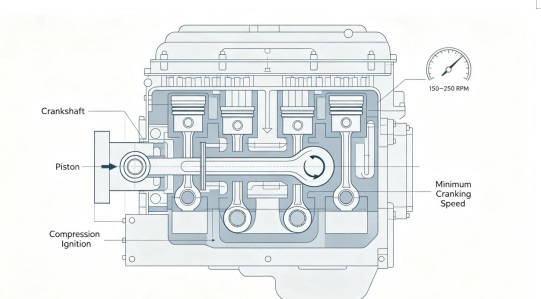
Most diesel engines have to be rotated between approximately 150 to 250 RPM before they start. However, there are certain technical sources stating an even larger range of 100 to 300 RPM, based on the engine’s design and size.This isn’t an arbitrary number — it’s the minimum cranking speed required for a diesel engine’s compression-ignition process to actually work, and falling short of it, even briefly, is enough to prevent a start entirely.
Why Diesel Engines Need a Minimum Cranking Speed to Start
In contrast to gasoline engines, diesel engines don’t have spark plugs to start the fuel and air mixture. It is instead reliant on compression. When the piston increases, it compresses air enough to raise the temperature over the autoignition point. Diesel fuel generally requires a temperature between 500 and 700 °F to ignite it, and the compression pressure being minimum 300psi generally as the minimum that is considered to be practical, particularly in temperatures that are cooler.
This is when the speed of cranking becomes crucial. If the crankshaft rotates too slowly, the heat that is generated through compression can escape into the cylinder’s walls during strokes, instead of accumulating sufficiently quickly to reach the ignition temperature. Cranking at the right RPM compresses the air quickly enough that heat builds up faster than it escapes — the entire mechanism depends on speed, not just pressure alone.
What Happens If Cranking RPM Is Too Low?
When cranking speed falls short of the threshold, the classic result is an engine that turns over persistently but never quite catches — or fires briefly on a lucky compression stroke before stalling again. This is precisely why low cranking RPM is so often misdiagnosed. The symptoms look almost identical to a fuel delivery problem or a failed glow plug, sending many owners and technicians chasing the wrong fix while the actual issue — insufficient rotational speed — goes unaddressed.
Factors That Affect Minimum Starting RPM
Engine Size and Compression Ratio
Higher compression ratios generally build ignition heat more efficiently per stroke, but larger displacement engines also demand more torque to reach the same RPM, since more air and more cylinders need to be compressed simultaneously.
Ambient Temperature
Cold weather is often the culprit behind starting failures. When the ambient temperature is low, the compressed air loses heat to the surrounding metal more quickly, it becomes harder to keep up with the ignition temperature. so the effective cranking speed needed goes up, just to reach ignition before the heat dissipates too much.
Battery Condition and Starter Torque
A weakened or partially discharged battery remains the most frequent real-world cause of insufficient cranking speed. Even a battery that reads “acceptable” at rest can sag significantly under the heavy current draw of starter motor operation, leaving the starter unable to spin the engine fast enough.
Engine Displacement
Large industrial, marine, or multi-cylinder diesel engines require sustained torque across more cylinders and greater rotational mass, making adequate starter torque — not just voltage — essential to reaching and holding the necessary RPM.
How Starting Systems Are Designed to Reach This RPM
A diesel engine’s starting system exists for exactly one purpose: to get the crankshaft to this minimum threshold reliably, every time. Electric starters are engineered to deliver enough torque to reach that RPM under normal conditions — but batteries degrade, cold weather saps chemical performance, and long periods of idle storage can quietly drain reserve capacity long before a failure becomes obvious.
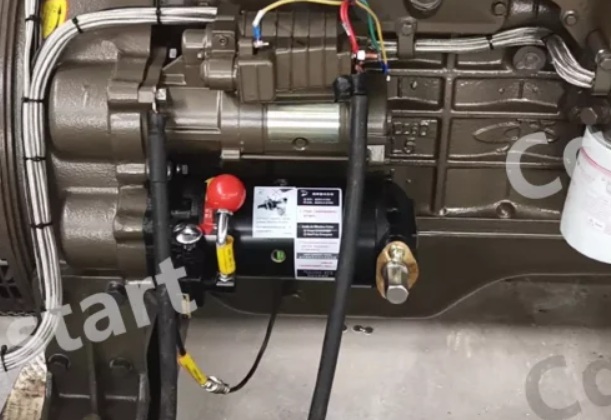
For engines where a failed start simply isn’t an acceptable outcome — marine vessels, military generators, emergency gensets, oilfield equipment — this is precisely why many operators pair electric starting with a mechanical backup. A mechanical spring starter stores manually wound energy independent of any battery, delivering the torque needed to reach starting RPM even when the electric system can’t, removing battery condition as a single point of failure for mission-critical engines.
How to Check If Your Diesel Engine Is Cranking Fast Enough
Before assuming a fuel or glow plug issue, it’s worth ruling out cranking speed first. Listen for a slow, labored cranking sound rather than a brisk, steady turnover — this is often the clearest audible sign of insufficient RPM. Check battery voltage under actual cranking load, not just at rest, since a battery can appear healthy until current draw exposes its real condition. Where possible, use a diagnostic tool or tachometer to measure actual cranking RPM directly, rather than relying on guesswork based on sound alone.
Most “won’t start” diesel problems get pointed at fuel or glow plugs, but too little cranking RPM is often the real culprit hiding under those same symptoms. For engines where a failed start has serious consequences, Cqstart’s mechanical spring starters provide a battery-independent way to reliably reach starting RPM, giving critical equipment a dependable backup when the electric system can’t get the job done.