
What causes a diesel motor to run away? A runaway diesel is a serious safety failure in which unregulated fuel sources enter combustion processes uncontrolled, exceeding engine design parameters and forcing engine speed beyond design limits. A runaway diesel can also occur if an engine breaks away from normal control of its fuel and draws in additional combustibles like oil or external gases that continue to burn due to compression ignition; ultimately it leads to both engine destruction and potential threats against people and equipment nearby.
So what are the seven most prevalent causes? After consulting field reports and maintenance logs, here they are. Acknowledging their existence puts you one step ahead in managing this arduous challenge.
What Is a Diesel Motor Runaway and Why Is It Dangerous?
Under normal operation, a diesel engine controls speed by regulating fuel delivery, not by choking off air. The injection system delivers precisely measured fuel, while the intake stays wide open. That gives the engine smooth power and quick shutdown when you cut the fuel.
But when an unexpected fuel source enters the cylinders, like engine oil pulled in through the intake, the balance breaks. The engine starts burning that oil as extra fuel, and it accelerates. As RPM rises, the intake airflow increases, sucking in even more oil mist. That creates a self-feeding cycle. Eventually, the RPM exceeds the design limits, and you get broken rods, burst cylinders, or a complete engine disintegration.
7 Common Causes of Diesel Motor Runaway
Knowing what causes a runaway diesel is the foundation for industrial maintenance and risk assessment. Below are the seven most frequent triggers we see in the field.
1. Turbocharger Seal Failure Allows Oil Into the Intake
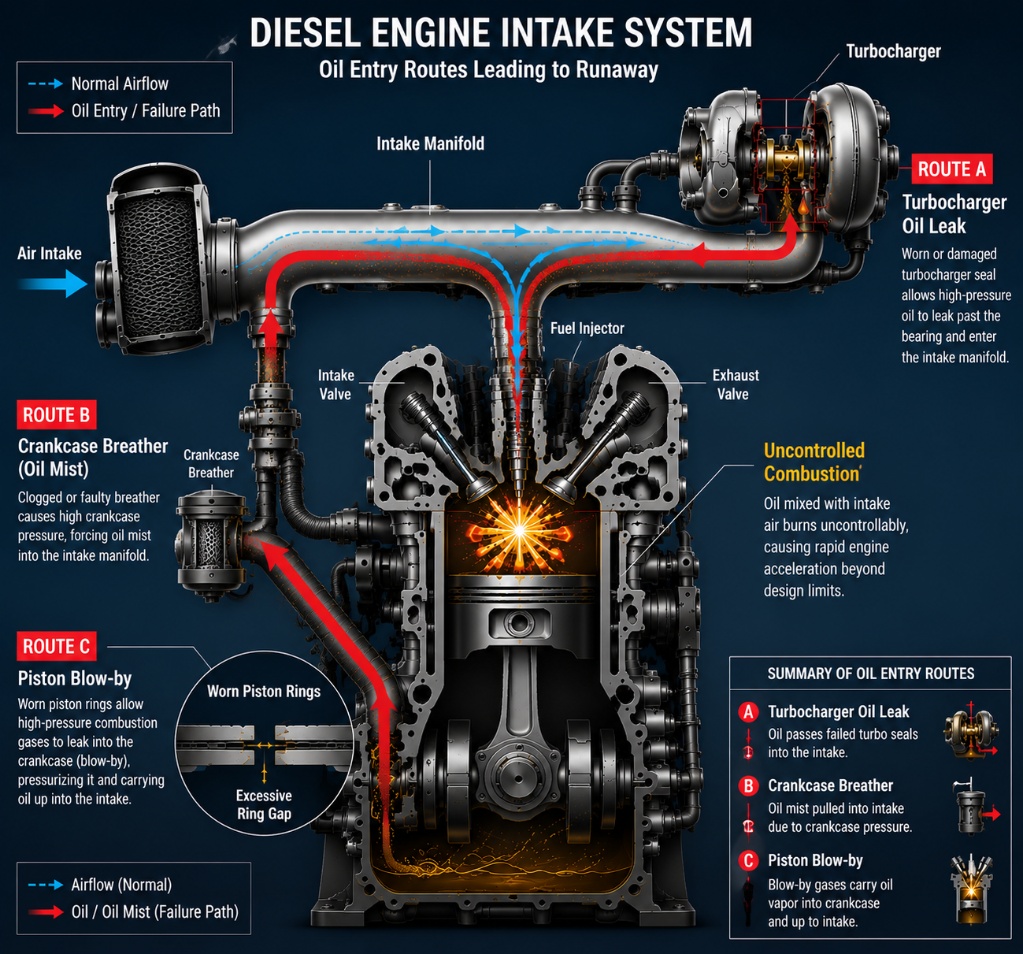
Turbocharger bearing seal failure is one of the leading causes. The turbo relies on pressurized oil for lubrication and cooling. When the shaft seal wears out, cracks from heat, or becomes brittle, pressurized oil leaks past the seal. The compressor wheel then throws that oil directly into the intake airstream. That oil vapor becomes an uncontrolled “second fuel” for the engine. The engine revs up, pulls more air, drags in more oil, and the cycle feeds on itself.
2. Faulty Crankcase Ventilation Systems and Oil Overfill
Overfilling the oil sump causes the crankshaft to churn the extra oil into a heavy mist. At the same time, if the crankcase ventilation system (breather system) is clogged or malfunctioning, pressure builds up inside the crankcase. That pressure forces the oil mist into the intake system. The engine starts consuming its own lubricant, and before you know it, you have a runaway feeding on its own sump.
3. Fuel Injector or Governor Failures
Mechanical issues in the fuel regulation system can also cause runaway. An injector nozzle might become lodged open, or its mechanical or electronic governor might stall at full fuel level, leading to an uninterrupted and uncontrolled supply of diesel to your cylinders, leading to overspeeding that you cannot stop with a key.
4. External Hydrocarbon Gas Leakage
Oilfields, chemical plants and mines often feature environments containing hydrocarbon gases like propane or methane that seep into the surrounding air. If a diesel engine inhales that mixture of gas-air mixture, it will continue burning it even after you turn off its diesel supply – making it almost impossible to stop its engine running due to all its surrounding vapors.
5. Internal Engine Wear and Excessive Blow-by
Worn cylinder liners and piston rings increase blow-by, forcing combustion gases past the rings into the crankcase, increasing crankcase pressure and pushing oil mist through breathers into intakes. Although this process begins slowly, if left unchecked it could escalate quickly into catastrophic overspeed.
6. Improper Engine Modifications or Fuel Settings
Unauthorized modifications, like cranking up the fuel pump limits or disabling factory speed governors, can overwhelm the engine’s control system. Also, operating equipment on slopes beyond the rated angle can allow oil to flow from the sump into the intake system. That pooled oil gets sucked in and triggers a runaway.
7. Ingestion of Contaminated Deposits
Engines that run for long periods at very low loads can accumulate oil and fuel deposits around the intake valves and manifold. When you suddenly apply a heavy load, the rush of intake air can rip those deposits loose and carry them into the cylinders as extra fuel. That causes a sudden RPM spike that catches operators off guard.
Diesel Engine Runaway Warning Signs You Should Never Ignore
In the seconds to minutes before catastrophic failure, you usually get clear early warning signals:
RPM Surge: Engine speed rises on its own with no load change or throttle input. Releasing the control does not bring it down.
Thick Smoke: Blue smoke from the exhaust means heavy oil burning. Black smoke means excess fuel detonation. Either is a bad sign.
No Throttle Response: No matter what action are taken by moving or pulling on the control lever or shutoff cable, engine speed will not decrease.
Unusual Screaming Noise: The turbocharger emits a high-pitched whine, and the whole engine shakes with violent mechanical vibration.
If you see any of these, treat it as an emergency. Do not wait.
How to Stop a Diesel Engine Runaway Safely (Emergency Steps)
In an industrial setting, your personal safety comes first. Do not attempt dangerous manual interventions.
Step 1: Activate Emergency Air Shutoff Valve (Overrun Valve)
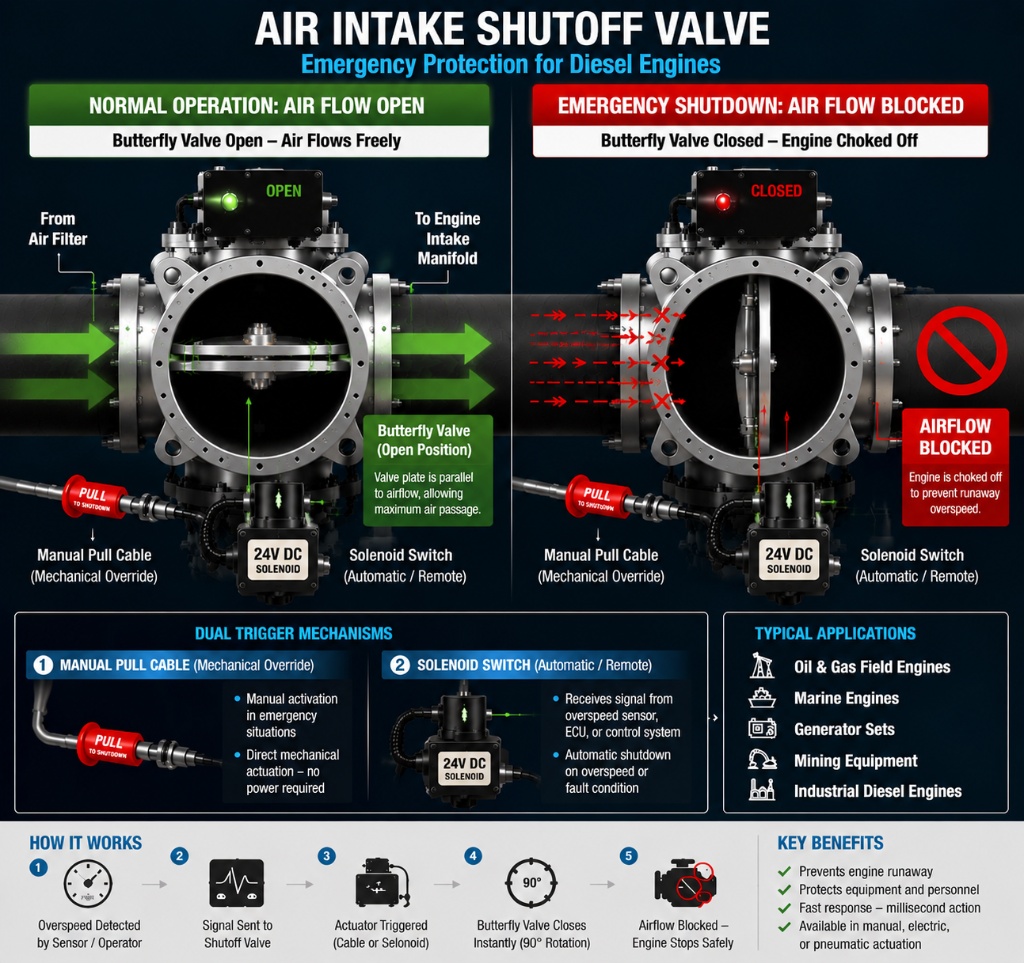
If your equipment features an emergency air shutoff valve or overspeed protection system, immediately activate either its manual cable or remote control switch to shut down its engine safely and immediately block its air supply. By doing this, an engine can be shutdown in a manner that does not compromise air supply to its engine.
Step 2: Stop Fuel Supply If Possible (With Limitations)
If you can reach the main fuel valve safely, shut it off. However, this won’t stop an engine that is burning oil or external hydrocarbon gases from going haywire; only cutting off its supply will have an effect. Only blocking the air will ensure it shuts down.
Step 3: Critical Danger Warning: What NOT to Do
To avoid injury, follow these safety prohibitions strictly:
Do NOT rely on the ignition key: It only cuts the electrical circuit. For a runaway running on oil, it does nothing.
Do NOT manually block intake without protection: The intake vacuum on a runaway engine is massive. It will suck your hand or clothing in, causing severe injury.
Do NOT spray water into the intake: Water does not compress. It will cause hydrolock, which can instantly crack the cylinder block and send fragments flying.
How to Prevent Diesel Engine Runaway in Industrial Applications
A systematic prevention plan is the foundation for avoiding runaway accidents.
Install Automatic Emergency Air Shutoff Valves
Installing an Air Intake Shutoff Valve into intake piping is widely recognized as an effective measure. The valve detects overspeed or abnormal signals and closes its butterfly flap quickly – instantly cutting off engine power and shutting it off.
Maintain Crankcase Ventilation and Turbocharger Health
Establish an effective maintenance schedule. Focus on regularly inspecting the breather system for blockages, turbocharger bearings and seals inspection, as well as regularly cleaning off oil residue from intake pipes.
Manage Low-Load Operations and Avoid Wet Stacking
Minimize prolonged idle or very low-load operation for diesel units. For standby generators, perform regular load bank tests. That not only uncovers hidden issues but also prevents unburned fuel mist from accumulating in the exhaust system (wet stacking).
How Industrial Diesel Engines Improve Safety After a Runaway Event
For high-risk industrial scenarios such as oilfields, offshore platforms, chemical transport, and mines, safety is a complete closed-loop system: Prevent → Detect → Shutdown → Restart.
Emergency Shutdown Is Only One Part of Diesel Engine Safety
After successfully stopping a runaway via the shutoff valve, the overall safety process is not over. After investigating the incident, clearing the fault, and confirming environmental safety, the equipment must be able to restart reliably. However, a runaway or emergency shutdown often comes with power system failures or escalated environmental risks.
Why Critical Diesel Engines Need Reliable Backup Starting Systems
In critical applications like oilfields, explosion-proof mining zones, emergency fire pumps, and marine lifeboats, restarting the diesel engine faces serious technical challenges:
Spark Risk: In hazardous industrial environments where flammable gases may be present, conventional electric starters can produce sparks that risk a secondary explosion.
Power/Battery Failure: During emergency response, batteries may fail due to high temperature, over-discharge, power outage, or simple aging.
Extreme Environment Limits: Severe cold, moisture, or long periods of inactivity can sharply reduce the reliability of electric starting systems.
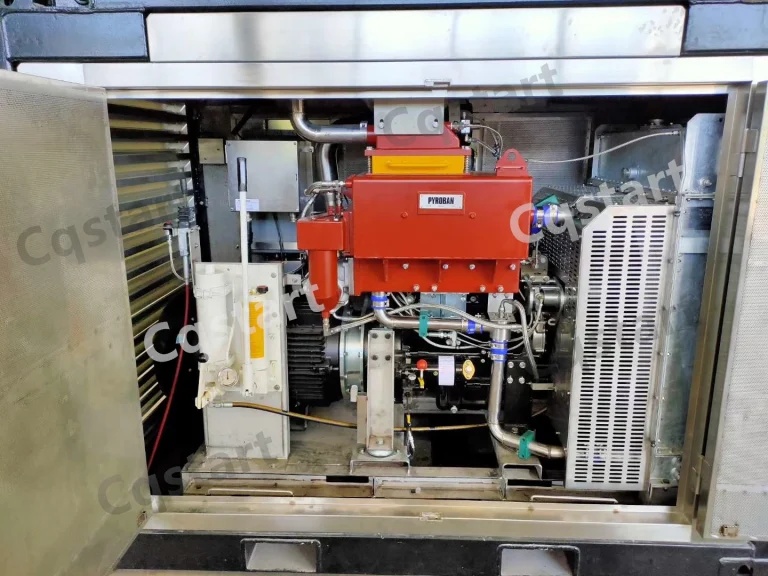
In these critical moments, a mechanical Spring Starter offers a reliable independent solution that is purely mechanical and needs no electricity.
Technical principle: A spring starter uses a manual crank handle to pre-tighten a high-strength internal spring. Releasing the spring releases mechanical energy to spin the diesel engine flywheel. It requires no electricity.
Explosion-proof and reliable: The entire starting process uses no battery, cables, or compressed air. There is zero spark risk, making it ideal for industrial environments that demand spark-free mechanical operation.
Safe restart application: After clearing a runaway fault or an emergency shutdown, maintenance personnel can simply pre-wind the spring with the crank handle and pull the release pin to achieve a highly reliable black start.
Need a Reliable Starting Solution for Critical Diesel Engines? For critical diesel engine applications where battery failure, power interruption, or hazardous environments are key considerations, a mechanical spring starter provides a completely independent starting solution.
Conclusion: What Causes a Diesel Motor to Run Away?
Deeply understanding what causes a diesel motor to run away, from turbocharger seal failure and crankcase ventilation issues to external gas ingestion, is the first step in building a safety system. Installing an intake shutoff valve and following routine maintenance can stop runaway at its source. And equipping a Cqstart mechanical spring starter gives industrial diesel engines a spark-free, externally independent restart solution after emergency shutdown.