
And you are looking at an air cooled diesel engine. Perhaps you have seen its specs or have made comparisons between models; whatever the case may be. Selecting the appropriate engine depends not only on horsepower output but also on where and how you will run it, how starting and maintenance are managed, as well as your willingness and experience in operating such an engine.
Let us walk together through it – without all the extraneous fluff – so we can focus on what truly matters.
What Is an Air Cooled Diesel Engine?
An air cooled diesel engine does exactly as its name implies – using air, not liquid, to dissipate heat from its combustion process. Instead of the traditional radiator/water pump/hoses setup, cooling fins and fan are used instead to direct outside air over its cylinder surfaces for better heat dissipation. That’s all it takes – simple yet robust yet impressively effective!
This design boasts several major advantages, with no radiator to leak and no coolant to freeze, making these engines perfect for applications ranging from agricultural pumps and portable generators to emergency gear and emergency shelter. They are often built for places with limited water sources or situations in which reliability matters over comfort.
Do not be misled by its apparent simplicity – selecting an ideal generator still takes some thought and consideration. Consider your power needs, environment and maintenance schedule before selecting your ideal model – most importantly how it will start when miles from an outlet!
How Does an Air Cooled Diesel Engine Work?
Consider it as two distinct processes occurring simultaneously inside a cylinder: diesel fuel is sprayed into it at high pressure, mixing with compressed hot air to ignite and pushes the piston down, creating mechanical power.
Outside the cylinder, a fan powered by the engine pulls in cool air via a shroud, while cooling fins increase surface area to carry away as much heat as possible. This prevents overheating and subsequent seizing up.
Balance between combustion on the inside and airflow on the outside is required for optimal operation of any facility. Both have to work perfectly.
Main Parts of an Air Cooled Diesel Engine
The beauty of this design is how compact it is. Every component serves a purpose, and there is not a lot of extra weight. No water pump. No radiator. No thermostat. That simplicity makes it easier to troubleshoot and cheaper to maintain. Let us break down the key parts you need to know.
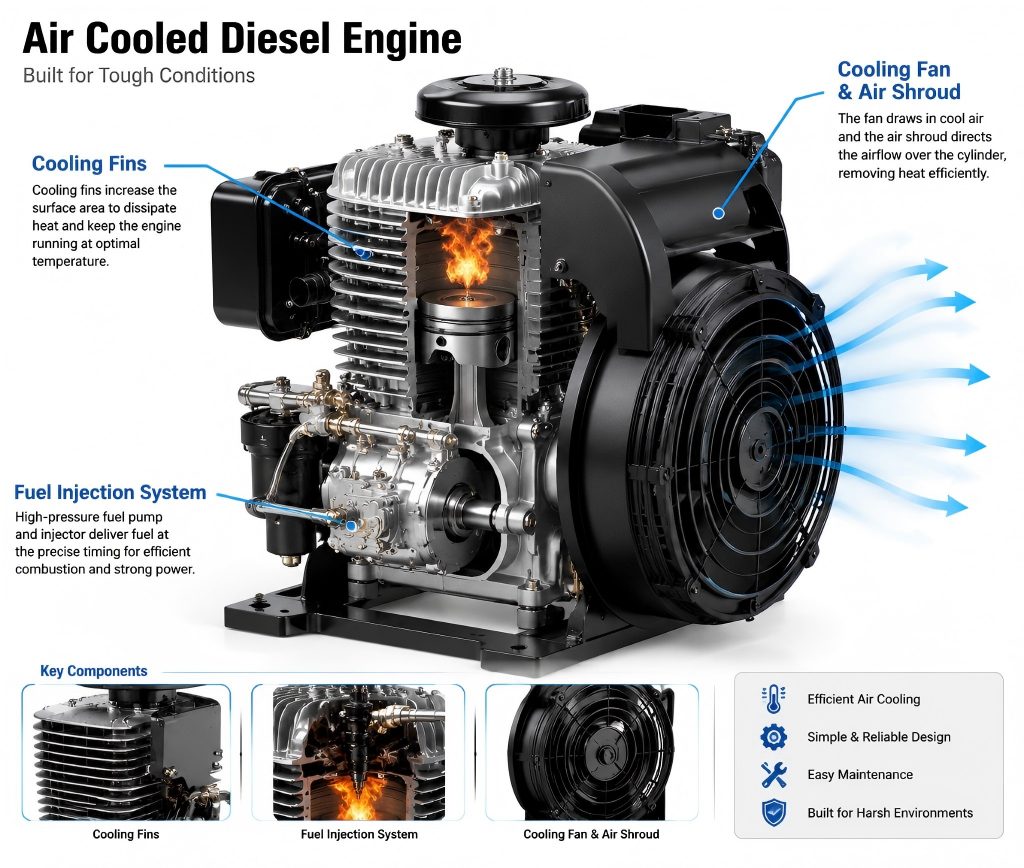
Cylinder and Cooling Fins
Take a look at the outside of the cylinder. Those metal ridges you see, those are the cooling fins. They multiply the surface area so the passing air can pull heat away faster. Without them, the heat from combustion would stay trapped in the cylinder walls. The piston would expand, scrape against the cylinder, and you would end up with a seized engine. Not fun. Not cheap.
Cooling Fan and Airflow System
The fan and shroud work together like a duct system. The fan, often mounted on the flywheel or belt pulley, spins as the engine runs. It creates a steady stream of air. The shroud channels that air so it hits the hottest spots, mainly the cylinder head and upper cylinder area. No wasted airflow. No hot spots left behind.
Fuel Injection System
This is where performance lives or dies. The injection system includes the high pressure pump, the injector nozzle, and the fuel filter. Clean fuel is non negotiable. A clogged filter or a dirty injector will mess up the spray pattern. Poor atomization means incomplete combustion. That costs you power and burns more fuel. Change the filter regularly. It is cheap insurance.
Starting System
This is the part that gets you from “off” to “running.” Depending on the model, you have options. Electric start is common. Recoil pull start is still around for smaller engines. And then there is the mechanical spring starter, which we will talk about more in a bit. The right choice depends on your site conditions and how much backup you need.
Advantages and Disadvantages of Air Cooled Diesel Engines
Every design has trade offs. Air cooled is no different. Let us be honest about what it does well and where it falls short.
Advantages
Simple construction, easier maintenance. No coolant levels to check. No water pump to fail. No thermostat to stick. Your daily checks are mostly oil and air filters.
No coolant leaks. You can forget about cracked radiators or loose hoses. That is a big deal for equipment that shakes a lot, like construction gear or farm implements.
Handles extreme climates. In freezing weather, there is no water to freeze and crack the block. In dry areas, you do not need a clean water source. Just air.
Lighter and more compact. No heavy radiator or gallons of coolant. That makes it easier to mount on mobile equipment or transport to remote sites.
Disadvantages
Heat dissipation has limits. Air cannot carry away heat as efficiently as liquid. That means if you are running at full load in 40°C weather, you might push the limits. That is why you rarely see huge air cooled engines.
Runs a bit hotter and louder. Without a water jacket to absorb sound and vibration, these engines can be noisier. The fan adds wind noise too. High heat also stresses the oil, so you need good quality lubricants.
Fins need cleaning. Dust, mud, grass clippings, they all clog the cooling fins. Once blocked, airflow drops and temperatures climb. It takes five minutes to blow them out, but you have to remember to do it.
Air Cooled Diesel Engine vs Water Cooled Diesel Engine
Which one is better? It depends. This comparison table lays it out clearly.
| Comparison Aspect | Air Cooled Diesel Engine | Water Cooled Diesel Engine |
| Cooling Medium | Ambient air blown over fins | Circulating coolant plus radiator |
| System Complexity | Very low: fan and shroud only | Higher: pump, radiator, thermostat, hoses |
| Cold/Dry Climate Performance | Excellent: no freezing, no water needed | Moderate: needs antifreeze, water supply |
| Maintenance Focus | Clean fins, change oil | Check coolant level, look for leaks, change antifreeze |
| Noise and Vibration | Generally higher | Lower, thanks to sound damping from water jacket |
| Typical Use Case | Mobile, remote, off grid equipment | Stationary, high power, climate controlled settings |
Where Are Air Cooled Diesel Engines Used?
These engines show up in places where reliability trumps everything else. Here are a few examples.
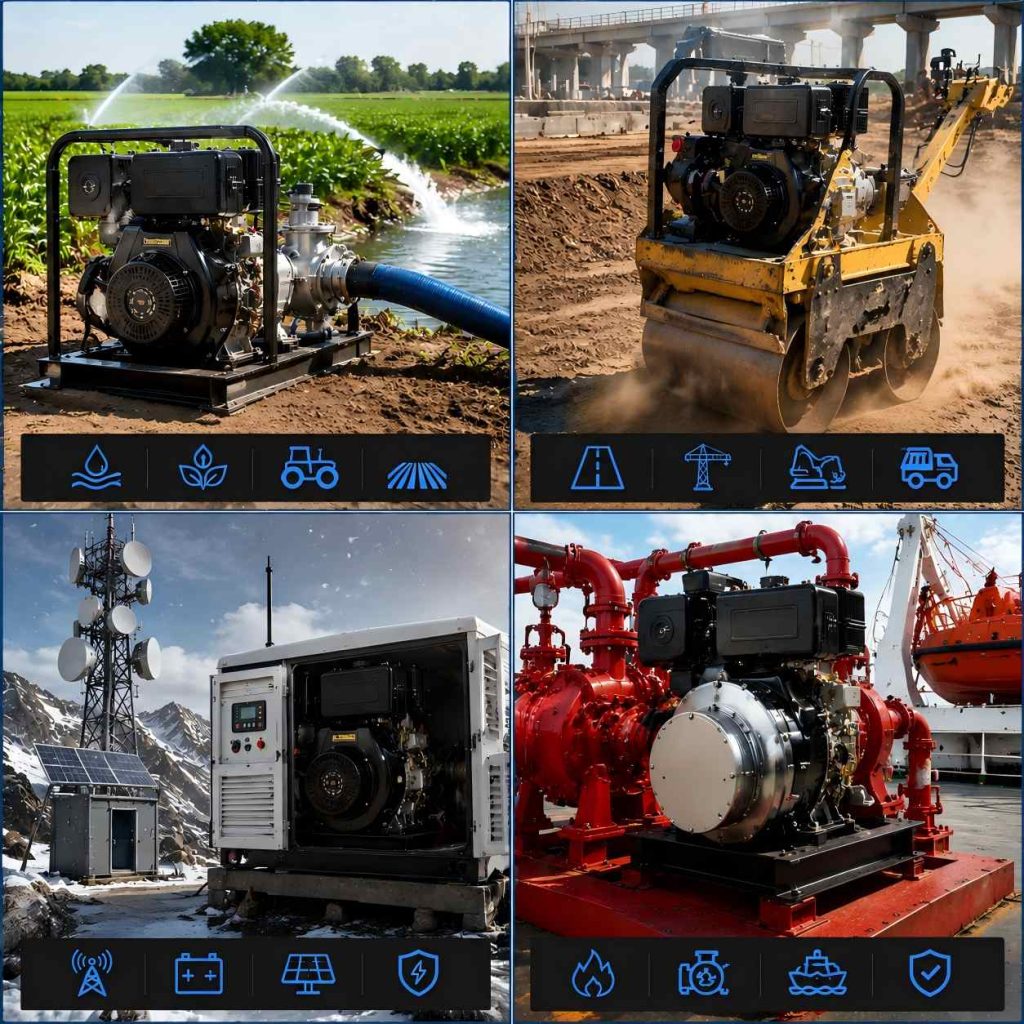
Agricultural Applications
Irrigation pumps, drainage pumps, portable sprayers. You can drag them to a pond, fire them up, and get to work. No need to haul water for cooling.
Construction Equipment
Rollers, rammers, small compressors. Construction sites are rough. Dust and vibration are everywhere. Air cooled engines hold up better without a radiator to crack.
Industrial Applications
Mine ventilation fans, pressure washers, portable welding generators. In remote industrial settings, simple maintenance is a lifesaver.
Remote Power Generation
Cell towers, survey stations, off grid cabins. Generators need to start on demand, even if nobody has checked them in months. Air cooled is a solid choice here.
Emergency Equipment
Lifeboats, fire pumps, backup gensets. When lives are on the line, you do not want to worry about coolant levels. Mechanical simplicity wins.
How to Choose the Right Air Cooled Diesel Engine: 7 Key Factors
Okay, this is the part where we get into the details. These seven factors will help you narrow down your options and avoid expensive mistakes.
1. Power Output and Load Capacity
Do not size it right at the limit. Whatever load you have, add 15% to 20% margin. Running at 100% capacity all day shortens the engine’s life. A little extra headroom keeps temperatures down and reliability up.
2. Operating Environment (Temperature and Altitude)
Both heat and altitude reduce power output. High temperatures thin the air. High altitude does the same. You may need a larger displacement engine to compensate. Check the derating curves before you buy.
3. Duty Cycle and Application Type
Is this your primary power source, running 24/7? Or is it standby, only kicking in during outages? Continuous duty engines need better cooling fan designs and heavier duty components. Standby units can be lighter spec.
4. Physical Dimensions and Weight Limitations
Measure your mounting space. Check the airflow clearances. Air cooled engines need plenty of room for intake and exhaust air. If you box them in, they overheat.
5. Maintenance Accessibility
Look at where the oil filter, fuel filter, and cooling fins are. Can you reach them easily? Are they covered by other components? In dusty jobsites, you will clean those fins often. Make it simple on yourself.
6. Noise and Emission Standards
Check local regulations. Urban sites or indoor use may require additional silencers. Some areas mandate Tier 4 or Stage V emission compliance. Know the rules before you order.
7. Evaluate Starting Requirements
This one is a big deal. Let us break it down.
Battery availability: Is there a charger nearby? Will the battery stay topped off during long idle periods?
Standby duration: Will the engine sit unused for weeks or months?
Ambient temperature: Extreme cold or heat kills battery performance.
Maintenance access: Is there someone to check the battery regularly?
For remote, unattended, or emergency sites, do not rely on electric start alone. Have a backup plan.
How Starting Systems Affect Air Cooled Diesel Engine Reliability
You can have the most bulletproof engine ever built. But if you cannot start it, it is just an expensive paperweight. This is especially true for equipment in remote locations.
The Hidden Risk of Battery Failure in Remote Areas
Here is what happens. You install a generator at a mountain site or a backup unit at a farm. The battery sits there for three months. Self discharge drains it. Winter drops the voltage. Summer heat cooks the electrolyte. When you need it, the starter just clicks.
It is a common failure point. And it is totally avoidable.
Mechanical Spring Starters as a Dependable Backup Solution
This is where the Mechanical Spring Starter comes in. It is a pure mechanical device. No wires. No battery. No compressed air. You wind it up with a hand crank, then hit the release. The stored energy spins the engine fast enough to start. Simple, effective, and proven.
For applications where power is unreliable or the site is truly remote, a spring starter is peace of mind. It gives you a fighting chance to get running when the battery lets you down.
Check out this solution if you are designing or operating equipment in tough conditions. Cqstart offers mechanical spring starters for a wide range of industrial diesel engines. They help operators improve starting reliability in harsh environments.
Conclusion
Air cooled diesel engines are highly resilient and self-reliant engines designed for remote or demanding applications, without relying on radiators and coolants for cooling. Their design keeps things simple and adaptable compared to radiator-cooled engines; however, you still must match it to your power requirements, climate requirements, maintenance plan, and ensure how you will start it when the grid goes down or batteries die. Get those factors right, and you will have a power source that delivers when it counts.