
For facility managers in industrial facilities as well as maintenance engineers, the capability to begin a vital engine without the use of electric power isn’t just an option for convenience, it’s a requirement for the continuity of operations. Although the hand crank has been an essential part of the workplace, demands from industry for security and reliability have changed the focus towards more advanced options. Knowing the differences between traditional hand cranks and mechanical engine starter is essential to improving the performance of your equipment and ensuring safety of your employees and ensuring that your equipment is ready even in harsh or remote conditions.
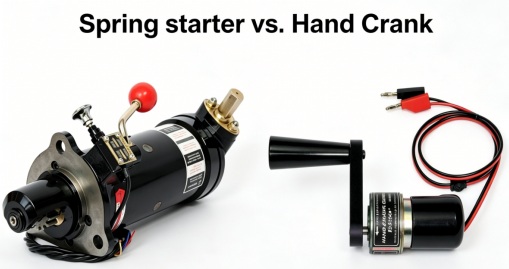
The Traditional Hand Crank: Understanding the Limitations
Hand cranks have served as a basic mechanical means of starting for a long time operating on a basic concept: the power of human muscles generates the necessary torque to spin the crankshaft of the engine until the engine starts to burn. Although the mechanism is incredibly simple, its use in the modern industrial setting reveals some flaws.
The main problem is the safety. Hand cranking is a serious danger in the form of “kickback,” where the engine’s premature firing causes it to turn quickly, posing the risk of serious injury to the user. In addition, the physical force required to crank high compression diesel engines is a lot which can lead to fatigue of the operator and inconsistent start speeds. In cold weather or when dealing with engines that have larger displacements the hand crank frequently is not enough and the engine is left in a state of utter immobility when it is most needed.
Mechanical Spring Starters: A Modern Safety Paradigm
Contrary to the manual effort of hand cranking mechanical spring starters uses an energy storage mechanism to give a steady and powerful surge of torque. The user cranks an internal spring, either via the hand-held crank or through an integrated lever–that holds potential energy in this high strength mechanism. If the trigger gets depressed the energy is instantly transferred into the motor flywheel.The benefits of this method are significant in industrial applications:
- Total Safety: The system eliminates all kickback risk by separating the user from the engine’s inertial rotation.
- Operational independence: They need no electricity hydraulic pressure, pneumatic air. This makes them the standard for remote mining platforms, offshore sites or backup systems for emergencies.
- Consistent Performance: Since the starter is pre-calculated to provide a precise performance profile of torque, engine’s rate remains constant regardless of an operator’s physical strength or the environmental conditions.
Traditional vs. Spring-Based Systems
In evaluating the efficiency and security of your equipment, the distinctions between these two methods are evident. The table below outlines the actualities of using either of these two methods:
| Feature | Hand Crank | Mechanical Spring Starter |
| Safety Level | Low; high risk of kickback | High; kickback-free design |
| Operator Effort | Extremely high; physically demanding | Low; mechanical assist |
| Starting Reliability | Unreliable; depends on operator | High; consistent energy release |
| Environment | Limited by user fatigue | Highly robust; all-weather |
| Operational Goal | Simple, cost-effective | Safety, speed, and reliability |
As illustrated by this comparison, moving from manual hand cranking to an engineered spring-based manual engine starter represents a major shift from reactive maintenance to proactive operational security.
Why Choosing the Right Starter Impacts Your Bottom Line
for those operating standby generators and fire pump engines and other construction machinery failure to start is more than a hassle; it can be a financial risk. In emergency situations delays of just an hour can cause catastrophic damage to equipment or even system shutdown.
When you invest in a top-quality spring starter, you’re not just purchasing a piece of equipment but you’re securing the reliability of your operation. While the initial cost is greater than the hand crank that is standard but the investment’s return is realized through lower cost of insurance for work safety, less chance of injuries to operators as well as the reduction of the downtime that is caused by failed starting attempts.
The ESG and Safety Imperative
Modern industrial standards focus on Environmental Social as well as Governance (ESG) standards as well as “Social” goals emphasizing workplace safety and protection of employees. Relying on hand-cranking at a modern workplace or factory is considered to be an outdated and risky practice.
The upgrade to a modern mechanical starter shows an investment in employee wellbeing by eliminating a potentially hazardous job from the maintenance workflow. If your business is running on technology that is designed to meet the latest standards, you enhance the overall safety profile of your business which is vital to keeping skilled workers and maintaining the strict industrial safety standards.
Transform Your Emergency Readiness
The decision to shift away from manual cranking is an important step towards a more robust and professional process. It doesn’t matter if you’re trying to reduce the chance of injuries to your operator, or ensure that the engine is running in the harshest climates or simply increase the efficiency in your spare equipment mechanical spring starters offer the required performance.
If you treat your emergency start system as a vital infrastructure asset instead of simply a tool to be used it allows your site to be more stable. Don’t allow outdated methods of cranking hinder your facility’s effectiveness or put your employees at risk. Visit Cqstart to discover the latest in professional-grade solutions for starting and make sure that the equipment you use is up and running regardless of the weather conditions. The road to a more secure efficient, stable industrial operation starts by utilizing the correct technology.
Reason 8. Sticky Governor & Fuel Control Rack
The mechanical governor of a lifeboat diesel engine contains a complex arrangement of flyweights and linkages. Due to long-term exposure to humid air and a lack of frequent operation, the internal fuel control rack can easily seize in the “Stop” position due to oil sludge or minor rust, preventing the injectors from delivering fuel during startup.
Symptom: The motor cranks frantically and the fuel lines are clear of air, but the injectors do not spray.
Emergency Action: Remove the side protective cover of the engine, spray WD-40 or a penetrating lubricant generously onto the linkages, and manually cycle them back and forth until the rack moves smoothly and springs back freely.