
In modern industrial equipment, electric starting systems have become the standard configuration for engine ignition. However, in specific heavy-duty or critical applications, battery degradation, electrical failures, or hazardous environments can render traditional electric starting systems useless. In these scenarios, non-electric engine starting technologies emerge as the vital solution to guarantee reliable equipment operation.
Whether deployed in fire pumps, emergency generators, marine vessels, oil and gas platforms, or mining machinery, non-electric starting systems play an irreplaceable role. This article provides a comprehensive overview of non-electric engine starting, explores the most common methods along with their pros and cons, and guides you on how to select the optimal starting solution for your equipment.
What is Non-Electric Engine Starting?
Non-Electric Engine Starting can be explained as the process of cranking the internal combustion engine and starting the engine without utilizing any battery power source, electrical energy, or power from external electrical sources.
Unlike conventional engine starting systems, which require an auxiliary battery source that supplies current to the electric motor, which starts the engine via its flywheel, non-electrical starting systems make use of other energy sources. These sources include mechanical, compressed air, or hydraulic energy to start the engine by directly engaging its flywheel.
Non-electrical engine starting systems are essential for critical equipment applications as the systems act as both the main starting system and the ultimate backup source.
Why More Industries are Turning to Non-Electric Systems
In modern heavy industries and emergency response sectors, non-electric starting systems are rapidly replacing or supplementing traditional battery-driven setups. This shift is driven by four core advantages:
1. Maximizing Equipment Reliability
In critical industrial assets, battery failure is the number one culprit behind an engine’s failure to start.
The Vulnerability of Electric Systems: Long periods of idleness lead to battery self-discharge, poor maintenance causes a drop in electrical conductivity, and fragile wiring harnesses can break due to severe equipment vibration—instantly paralyzing the system.
The Non-Electric Advantage: Accumulators, air tanks, and mechanical springs possess a virtually infinite physical shelf life. Because they do not rely on chemical reactions inside a battery, the risk of power loss is completely eliminated. For life-safety facilities like fire pumps and emergency backup generators, non-electric starting delivers absolute certainty.
2. Engineered for Hazardous Explosive Zones
In oil and gas extraction, refineries, underground mining, and dust-heavy chemical environments, safety compliance is paramount to operational continuity.
Eliminating Ignition Sources: Relays, short circuits, or motor arcing found in traditional electric starting systems present catastrophic ignition hazards in environments filled with flammable gases (like methane or volatile vapors).
Intrinsic Safety: Non-electric starting systems operate through pure physical energy (hydraulic or air pressure). When paired with non-sparking pinions made of beryllium copper or aluminum bronze, these systems effortlessly comply with stringent international explosion-proof standards, such as ATEX, IECEx, or Class 1, Div
3. Resilience to Extreme Environments
Extreme temperatures are the natural enemy of chemical batteries, but they have virtually no effect on non-electric starting systems.
Breaking the Cold-Start Curse: When ambient temperatures drop below -20°C, the discharge efficiency of traditional lead-acid batteries plummets by over 50%, often leading to ignition failure due to insufficient Cold Cranking Amps (CCA).
All-Weather Stable Output: Whether it is a hydraulic accumulator or a mechanical spring starter, physical energy release characteristics are unaffected by external temperatures. On sub-zero arctic mining sites (e.g., Siberia, Canadian oil fields) or scorching desert drilling rigs, these systems consistently deliver full high breakaway torque.
4. Meeting Critical “Black Start” Requirements
In the design of critical infrastructure, Dual Starting Systems have become an industry mandate.
The Gold Standard Configuration: Systems are typically designed with an electric starter for routine daily operations, while utilizing a hydraulic or mechanical spring starter as the ultimate redundant backup.
Zero-Power Black Start Capability: In the event of an earthquake, typhoon, or catastrophic grid blackout where primary power grids and batteries are completely dead, operators require no external power. Using just a hand pump or a manual winding crank, they can physically “wake up” giant diesel engines within minutes, restoring the final line of emergency power.
Common Types of Non-Electric Engine Starting Systems
To reliably crank an engine without electricity, modern industrial engineering utilizes three primary mature technical routes: Mechanical Spring Starters, Hydraulic Starting Systems, and Air Starters. Each caters to different displacement scales and application environments.
1. Mechanical Spring Starters
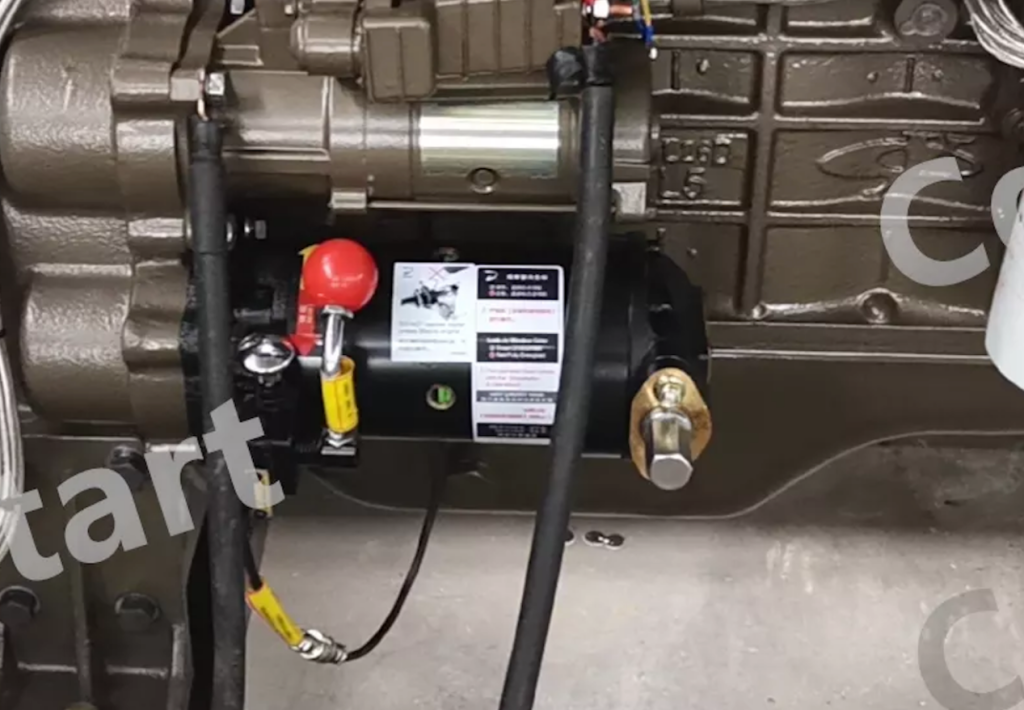
A mechanical spring starter is a completely self-contained, purely mechanical solution that uses stored physical energy to start an engine.
How it works: An operator uses a manual winding crank to compress high-strength disc or Belleville springs inside the starter casing, locking the energy in place. Upon activation, a trip mechanism instantly releases all the stored energy within milliseconds, driving the pinion to rotate the engine flywheel and initiate ignition.
Key Benefits: It is 100% independent. It requires no batteries, compressed air lines, or hydraulic hoses, maintaining extreme reliability in the harshest environments. Featuring a simple structure, compact footprint, and low maintenance costs, it is the quintessential “permanently ready” solution.
Power Capacity: While traditionally limited to smaller engines (typically under 18L), recent technological advancements by specialized manufacturers, such as Cqstart, have expanded their mechanical spring starter capacity to cover a massive range, spanning from under 2L up to a maximum of 50L diesel engines.
Typical Applications: Fire pumps, marine lifeboats, small-to-medium diesel generators, agricultural machinery, and construction equipment.
2. Hydraulic Starting Systems
A hydraulic starting system is essentially a closed-loop energy storage and release network.
How it works: Hydraulic fluid is pumped into an accumulator using a manual hand pump, an electric pump, or an engine-driven recharge pump. As the fluid enters, it compresses a pre-charged bladder of nitrogen gas to store energy, typically reaching high-pressure levels of up to 3,000 psi (approx. 210 bar). Upon starting, the high-pressure oil is instantly released into a hydraulic starter motor, which rapidly cranks the engine flywheel.
Key Benefits: It provides the highest initial breakaway torque among all non-electric methods and allows for multiple consecutive start attempts. Crucially, it offers superior “black start” capabilities; even if plant power is entirely lost and compressed air is depleted, operators can manually build pressure via the hand pump to crank massive diesel engines (even those with displacements exceeding 100 liters).
Typical Applications: Fracking pump trucks, offshore drilling rig emergency generators, ocean-going vessel main/auxiliary engines, and heavy-duty mining equipment.
3. Air Starters
Air starting systems utilize compressed air (or gas) as their driving medium to spin vane-type or turbine-type air motors.
How it works: The system draws high-pressure air directly from a plant’s compressed air network or dedicated air storage tanks, usually operating at pressures between 90–150 psi (approx. 6–10 bar). When triggered, the rapid expansion of high-pressure air through the air motor generates instantaneous high rotational speeds, swiftly bringing the engine up to its ignition RPM.
Key Benefits: These systems offer an exceptionally high power-to-weight ratio and are naturally suited for explosion-proof environments as they carry zero risk of electrical sparking. However, they depend on a steady supply of compressed air, requiring a reliable upstream compressor or adequately sized storage tanks.
Typical Applications: Gas turbines, large stationary power generation sets, and industrial facilities with existing compressed air infrastructure.
Comparison Summary of 3 Types of Non Electric Starting System
| Technical Feature | Hydraulic Starting System | airAir Starter | Spring Starter |
| Energy Source | High-pressure hydraulic oil + Nitrogen | Compressed air / Natural gas | High-strength mechanical spring |
| Torque Output | Extremely High (200+ ft-lbs) | High | Medium |
| Manual Black Start | Supported (via manual hand pump) | Dependent on pre-stored air in the tank | 100% Independent (via manual crank handle) |
| Optimal Engine Displacement | Medium to Ultra-Large (up to 100L+) | Medium to Large | Small to Medium (Under 2L up to 50L) |
| Explosion-Proof Suitability | Extremely High (ATEX/IECEx core recommendation) | High (Must manage exhaust noise & icing) | Extremely High (Zero risk of external media leaks) |
Target Industries for Non-Electric Starting Technologies
Non-electric engine starting systems are widely adopted in industries where operational uptime is non-negotiable, power grids are unreliable, or hazardous conditions exist.
Fire Protection Systems:
Fire pumps must start instantly during emergencies. Even if the facility’s main electrical grid fails or the starter battery dies, the pumps must run. Mechanical spring starters are heavily favored here as an ironclad backup to electric starters.
Power Generation:
Emergency diesel generators provide power generation when power supply is cut off. In order to prevent batteries that would otherwise degrade and lead to complete system failure, modern gensets have integrated non-electrical starting systems for added redundancy.
Marine/Offshore:
Ships work in isolated and dangerous settings where failure in the engine leads to the loss of complete control. In order to protect against rough weather conditions and in case of complete loss of power, the ship relies on non-electrical starters for life boat engines, emergency auxiliary gen sets, and thrusters.

Oil & Gas Industry:
Drilling sites and refineries are located in isolated regions that pose a huge hazard due to highly volatile atmosphere and explosion risks. For these reasons, use of non-electrical systems is imperative to ensure safety and avoid electrical arcs.
Mining Industry:
Miners work in isolated regions where harsh conditions such as dusty environments and high vibration levels pose a danger. Simple, robust and durable non-electrical systems offer protection to miners in harsh conditions as compared to electrical systems.
How to Select the Right Non-Electric Engine Starting Solution
Selecting a Non-Electric Engine Starting system requires a comprehensive evaluation of engine parameters, on-site conditions, and safety level requirements. The optimal solution varies depending on the specific application scenario.
Engine Power
Engine power directly determines the required starting torque. Generally, higher power demands greater torque output from the starting system.
Small to Medium Displacement Diesel Engines: Mechanical spring starters are typically sufficient, offering the advantages of a simple structure and low cost.
Large Displacement or High Compression Ratio Engines: Air (pneumatic) or hydraulic starting systems are more commonly used to provide stronger starting capability and a more stable starting process.
Installation Environment
Access to auxiliary energy sources is another important consideration while selecting the start-up method.
No Existing Utility: In cases where the site does not have a compressed air source or hydraulic power pack available, a mechanical spring-type start-up will prove to be more direct and reliable since there is no dependency on any external source of energy.
Existing Utility: On the other hand, if the facility already has the facility for compressed air or hydraulic systems installed, it is preferable to opt for air or hydraulic starters.
Safety Requirements
In hazardous areas such as oil, gas, and chemical industries, the engine starting system must eliminate safety risks associated with electrical sparks or electrical failures.
While non-electric starting systems naturally inherently possess this advantage, air and hydraulic systems are widely used in explosion-proof environments. Mechanical spring starters, being completely free of electrical components, are also frequently deployed in emergency equipment with stringent safety requirements.
Maintenance Costs
Long-term maintenance cost is another key consideration during selection.
Spring Starters: Feature a relatively simple structure with fewer components, resulting in low maintenance frequency and low long-term operating costs.
Air and Hydraulic Systems: Although they offer higher output capabilities, their system architectures are more complex, demanding higher maintenance for pipelines, seals, and auxiliary equipment.
Summary
Non-Electric Engine Starting System is much more than an alternative means of engine starting; it is a safety precaution that ensures that there will always be efficient functioning of important equipment. In situations where some machines have to function without electrical power for long periods of time, the selection of an appropriate non-electric starting system becomes very important for ensuring that such machines work effectively and safely.
Amongst the various non-electric starter options currently available, the spring starter appears to be one of the more popular means of starting fire pumps, diesel engines, marine equipment, and industrial power stations because of its simplicity, reliability, energy independence, and cost-effectiveness. As far as the improvement of engine starting efficiency is concerned, the spring starter technology can definitely pay off in the long term.