
In the design of emergency generator sets (Gensets) for marine contingencies, mining operations, oil and gas field activities, and hazardous explosion-proof areas, Mission-Critical Reliability always comes first. However, many engineers often encounter a frustrating blind spot during system integration or international project delivery: at the critical moment, the diesel engine fails to fire up and start successfully.
On the surface, this may look like an underpowered starter motor. From the underlying physics of mechanical engineering, however, the root cause is that the energy output by the starting system fails to meet the Minimum Starting Torque required by that specific diesel engine under its particular environmental conditions.
In this post, we will provide an in-depth analysis of the underlying physical characteristics of diesel engine starting torque, the critical variables that affect it, and a comparison of the torque release curves of different starting technologies. It aims to help you lock in the most reliable “black start” solution right at the initial phase of project design.
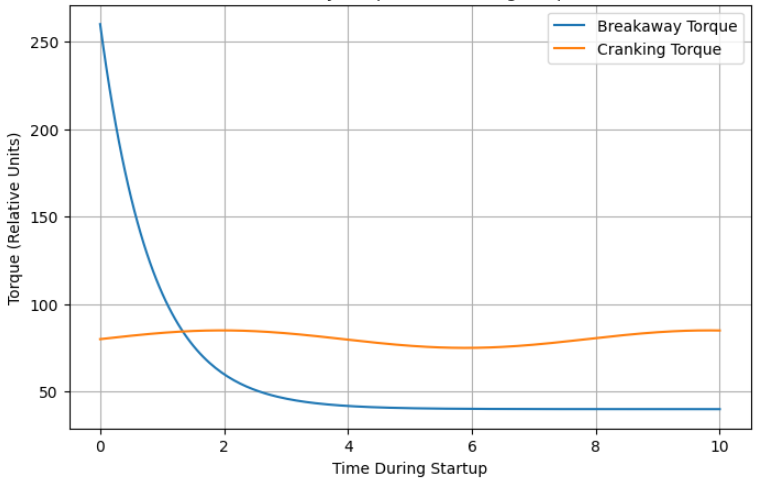
Differences: Breakaway Torque vs Cranking Torque
To accurately evaluate whether a starting system is up to par, starting torque cannot be viewed as a static average value. Within a complete starting cycle, a diesel engine must overcome two distinctly different types of resistance:
Breakaway Torque
This refers to the instantaneous, ultra-high torque required to push the engine from a completely stationary state into its very first rotation. At this moment, the interface between the cylinder walls and the piston rings is in a state of dry friction or boundary lubrication.
Lacking the support of a hydrodynamic oil film, static mechanical resistance reaches its peak. The starter must possess exceptional “instantaneous explosive power” to break through this barrier.
Cranking Torque
Once the engine begins to rotate, the resistance drops slightly. The torque required here is primarily used to overcome the alternating compression stroke resistance across individual cylinders, as well as the viscous shear resistance of the engine oil at higher rotational speeds.
The starting system must sustain this torque until the engine reaches its minimum ignition auto-reception speed (typically 100–150 RPM).
Core Conclusion: Diesel engine startup is not a gradual, smooth process, but a “make-or-break battle” to overcome static friction and maximum compression resistance within the first few revolutions. If the starter fails to deliver sufficient Breakaway Torque within the first 500 milliseconds, the engine will jam at Top Dead Center (TDC).
4 Key Factors Driving Higher Starting Torque Demand
In practical industrial applications, the required starting torque for a diesel engine is not a fixed number. The following four variables can cause torque demand to surge exponentially:
Factor 1. Engine Displacement and Compression Ratio:
Diesel engines rely on high-pressure compression ignition, with compression ratios typically as high as 15:1 or even 22:1. The larger the displacement and cylinder bore, the greater the torque required for the piston stroke to combat air compression. For medium-to-large diesel engines (e.g., more than 6 cylinders, displacement greater than 10L), the required starting torque often reaches several thousand Newton-meters (Nm). From a theoretical formula perspective, the cranking resistance torque is proportional to the maximum cylinder pressure and total displacement:
Ambient Temperature and Oil Viscosity:
This is the most common culprit behind the startup failure of outdoor emergency equipment. When the ambient temperature drops below 0°C or even down to -20°C, the kinematic viscosity of the engine oil skyrockets. Thick, dense oil acts like glue, binding the crankshaft and bearing bushes, causing the system’s Breakaway Torque demand to surge by 2 to 3 times.
External Parasitic Loads:
In B2B industrial scenarios, diesel engines are often directly coupled to gearboxes, large hydraulic pumps, or high-power generator excitation systems via couplings. These external devices also present static resistance during startup, and these “parasitic loads” superimpose directly onto the starting torque demand of the engine block itself.
Prolonged Storage and Dry Friction:
Emergency gensets or lifeboat engines may remain idle for months. Over time, gravity pulls the oil on the crankshaft surfaces back down into the oil pan, leaving critical friction surfaces in a near dry-friction state. This dramatically escalates the breakaway torque required for the initial startup.
Diesel Engine Torque Features and Scenario Matching of Different Starting Systems
To meet massive starting torque demands, the market currently offers three mainstream solutions: traditional battery-powered electric starters, high-investment air starters, and purely mechanical spring starters. Their torque release characteristics are fundamentally distinct:
Electric Starter Motors
Electric starting relies on electric current to drive a DC motor. Its torque output is highly dependent on the instantaneous discharge capability of the battery.
Drawbacks:
The torque of an electric starter builds up gradually. More critically, batteries are highly vulnerable to cold temperatures. In low-temperature environments, battery chemical activity drops sharply and the output current can be cut in half, meaning the motor cannot achieve the power required to sustain the Cranking Torque. Additionally, battery self-discharge during long-term storage and wiring aging are leading causes of failure at critical moments.
Mechanical Spring Starting Systems
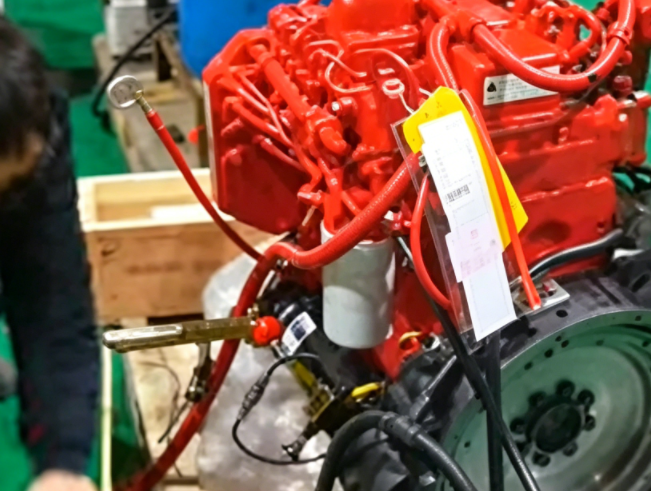
A mechanical spring starter pre-compresses high-performance disc springs or scroll springs inside the unit, either manually or mechanically, storing energy in a purely mechanical form. Upon activation, this energy is released instantly through a unidirectional clutch.
Advantages:
The torque output characteristic of a spring starter is “peak torque at zero speed” (instantly unleashing maximum peak torque the moment it turns). At the split second of release, it generates an immense explosive force far exceeding that of an electric motor of equivalent power, forcefully driving the engine past its maximum resistance torque and Top Dead Center (TDC). Because it does not rely on electrical power or an air source, its torque output remains completely unaffected by extreme cold, moisture, or prolonged storage.
Comparison of Starting Technologies
| Starting Method | Torque Output Characteristics | Environmental Adaptability | Maintenance & Reliability | Best Application Scenarios |
| Electric Start | Builds up gradually; decays along with battery capacity. | Poor in cold conditions (low-temperature discharge capability drops sharply). | Requires frequent battery maintenance; high risk of failure. | Routine civil use, automotive, light-duty equipment. |
| Air Start | High and stable torque; long duration. | Fair, but pipelines are prone to freezing. | Complex structure; highly dependent on an external air source. | Large marine main engines, facilities with centralized air supply. |
| Mechanical Spring Start | Instantly unleashes maximum peak torque. | Extremely robust (consistent performance from -20°C to +50°C). | Purely mechanical, zero-maintenance, explosion-proof. | Oil & gas fields, mining, marine emergency auxiliary engines, lifeboats, black-start contingencies. |
How to Precisely Select a Spring Starter Based on Torque Demands?
When selecting equipment for emergency systems or international export projects, you cannot simply look at the engine’s rated horsepower (HP). The matching must be strictly calculated based on torque and energy. Here are the standard industrial selection principles:
Identify the Operating Environment and Extreme Resistance:
Evaluate the engine oil viscosity at the minimum target operating temperature and check for any parasitic loads that cannot be decoupled.
Reserve a Safety Margin for Starting Torque:
Industrial emergency black-start environments are highly variable. It is highly recommended to build a safety factor of 1.2 to 1.5 times into the engine’s nominal minimum starting torque.
Precisely Match the Engine Model:
Spring starter manufacturers typically maintain comprehensive standard databases. For example, for various displacements (ranging from 1L to 19L) of mainstream brands like Cummins, Perkins, Deutz, and Caterpillar, there are already verified, lab-tested standard starter models mapped out.
Conclusion
Understanding the physical essence of Diesel Engine Starting Torque is the foundational step to ensuring an industrial system does not paralyze under extreme conditions. While storage batteries and external air sources perform well during routine, day-to-day operations, purely mechanical, high-burst, weather-independent spring starters stand out as the ultimate closed-loop solution against massive cranking resistance. They are indispensable for high-stakes environments like emergency rescue, marine auxiliary machinery, and explosion-proof industrial sites that demand an absolute Black Start.
As a global professional manufacturer of mechanical spring starters, Cqstart spring starter understands the torque engineering behind every industrial diesel engine. We maintain a comprehensive starting torque matching database and export selection case files covering a full range of diesel engines, from under 2L up to 50L.
If you are currently selecting a starting system for a new project, feel free to contact Cqstart at any time.