
A fire pump starter is the critical device or system component that delivers the initial burst of energy to get a diesel engine or electric motor up and running for fire protection service.
Think about fire pumps. They sit there. Quiet. For months. Even years. Waiting for a fire that might never come. But then, when an emergency actually hits, stop and look at the hardware. A massive diesel engine, pushing hundreds of horsepower. Or a high-voltage electric motor. Neither one can just fire up on its own. Not by itself. You need a starter that can kick things into gear within seconds. And because fire pump systems are expected to respond without fail when lives and property are on the line, the starter’s reliability isn’t just important, it’s absolutely mission-critical.
What IsWhat Is a Fire Pump Starter?
If you spend any time around fire protection engineering or equipment procurement, you’ll hear “starter,” “starter panel,” and “controller” thrown around like they’re interchangeable. They’re not. They work together, sure, but each one has a distinct job and a different physical identity.
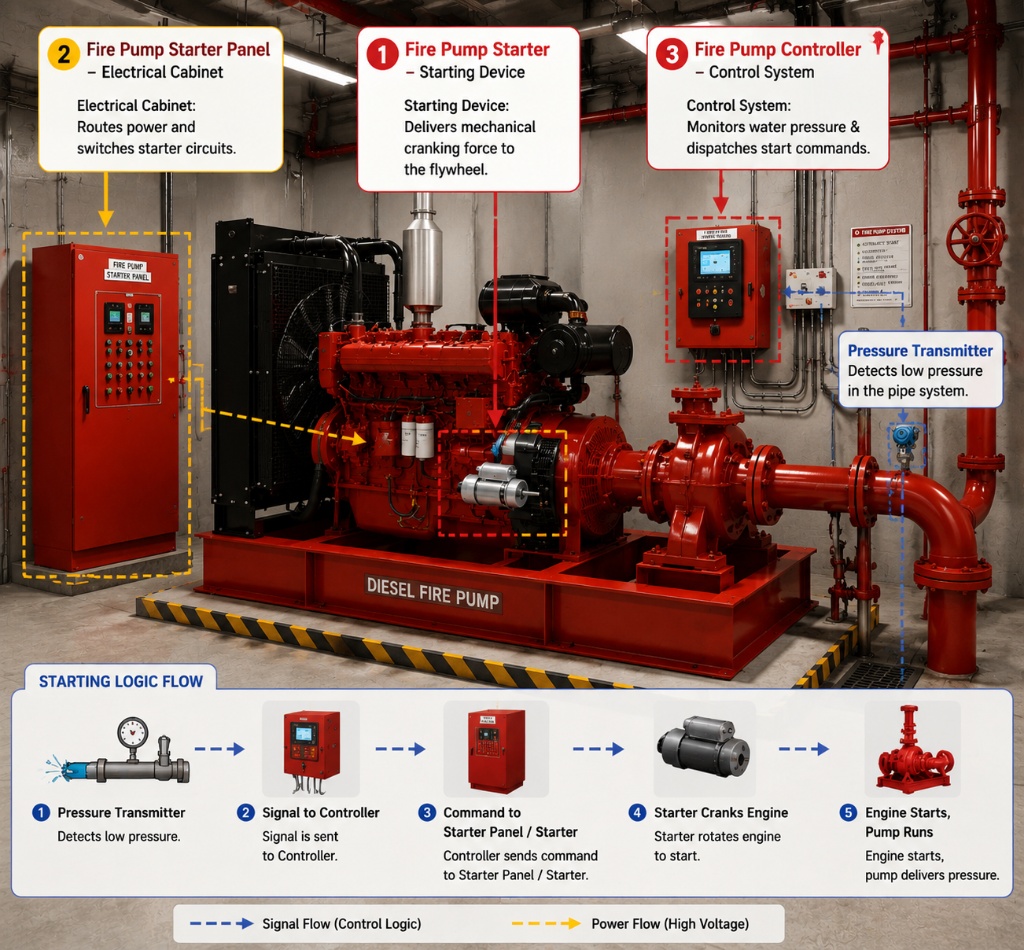
Fire Pump Starter: The Starting Device
A starter is the physical mechanism that delivers that first jolt of energy to a diesel engine or handles the switching duties for an electric motor.
With diesel fire pumps, we’re usually talking about something that physically engages with the engine’s flywheel ring gear, like a DC starting motor, a pneumatic motor, or even a mechanical spring mechanism that cranks the engine over. For electric fire pumps, the starter is more about the switching and distribution components that control motor startup.
Fire Pump Starter Panel: The Electrical Cabinet
The starter panel is a physical enclosure packed with contactors, circuit breakers, and protection relays.
Think of it as the distribution hub for high-voltage power. Its job is to safely switch circuits during motor startup and running, and to protect the supply lines from overloads or short circuits.
Fire Pump Controller: The Control System
The controller is the automated brain of the entire fire pump system.
Usually a microprocessor-based control box, it monitors water pressure in the fire protection network 24/7. When a sensor detects a sudden pressure drop, the controller makes a decision based on its programmed logic and sends a signal that tells the starter to do its job. The controller doesn’t deliver the actual starting power, it just gives the command.
Why Does a Fire Pump Need a Reliable Starter?
Fire protection equipment has one of the toughest job descriptions out there. It sits idle for long stretches, often in less-than-ideal conditions, and then it’s expected to perform flawlessly in the middle of a crisis. That’s why reliability is such a huge deal.
Diesel fire pump starting systems, in particular, need robust backup arrangements and careful configuration. Industry standards generally require automatic starting and specific response times. But in practice, there are a few common failure points that keep engineers up at night.
Power outages. They’re a real threat. A fire hits. Building power? Cut off. Or damaged. Electric fire pumps? They need utility power. Without it, they’re useless. And that’s precisely when the diesel pump set needs to take over.
Now batteries. They degrade. Over time. This is one of the biggest hidden risks out there. A fire pump battery fails more often than people realize. The culprit? Poor maintenance during those long standby periods. Lead-acid batteries lose water. They self-discharge. They develop sulfation. All of that eats away at their ability to deliver enough current. And you need that current when it matters most.
Harsh environments take their toll. Fire pump rooms are frequently stuffed into basements, high-humidity areas, or remote outdoor facilities. Freezing cold temperatures thicken engine oil and reduce battery efficiency, making it much harder to get the engine spinning in the first place.
4 Common Fire Pump Starter Types Explained
Based on available power, engine size, and environmental conditions, engineers typically pick from four main starter configurations.
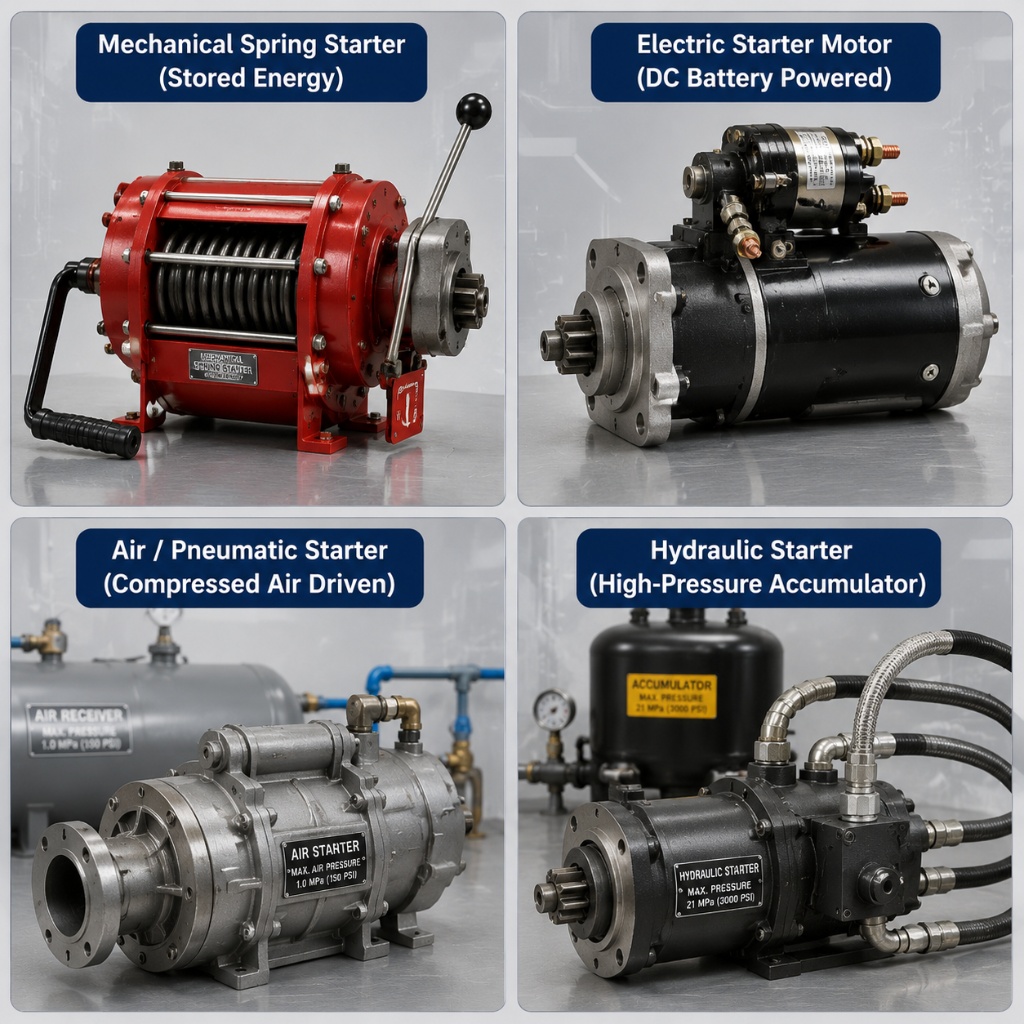
Mechanical Spring Starter
A mechanical spring starter stores energy manually through a winding crank, compressing a heavy-duty spring. When you release the mechanism, that stored mechanical energy converts instantly into rotational force to spin the engine flywheel.
The big selling point here? It runs on zero external power. No batteries, no compressed air, no hydraulic pressure. Just pure mechanical independence.
That makes it a solid backup option for diesel fire pumps in explosive environments, cold storage facilities, or remote sites where battery maintenance is a headache. It’s also inherently spark-free, which is a major safety advantage.
Electric Starter
Electric starting systems are used for both electric motor-driven fire pumps and diesel engine-driven units, though the actual mechanisms differ.
For diesels, it’s typically a DC starting motor powered by a battery bank. For electric fire pumps, you’ll see direct-on-line (DOL), reduced-voltage, or soft starter configurations depending on motor size and grid capacity.
Electric starters are everywhere because the technology is well understood and easy to integrate with building management systems and standard fire controllers.
Electric starter – the catch. They rely heavily on battery state of charge. No way around that. You need constant-voltage float chargers. And a solid maintenance schedule. That schedule has to include regular load testing. Skip any of that, and you’re asking for trouble.
Air Starter
Now let’s talk air starters. They use compressed air. Stored in a receiver tank. That air drives a pneumatic motor. The motor cranks the engine flywheel. Simple enough.
Here’s how it plays out. The start signal comes in. A pneumatic valve opens. High-pressure air rushes through the motor. Expands. And you get some serious cranking torque. Right from the get-go.
That’s why air starters shine on large-displacement, heavy-duty industrial diesel engines. Those big beasts need a lot of grunt to get moving. And air delivers.
But there’s a downside. You’re adding extra gear. An air compressor. Pressure regulators. A tank monitoring system. All into the mix. That takes up floor space. And it needs ongoing attention. You can’t just install it and forget it.
Hydraulic Starter
Now hydraulic starters. Different approach. They use pressurized hydraulic fluid. Stored in a sealed accumulator. That fluid drives a hydraulic motor. The motor turns the engine flywheel.
You pre-pressurize the system beforehand. With a hand pump. Or a small electric pump. Then, when it’s time to start, the high-pressure fluid gets released. It spins the motor. Fast.
With proper design, hydraulic starters give you strong cranking torque. Plus fast acceleration. Even in demanding conditions. They’re tough.
But complexity is the tradeoff. That’s the price you pay. Hydraulic lines need clean fluid. No dirt, no contaminants. You need careful sealing. And regular inspection for leaks. Every joint, every fitting. Because a tiny drip can ruin your day.
Fire Pump Starter Types Comparison
Here’s a side-by-side look at how these four options stack up on energy source, strengths, and weak spots.
| Starter Type | Energy Source | Advantages | Limitations |
| Mechanical Spring Starter | Stored Mechanical Energy | Battery-free, spark-free, low maintenance | Requires manual winding reset after release |
| Electric Starter | Battery Bank / Grid Electricity | Highly automated, widely standardized | Dependent on battery state-of-charge |
| Air Starter | Compressed Air Receiver Tank | High initial cranking torque | Requires continuous air tank pressure |
| Hydraulic Starter | High-Pressure Accumulator | Fast cranking speed in heavy-duty engines | Complex fluid piping and leak monitoring |
How Does a Diesel Fire Pump Starter Work During an Emergency?
When a fire triggers the system, the starter has to move from dead stop to spinning the engine in just seconds. Knowing the standard emergency fire pump manual starting procedures helps operators step in properly if the automatic system fails.
In a normal automatic sequence, the workflow follows five clear steps:
Step 1: Signal Detection (Water Pressure Drop)
A sprinkler head opens or a hydrant valve gets turned on. Pressure in the piping network drops. A pressure switch detects the change and sends an electrical signal to the controller.
Step 2: Command Dispatch (Start Signal Sent)
The fire pump controller verifies the signal, closes the control circuit, and dispatches an electrical, pneumatic, or control signal to the starting mechanism.
Step 3: Starter Engagement (Gears Mesh)
For systems with a drive gear, the starter’s pinion gear extends and meshes with the diesel engine’s flywheel ring gear. Now it’s ready to transmit torque.
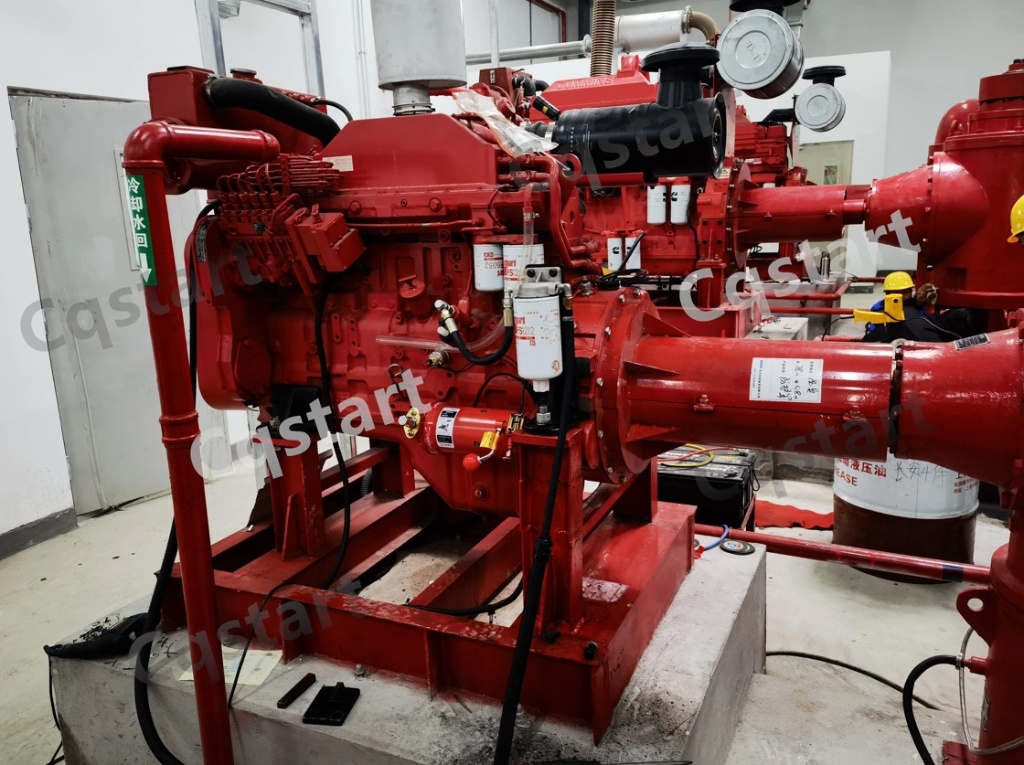
Step 4: Engine Ignition (Combustion Takes Over)
The starter spins the crankshaft up to starting speed. Fuel injects into hot compressed air, combustion begins, and the engine runs on its own. The starter gear disengages automatically.
Step 5: Pump Pressurization (System Gets Charged)
The diesel engine hits rated operating speed, drives the fire pump, and sends water into the network to restore pressure and flow for firefighting.
How to Choose the Right Fire Pump Starter
Picking the right starter involves balancing real-world site conditions, code requirements, and mechanical compatibility. Here’s a practical approach:
Step 1: Match Engine Displacement and Torque Requirements
Calculate the breakaway torque needed based on engine displacement. Verify the flywheel housing (SAE Housing) dimensions and gear specs to make sure everything fits physically.
Step 2: Evaluate Site Emergency Power Security
Look hard at the local power grid’s track record. If you’re in an area with frequent outages, lightning storms, or critical infrastructure status, you need to think about what happens when utility power drops out.
Step 3: Align with NFPA 20 Redundancy Recommendations
NFPA 20 puts serious emphasis on reliability and redundant starting arrangements. If the application demands high starting independence, look at alternatives like mechanical spring starters as a secondary path.
Step 4: Assess Environmental Extremes
For cold climates, offshore platforms, or chemical plants with explosion hazards, choose starting equipment that shrugs off low temperatures or eliminates spark risks.
Common Fire Pump Starter Problems and Solutions
Maintenance crews? They see the same problems over and over with fire pump starting systems. Here’s what to keep an eye on. And how to fix it.
Problem 1: Battery Failure Causes Engine to Click but Not Crank
You hit the start button. You hear the solenoid click. Then nothing. The engine doesn’t crank. Not a turn.
That usually points to one of three things. Corroded terminals. Low battery voltage. Or damaged plates inside the battery.
Solution: Clean the terminals. Tighten them up. Test internal resistance regularly. And check the state of charge. Do that on a routine basis. Consider adding a mechanical spring starter as an independent backup path.
Problem 2: Reduced Cranking Power in Low Temperatures
Cold weather hits battery chemistry hard, reducing output. Now the cold weather. Engine oil gets thicker. That adds more resistance when you try to crank. It fights you.
Solution: Put in pump room heating. Or a jacket water heater. Keeps everything warmer. Also, mechanical stored-energy starters? They handle temperature swings better. Less sensitive. So that’s another option.
Problem 3: Pneumatic / Hydraulic Pressure Drop
This one shows up after long standby periods. Small leaks. At fittings or seals. They’re tiny, but they add up. Over time, accumulator pressure drifts downward. Slowly. Then one day, it’s not enough.
Solution: Set up a routine inspection schedule. Check pressure regularly. That’s really the only way to catch it early. Check line integrity and make sure automatic makeup systems are enabled and functional.
Conclusion
Choosing the right fire pump starter configuration is one of those engineering decisions that can make or break system performance when it counts.
Electric starters are common and effective in many installations, but they come with dependencies on battery health and external power that can become liabilities during a real emergency, especially when the grid goes down or batteries have been neglected.
For diesel fire pump systems where starting independence matters, mechanical spring starters offer a proven backup approach. They rely on stored mechanical energy, not batteries or external power, which gives them a level of autonomy that’s hard to beat.
If you’re evaluating backup starting options for your diesel fire pump system, Cqstart provides reliable mechanical spring solutions. We work with diesel engine applications across fire protection, industrial equipment, and other high-reliability scenarios. Reach out if you’d like to explore whether a mechanical spring starter makes sense as part of your redundancy strategy.