
How much torque does a starter motor have? There’s no single number. That’s the first thing to get straight.
A small gasoline engine? Its starter might only need to push out a few dozen Newton-meters. But a heavy-duty industrial diesel? You’re often looking at hundreds of Newton-meters at the pinion. It all depends on the design. And the gear ratio. And the engine itself.
The only reliable move? Check the manufacturer’s published pinion torque ratings. Or look at their performance curves. That’s where the real numbers live. Guesswork won’t cut it.
This guide walks through starter torque across different industrial applications. We’ll cover what physical factors actually drive torque requirements. How torque behaves while the engine is cranking. How to tell if your starter has enough muscle. And when alternatives like mechanical spring starters make more sense than electric ones—especially in heavy industry.
How Much Torque Does a Starter Motor Have?
Starter Torque Depends on the Application
A starter’s output torque gets matched to the engine’s cranking needs. Period. You need technical data from both the engine and starter manufacturers to know what you’re dealing with.
Small engines don’t demand much. Displacement is low. Moving parts are light. So required torque stays relatively modest.
Medium-duty commercial diesel engines? Different story. You’ve got bigger cylinders. Higher compression ratios. Thick oil that creates serious drag. These need a starting system with real guts.
And the torque value isn’t plucked from thin air. It’s calculated. Matched directly to the actual starting resistance of that specific diesel engine or industrial machine.
Requirements vary wildly across applications:
Small Engines:
Gasoline engines. Single-cylinder or twin-cylinder auxiliary diesel units. These typically need lower cranking torque. Less compression load. Lighter internals.
Medium-Duty Diesel Engines:
Construction equipment. Truck diesel engines. These need more torque. Stronger gear reduction too. Why? Higher cylinder compression. Greater friction loads.
Heavy-Duty Diesel Engines:
Industrial diesel engines. Often require several hundred Nm of cranking torque. High compression ratios demand it. Thick oil adds resistance too.
Industrial / Generator Set / Marine Engines:
Generator sets. Marine propulsion. These have major torque demands. Exact figures depend on displacement. On extreme low-temperature conditions. On the starting energy source you choose.
Heads-up: always check factory technical data sheets from both the engine and starter manufacturers. That’s where the precise numbers live.
Why There Is No Fixed Starter Torque
“Standard torque value”? Doesn’t exist. Every engine has completely different starting requirements.
The torque a starter produces gets dictated by what the engine actually needs.
And here’s something that confuses a lot of people. Motor torque isn’t the same as pinion torque. And pinion torque isn’t the same as what actually reaches the engine. Why? Because the starter’s internal gear reduction changes things. So does the ratio between the pinion and ring gear. Both affect the torque that finally hits the crankshaft.
That’s exactly why you can’t use one number for all starters. We’ll dig into the specific physical and electrical factors that determine starter torque in the next section.
What Determines How Much Torque a Starter Produces?
Starter Design: Direct Drive, Gear Reduction, and Mechanical Starters
Starter design matters. A lot. Direct-drive units use a big motor. Gear-reduction units use a smaller motor plus gears to multiply torque.
Direct-drive starters connect the motor armature straight to the drive pinion. Simple setup. But you need a larger motor to get enough torque.
Gear-reduction starters take a different approach. They use a smaller, higher-speed motor. Add a gear train. The result? A compact motor that still delivers more torque at the pinion. Modern designs lean this way for good reason.
But electric starters aren’t the only game in town.
Mechanical spring starters store energy internally. In a spring. When you trigger the start, that stored energy releases as rotational motion. Transfers torque to the flywheel through the drive pinion. No battery needed. So no, cranking torque doesn’t always have to come from an electric motor.
Gear Ratio and Ring Gear Multiplication
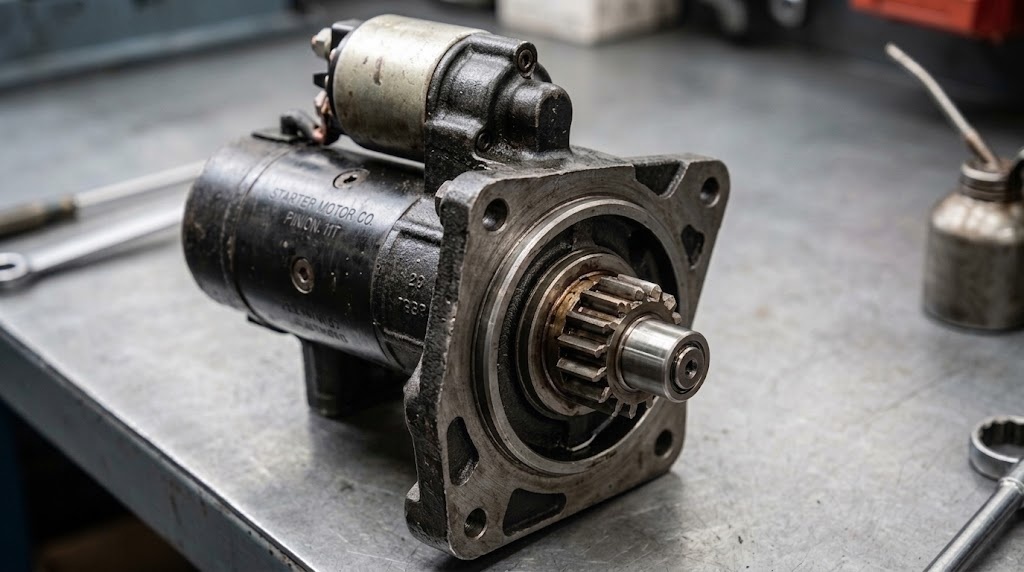
Here’s how torque multiplication works. The starter pinion has fewer teeth. The flywheel ring gear has more. Small gear drives big gear. Speed drops. Torque multiplies at the crankshaft.
That’s mechanical advantage in action.
Want to estimate the overall effect? Engineers use this simplified relationship:
Engine Cranking Torque ≈ Internal Motor Torque × Internal Reduction Ratio × Pinion/Ring Gear Ratio × Overall Efficiency
This leverage effect explains something important. A relatively compact starter motor can still turn over a heavy diesel crankshaft. Gear reduction does the heavy lifting.
Engine Size, Compression, and Mechanical Resistance
Torque requirements climb with engine size. With compression ratio. With internal friction. All of it adds up.
Small engines spin relatively easy. Large multi-cylinder diesels? Different beast entirely. Just pushing pistons past top dead center takes serious force.
Oil resistance contributes. Valve train friction adds to it. Auxiliary loads pile on too. The starter has to overcome all of it.
When you’re running calculations for diesel engine starting torque, you need to account for every factor. Friction. Oil drag. Cylinder compression resistance. Skip any of these and your numbers won’t be reliable.
Temperature, Voltage, and Current
Electric starter torque ties directly to current. Drop the voltage. Add resistance in the cables. Torque gets limited. Simple as that.
The torque an electric motor produces is proportional to current flow.
Cold weather hits you twice. Low temperatures thicken the oil—that increases required torque. At the same time, cold slows battery chemistry—that reduces available current. Double whammy.
Corroded terminals? Voltage drops in the wiring? The starter won’t get enough usable power. Output torque drops. Cranking speed drops. Both suffer noticeably.
How Does Starter Torque Change During Cranking?
Breakaway Torque Is Needed at the Start
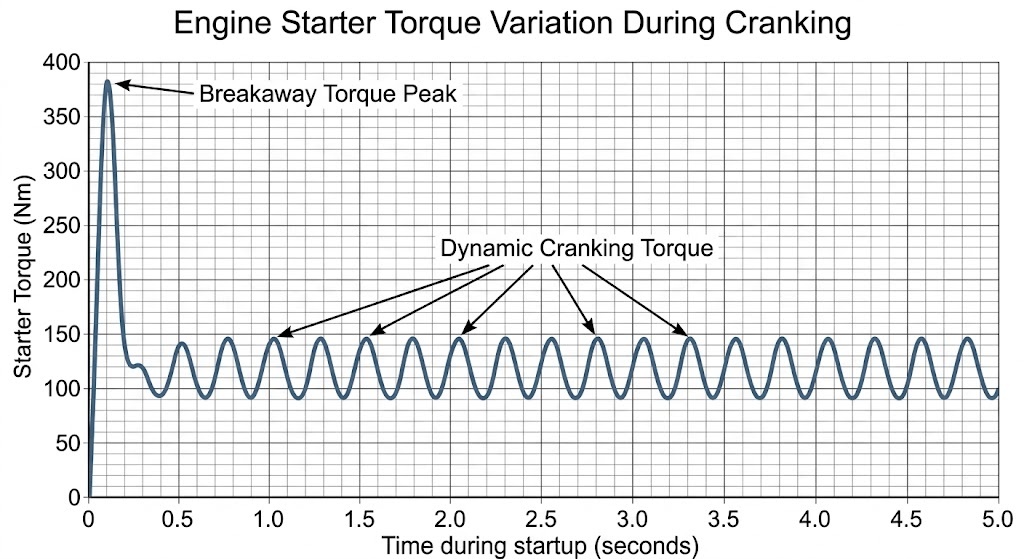
At the very beginning of cranking, the starter needs high breakaway torque. Static resistance has to be overcome. The crankshaft has to start moving.
Motor speed sits near zero at this instant. Back EMF is low. Armature current spikes.
Meanwhile, the engine might have high initial mechanical resistance. That puts a big instantaneous load on the starting system.
And once the crankshaft starts turning? Torque demand doesn’t stay steady. It fluctuates. Piston position changes. Compression strokes hit. Lubrication conditions shift. Engine speed varies.
Key point: static friction plus compression peaks mean the starter must deliver high peak torque during those first few revolutions.
Torque Changes as Engine Speed Increases
As cranking speed rises, engine resistance becomes cyclical. Starter torque naturally drops with higher rpm.
Engine cranking resistance isn’t smooth. It peaks every time a piston hits compression.
For a conventional DC starter motor, torque hits its maximum at zero speed. As rpm climbs, back EMF builds. Current drops. Output torque decreases.
The starter has to maintain enough torque to push through compression peaks. All the way until the engine reaches target cranking speed. Until fuel injection fires. That’s the window it has to work within.
Direct Drive vs Gear-Reduction Torque Curves
Direct-drive starters and gear-reduction starters behave differently across the rpm range. Their torque curves tell the story.
Direct-drive units rely on a large armature driving directly. Torque drops off smoothly as speed increases. Predictable curve.
Gear-reduction starters let the internal motor run at higher speeds. The gear reduction delivers higher cranking torque at the pinion. That’s the advantage.
Because of that gearing advantage, gear-reduction starters can stay compact while still delivering strong rotational force at engine cranking speeds.
How Do You Know If a Starter Has Enough Torque?
Do Not Choose a Starter by kW Alone
Don’t size a starter by torque alone. Don’t size it by kW alone either. The right starter has to meet both cranking torque and minimum cranking speed requirements. Under your specified starting conditions.
Here’s why kW can mislead you.
Power equals torque times angular speed. A high-kW starter might achieve that number by spinning fast with low torque. Sounds impressive on paper. But that kind of starter won’t help a high-compression diesel in freezing weather. You need low-speed grunt, not high-speed bragging rights.
Engineers have to verify low-speed torque. Make sure the starter delivers enough effective torque at the speeds needed to overcome compression loads.
Look at the Energy Source, Not Just Motor Torque
Here’s something people overlook. If the energy supply is unstable, rated torque doesn’t matter. The starter won’t deliver it. Whether that supply is electrical, mechanical, or pneumatic—same rule applies.
Different starting systems use different power sources. Each handles harsh conditions differently:
Electric Starter Systems:
Run on batteries. Convenient for daily use. But batteries degrade. Voltage drops happen. Extreme cold reduces performance.
Mechanical Spring Starter Systems:
Store mechanical energy in a spring. Starting doesn’t depend on batteries. Perfect for backup scenarios. Or locations without reliable power.
Air Starter Systems:
Run on high-pressure compressed air. Deliver high cranking torque. Good for large heavy-duty industrial applications.
Always check the whole energy chain. Make sure you’ve got enough power when conditions get tough.
Check Required Cranking Torque and Speed
Want to verify compatibility? Match the starter’s torque-speed curve against the engine’s requirements. Required cranking torque. Minimum cranking speed. Both matter.
Engine manufacturers publish these numbers. Especially for diesel engines. Compression ignition depends on it.
Don’t rely on simplified formulas. “Displacement times a fixed factor” won’t give you accurate results. Without detailed data from the engine manufacturer, displacement alone tells you very little.
Best approach? Check the starter’s published performance curves. Confirm it delivers sufficient torque at your engine’s target cranking speed.
Check Ring Gear and Mounting Compatibility
Torque numbers might look perfect on paper. But if the pinion teeth don’t match the ring gear, it won’t work. If the flange depth is wrong, it won’t work. If the mounting interface doesn’t align, it won’t work.
Physical compatibility matters just as much as torque output.
The starter pinion has to match the flywheel ring gear. Module or pitch needs to be correct. The mounting flange has to keep the pinion aligned under rotational load.
Get this wrong and problems follow. Improper gear engagement can damage the ring gear. Misalignment can stress the starter housing. Cranking torque becomes destructive torque.
What Happens When Starter Torque Is Not Enough?
Slow Cranking
Insufficient starter torque means the engine won’t reach specified cranking speed. Hard starting follows. Or complete failure to start.
When the starter lacks rotational force, the crankshaft turns too slowly.
For diesel engines, this creates a compounding problem. Lower cranking speed reduces compression temperature. Cylinders can’t reach the conditions needed for reliable ignition. No ignition, no start.
Battery and Voltage Problems
Here’s what happens when an electric starter struggles against high resistance. It draws heavy current for longer periods. Voltage drops. The battery drains faster.
Under heavy mechanical load, the electric starter runs near stall. Current draw goes through the roof.
That excessive current generates heat in the cables. System voltage drops. Battery reserves deplete quickly after repeated start attempts. It becomes a downward spiral.
Starter Overheating
Starters get designed for short-duration cranking. Extended cranking creates heat. Internal coils overheat. Damage follows.
Starters aren’t meant for continuous operation.
Insufficient torque forces the motor to crank too long. Heat builds up in the armature. In the brushes. Enough heat damages insulation. Shortens starter life. Sometimes permanently.
Always follow the duty cycle specifications from the starter manufacturer. They specify maximum cranking time for good reason.
Check the System Before Replacing the Starter
Slow cranking doesn’t always mean the starter is underrated. Or broken. The problem might live somewhere else in the system.
Before swapping in a bigger starter, run through this checklist:
Battery State of Charge and Health: Does it hold proper voltage under load? Test it.
Cable Connections and Terminals: Look for corrosion. Loose connections. High resistance causing voltage drops.
Pinion and Ring Gear Engagement: Is engagement smooth? Any binding? Misalignment?
Engine Oil Viscosity: Is the viscosity grade right for current temperatures? Wrong oil adds excessive resistance.
Auxiliary Loads and Mechanical Binding: Any pumps or generators creating abnormal drag? Internal engine parts binding?
Check these first. Replace the starter only after you’ve ruled everything else out.
When Should You Consider a Spring or Air Starter?
When a Mechanical Spring Starter Makes Sense
Need starting independent of batteries? Or the power grid? A mechanical spring starter is worth considering.
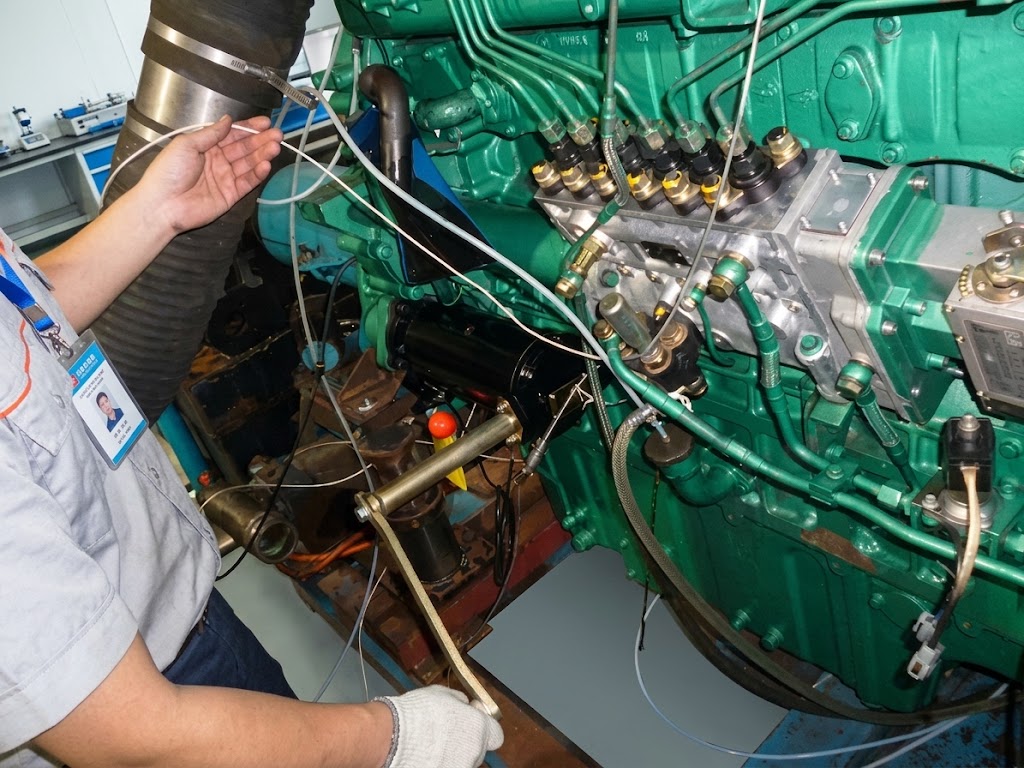
Spring starters store energy manually. Using a winding handle. That energy goes into a powerful internal spring. When triggered, the spring releases. Rotational motion follows. Torque delivers to the flywheel through the drive pinion.
This approach works well as a battery-independent backup. Ideal for remote equipment. Emergency generator sets. Industrial diesel applications where electric starting isn’t suitable.
Take the spring starter from Cqstart for example. It lists Max Pinion Torque right in the specs. Engineers can match that directly to engine starting requirements. No guesswork.
When an Air Starter Makes Sense
Got compressed air on-site? Need high cranking torque? An air starter fits well in that scenario.
Pneumatic starters run on high-pressure compressed air. The air drives the mechanism. Delivers strong cranking torque for large heavy-duty diesel engines.
Common applications include mining equipment. Marine propulsion systems. Oil and gas facilities. Places where compressed air is already part of the infrastructure.
Electric Starter vs Spring Starter vs Air Starter
Each starting technology has different strengths. Power source matters. Operating environment matters. Here’s how they compare.
| Starting System | Energy Source | Main Advantage |
| Electric Starter | Chemical Battery | Standard solution for normal conditions. Automation is convenient. |
| Spring Starter | Stored Mechanical Energy | No battery dependence. Extremely reliable for emergency generators. Works in no-power backup scenarios. |
| Air Starter | Compressed Air | Good for large diesel engines. Uses existing compressed air systems. Delivers strong cranking torque. |
Choosing the right starter depends on three things. Engine starting resistance. Ambient operating temperatures. Power supply reliability.
Evaluate all three. Then select. That’s how you ensure your starting system delivers exactly the torque needed. Consistent starts follow. Reliable starts follow.
Conclusion
So how much torque does a starter motor have? No single number answers that question. Output ranges from a few dozen Newton-meters in small applications to several hundred in heavy-duty industrial systems.
Starter torque comes down to multiple factors working together. Internal motor design matters. Gear reduction ratios matter. Battery condition matters. Engine mechanical resistance matters.
Want to know if a starter has enough muscle? Look at its torque-speed curve. At specific rpm ranges. Don’t just read the kilowatt rating.
For critical diesel equipment, electric starting isn’t always the answer. Sometimes you need backup protection. Mechanical spring starters offer that battery-independent alternative. They deliver reliable cranking torque exactly when you need it.